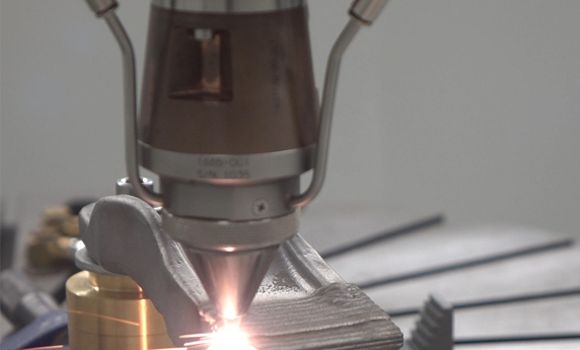
An international team is harnessing the power of artificial intelligence (AI) to revolutionize laser metal deposition (LMD), a crucial technique for repairing and coating wear parts in industries like mining. The AI-SLAM project aims to optimize LMD by integrating high-performance sensors and machine learning, ultimately reducing defects, enhancing quality, and lowering costs.
Spearheaded by the Fraunhofer Institute for Laser Technology ILT in Germany and the National Research Council of Canada (NRC), the project has brought together researchers from around the globe. The team is developing advanced methods for monitoring and controlling the LMD process in real-time.
"Industry is facing the challenge of realising complex manufacturing processes efficiently and cost-effectively," researchers note. The AI-SLAM project tackles this by utilizing AI to automatically predict process parameters, aiming to improve laser-based coating processes by 2025.
The project utilizes advanced sensors, including pyrometers and CMOS cameras to collect real-time data on molten pool temperature and geometry, while a laser line scanner captures coating geometry. This data feeds into a proprietary algorithm that models geological features in space and time, delivering a high accuracy rate for AI’s 77% in predicting target locations.
The team has developed OpenARMS (Open Adaptive Repair and Manufacturing Software), a user-friendly interface that combines all process information and utilizes Braintoy’s mlOS (Machine Learning Operating System) for high-powered computing and AI feedback.
Dr.-Ing. Thomas Schopphoven, head of department laser material deposition at the Fraunhofer Institute for Laser Technology ILT, explained: "The comprehensive tests are producing high-quality and poor components with defects which are as different as possible in order to use the data for the training of AI clustering the data.”
Early results are promising. AI models can now successfully recognize defects in situ. The consortium is now optimizing the system to further slash defect rates and maintain consistent coating quality. The adjustments of the process parameters by the AI makes it possible to shorten the processing time per part and to raise the efficiency.
The developed technology has the potential to reduce dependence on highly qualified personnel, enabling less experienced operators to control the process with AI-driven adjustments. It also improves process transferability and standardization across different machines and locations.
The AI-SLAM project receives funding from the Federal Ministry for Education and Research (BMBF) in Germany and the National Research Council of Canada (NRC). Partners include Fraunhofer ILT, BCT Steuerungs- und DV-Systeme GmbH, the NRC, McGill University, Braintoy, and Apollo Machine and Welding Ltd.
The AI will help make this process cheaper and faster for mining. By doing this, researchers believe the project might be used as a model for other industries and the team is excited for the potential in the coming years.

Comments