Improving measurement of clays and other parameters in process flows using online automation
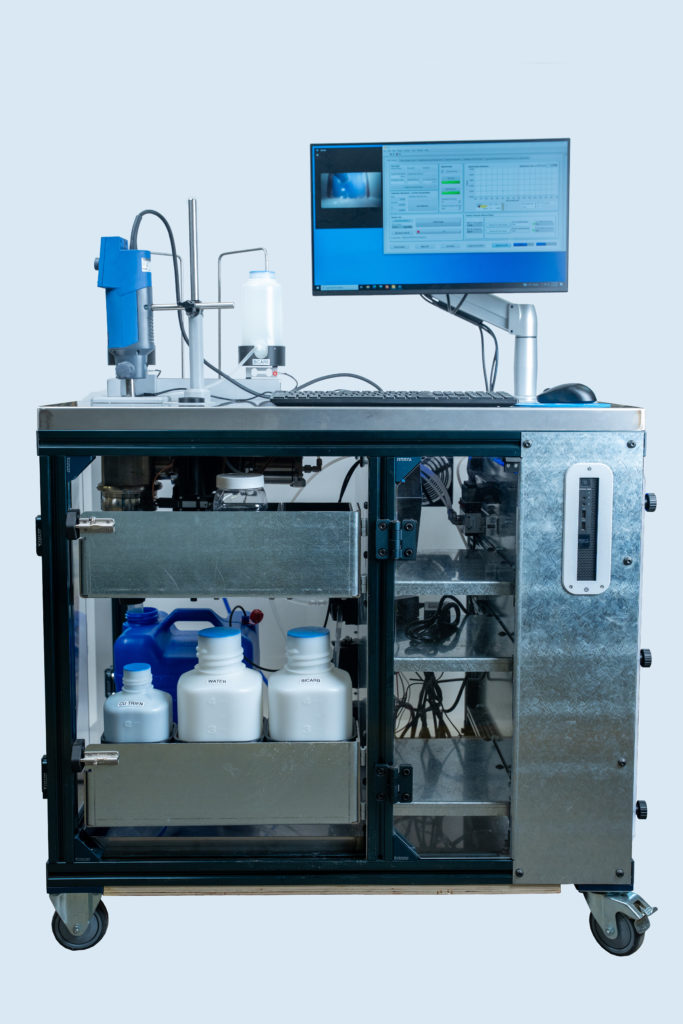
Whether in potash slimes, oilsands, or in kimberlite slurries, active clay minerals can cause serious issues in many plant operations. For industries where clay minerals are present, a better analytical approach is needed to more quickly and accurately measure these minerals. In response to this, experts at SRC’s Pipe Flow Technology Centre developed an automated measurement platform (AMP) that provides accurate, real-time, measurement of clay minerals.
Clay minerals are small, negatively charged particles that are highly reactive in industrial slurries, wastewater, and soils. However, their reactivity can vary significantly depending on the chemistry and crystal structure of the mineral.
Industrial processes are affected by the reactivity of the clays present, and how those clays interact with cations in the environment — this is known as the cation exchange capacity (CEC). Depending on what clays are present in an ore, the reactivity or CEC can vary, ranging from small in “inactive” clays, such as kaolinite, to very large in “active or swelling” clays, such as smectite.
Particularly where there is a solid-liquid separation process or pumps, the amount and CEC of the clay minerals present can lead to significant operational problems.
“As soon as a mine has an active clay in it, there is probably going to be a problem, and it is going to be a big problem,” said SRC research scientist Jennifer Bentz, who works at its Pipe Flow Technology Centre. “It can cause a shutdown or a stop to production to fix the issue or clean it up,” Bentz added.
For example, in the potash industry, clay minerals will consume the flotation reagents used to collect potash, increasing processing costs and reducing recovery. They will also clog filters, increase wear on equipment and increase the yield stress of slurries making them harder to pump.
In hard rock mining, such as diamond and uranium operations, clays will stick to crusher plates and liners, gum up the thickener discharge, bog down scrubbing units and require more thickener to settle.
In geotechnical applications, they also cause structural damage to foundations, roads, and pipelines owing to the shrinking and swelling nature of the clays.
Not only do they cause process problems for minerals processing, but also small amounts of clay can prevent solids from settling and the amount of water that is recovered as part of tailings management and water reuse.
In certain applications active clays are beneficial, like at foundries where they are a key component of molds made with a compound mixture called “green sand” that are used for metal casting. Active clays are also used in cat litter because of their exceptional absorbent and clumping properties, and in water and soil treatments to adsorb contaminants from the environment, such as heavy metals, organics, industrial dyes, and radioactive isotopes.
They can also be used as liners for landfills, tailing ponds, and heap leach processes owing to their very low permeability, which prevents contaminants from escaping into the environment.
Clays are difficult to measure because they are small and share a similar crystal structure to each other, despite significant differences in CEC.
This means that many of the traditional analytical methods used to measure them (e.g., X-ray diffraction (XRD), Fourier transform infrared spectroscopy (FTIR), short-wave infrared reflectance spectroscopy (SWIR), and particle size) require intensive sample preparation to get accurate data, as well as sophisticated equipment and robust chemometric models to resolve overlapping patterns.
Historically, the most practical way to detect active clays was a manual technique called the methylene blue index (MBI) because the procedure could be performed in the field without any expensive analytical equipment.
In the MBI method, a technologist takes a sample, then performs a manual titration by carefully adding blue dye to clay mixtures and “dotting” a filter paper after each successive addition. The appearance of a blue halo around a dot signifies the endpoint of the titration, indicating that the clay has absorbed the maximum amount of dye it can hold. The process is straightforward but slow — taking as long as an hour — and relies on subjective assessments from technologists to determine the endpoint.
This is where SRC’s AMP comes into play. The AMP combines automation and a tailored spectroscopic analytical technique to make on-site measurements of CEC using a cationic dye simpler, faster, and more precise.
In 2019, SRC received funding from Natural Resources Canada’s Clean Growth Program to develop an at-line automated clay analyzer for oilsands applications. With support from its project partners, SRC developed a separate prototype during the project based on its own technology design. SRC’s prototype was later successfully validated during a field trial.
Field testing was key, as according to Bentz, “The problem of going from benchtop to a large-scale industrial setting is that everything can get more complicated and does not always work. But that is the power of SRC — the team is good at the kind of innovation and automation needed for scaling-up technologies.”
The clay analyzer performed so well at precisely analyzing the CEC value (in this way deducing the clay content) in tailings slurries that SRC is continuing to develop the technology for other industrial applications.
However, the real advancement of this technology is that SRC went further and automated all the steps in the process into an AMP that can also connect to process lines for online capabilities.
The AMP performs every step of the spectroscopic CEC measurement, including accurate chemical dosing of the buffer solutions and cationic dye, dispersion and mixing of the samples, automatic subsampling and filtration down to 0.45 microns, and the daily initializations required by the spectrometer. It also contains built-in calculations to give the operator or lab technician the final CEC of the sample — all with custom software programmed at SRC.
To make this work at industrial-scale and for different applications, the team needed to optimize the exact concentration and dosing of the cationic dye for maximum efficiency and accurate detection of the clays, depending on inputs.
“The good news is we really perfected this for a whole range of different samples, and the team has this basically down to a science of how to get the right recipes,” Bentz said.
With the AMP, industries can now receive a reliable reactivity measurement (i.e., estimated active clay measurement) of the solids in 15 minutes, a drastic reduction in result times. This helps laboratories to increase the number of samples that are
processed and the reliability of the results.
For applications within the plant, termed “at-line,” the AMP only requires the operator to input the sample and apply changes to operational settings on the line in response to detector outputs. Sample preparation, detector calibration, and cleaning are all automated.
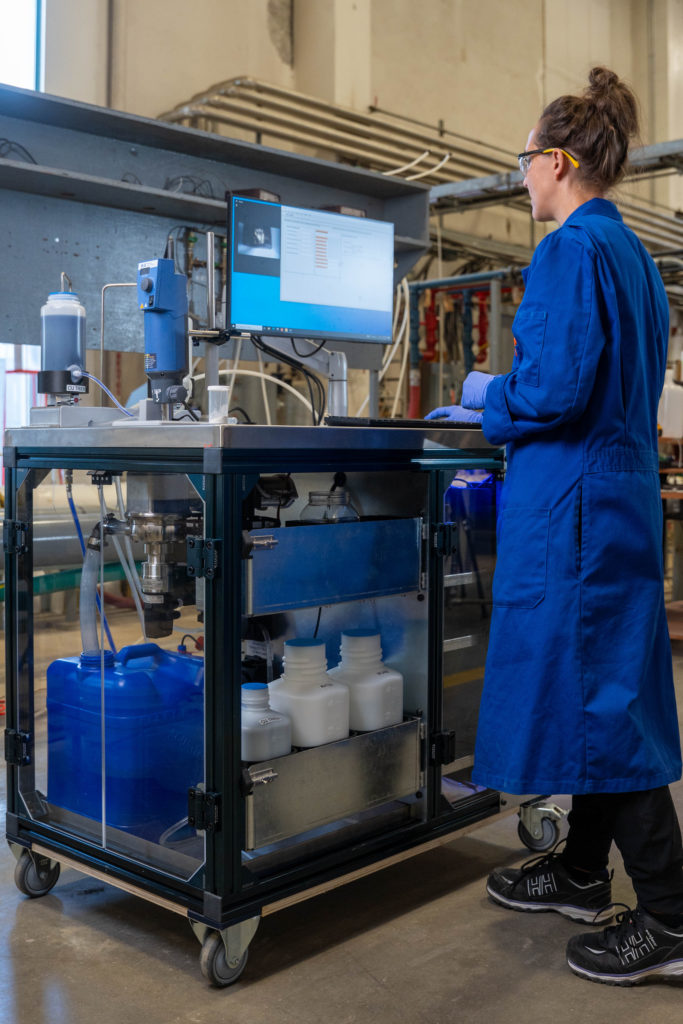
An online solution goes even further by helping processing plants prevent recovery losses or unplanned shutdowns by quickly and reliably detecting the presence of active clays.
Beyond mining, the AMP could be beneficial to the foundry industry, which use active clays like bentonite in their green sand molds. They regularly measure clay levels to adequately refresh the spent green sand.
Automating the CEC (or clay) measurements with the AMP could make foundry processes more effective and reduce waste, helping lower costs by maximizing the reusability of the sands throughout the production cycle.
SRC is also looking at applications for the AMP beyond clay measurement. With an established reputation in potash in Saskatchewan and beyond, the potash industry is one key area SRC is looking to support with the AMP.
For potash processing, insoluble — in this case, clay minerals that are not necessarily active — can pose challenges. Insolubles in the brine, especially if clays are present, affect separation and flotation, absorb chemicals, and decrease recovery. They may clog filters, wear down equipment, and require more reagents.
In tailings management, getting near real-time data on the clay content of tailings can aid in determining optimum flocculant dosages and prevent settling issues in the tailings.
The AMP also has potential in several applications beyond active clay and insoluble particle detection. It can be configured to perform other analytical measurements, including pH, conductivity, or water hardness.
For each new analytical method, SRC tests and validates the platform for the specifics that are unique to each industry. With the core instrumentation and methodology established, many of these other applications are sure to follow. 
SRC has patents pending for the Automated Measurement Platform
in Canada, the U.S., and Brazil. To learn more about SRC’s Automated Measurement Platform, visit https://www.src.sk.ca/service/mining/automated-measurement-platform-including-automated-online-clay-analyzer.
Victoria Martinez is a freelance writer for SRC, and Lucinda Wood is SRC’s manager of business development and services integration.
Comments