CEO says oil price swings push mines to reassess transport costs
Railveyor CEO: Hybrid haulage is a “strategic hedge” against diesel volatility Rising oil prices triggered by geopolitical disruptions in the Gulf region […]
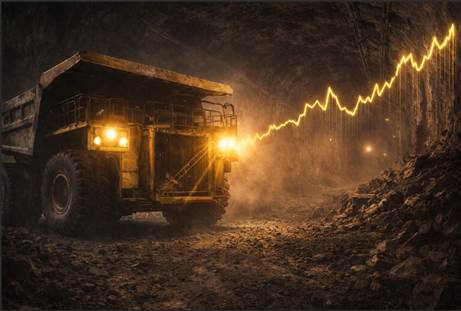
Every tonne moved by diesel is exposed to a cost curve operators cannot control. As fuel volatility persists, traditional haulage models are increasingly misaligned with the economics of modern mining.
Credit: Railveyor
Railveyor CEO: Hybrid haulage is a "strategic hedge" against diesel volatility
Tas Mohamed, CEO, Railveyor Credit: Railveyor
Rising oil prices triggered by geopolitical disruptions in the Gulf region have mining companies reassessing their reliance on diesel-powered truck fleets, according to Tas Mohamed, CEO of Railveyor, a Sudbury-based provider of fully electric and autonomous light-rail haulage systems for underground and surface mining. The escalating crisis affecting supply routes through the Strait of Hormuz has created sharp increases in diesel costs that directly impact mining operations' bottom lines.
"The renewed volatility in global oil markets has once again exposed the mining sector's vulnerability to energy price shocks, highlighting the value of electrified and automated haulage options," Mohamed said. Traditional truck haulage fleets rank among the largest fuel consumers in mining operations, meaning price spikes translate immediately into higher operating expenditure and tighter margins.
Mohamed explained that this environment forces mining companies to examine alternatives to diesel-based haulage models. Electrified and infrastructure-based systems are gaining attention not only as decarbonization tools but as strategic approaches for cost reduction and operational resilience.
Operational analysis reveals substantial savings
Recent site-based operational analysis demonstrates the financial advantages of shifting away from conventional truck haulage. Mohamed cited data showing that electrified and rail-based alternatives can reduce haulage costs by over $3 per tonne compared to traditional methods.
"A hybrid system that combines the strengths of light rail and conveyor technologies delivers not just a lower-cost way to move material – it reshapes the cost structure," Mohamed explained. The system introduces greater predictability while reducing exposure to fuel price fluctuations and removing significant volatility that mining operations typically absorb from oil markets.
According to operational analysis from an existing global mining installation, such a system would reduce haulage costs to between $0.77 and $0.84 per tonne compared to benchmark truck haulage costs of $4 per tonne. Assuming annual throughput of 823,000 tonnes, this saving of over $3 per tonne equals avoided costs of $2.6 million per year.
Mohamed noted that over a three-year period, cumulative savings could exceed $7.25 million based on historical throughput data. The analysis provided transparent cost modeling across five primary categories that allows direct comparison with truck haulage systems.
Labour efficiency creates largest cost advantage
Labor represents the largest single cost component in the hybrid model, accounting for 41.9% of operational expenditure. However, Mohamed emphasized that unlike truck haulage where labor scales with fleet size, the hybrid system decouples labor from throughput growth.
"With trucks, every increment of production typically requires more operators, more shifts and more supervision," Mohamed said. "The hybrid model allows an increase in throughput without proportionally increasing labor." This reduced labor intensity drives major cost savings, particularly as skilled operators become scarce and expensive across the industry.
Power costs account for 9.1% of operational expenditure in electrified systems, reflecting inherent efficiency advantages over diesel-powered fleets. Mohamed pointed out that in high oil price environments, this becomes a decisive advantage.
Electrification provides price stability
"Diesel remains one of the most volatile inputs in mining – and the current global disruptions show that this can translate into business continuity risk," Mohamed observed. Electrifying haulage operations not only reduces energy costs but stabilizes them, providing valuable predictability for long-term planning.
Electricity sourced at industrial tariffs insulates operations from global oil price fluctuations and reduces exposure to fuel logistics challenges. In countries where grid power comes from renewable sources, this approach also supports mining companies' decarbonization efforts.
The hybrid system demands less from equipment, resulting in lower consumption of replacement parts and consumables compared to truck-based haulage. Mohamed explained that the components minimize mechanical complexity and eliminate many high-wear elements associated with heavy vehicles, such as engines, transmissions and tires.
Digital systems optimize performance
Remote software support reflects the increasing role of digital systems in modern mining operations. Mohamed noted that leveraging remote monitoring and control optimizes performance and detects issues early, reducing the need for on-site intervention. On-site technical support, including specialized maintenance, accounts for 13.5% of operational expenditure.
"Global energy uncertainty is becoming the norm rather than the exception," Mohamed concluded. "The current environment risks rendering traditional haulage uneconomic in many cases, exposing mine operations to diesel price volatility and escalating operating costs." He emphasized that the focus is shifting toward solutions that fundamentally reset haulage economics while unlocking both immediate and long-term value.
Infrastructure investment drives long-term value
The shift toward electrified haulage systems requires upfront infrastructure investment that many mining companies are now viewing as essential rather than optional. Mohamed emphasized that current market conditions make the business case increasingly compelling, especially for operations planning extended mine lives.
"We're seeing mining executives recognize that infrastructure-based solutions offer protection against future energy price shocks," Mohamed said. "The capital investment creates a hedge against diesel volatility that becomes more valuable as geopolitical risks persist."
The Railveyor CEO noted that financing options for electrified haulage infrastructure have evolved to accommodate different operational requirements. Some mining companies prefer direct capital investment, while others explore leasing arrangements that spread costs over longer periods.
Mohamed highlighted that the operational analysis excluded certain cost factors that would further strengthen the economic case for hybrid systems. Truck rebuilds, ventilation costs for underground diesel operations, and environmental compliance expenses associated with emissions were not factored into the comparative analysis.
Industry adoption accelerates
Several major mining operations have initiated pilot programs to evaluate electrified haulage alternatives, according to Mohamed. The combination of immediate cost savings and long-term strategic benefits has accelerated industry interest beyond initial sustainability motivations.
"Mining companies that began exploring these technologies for decarbonization purposes are now implementing them primarily for economic reasons," Mohamed observed. "The cost advantages have become the primary driver, with environmental benefits serving as additional value."
The CEO expects adoption to continue expanding as more operational data becomes available and as diesel price volatility persists. Mining operations in regions with stable electricity infrastructure and favorable industrial power rates represent the most attractive early deployment opportunities.
Mohamed concluded that the convergence of energy market uncertainty, labor shortages, and operational efficiency demands has created ideal conditions for fundamental changes in mine haulage approaches. Companies that move quickly to evaluate and implement electrified alternatives will likely achieve competitive advantages that extend well beyond current energy price cycles.
Looking beyond diesel
Electrified, infrastructure-based mine haulage can reduce costs by over $3 per tonne when compared to diesel truck fleets, delivering substantial operational expenditure savings. These systems offer multiple additional benefits including decoupling of labor from production growth for improved scalability, reduced exposure to volatile diesel prices for better cost predictability and planning certainty, simpler mechanical systems which reduce wear, maintenance and component replacement costs, automation and remote optimization to improve production efficiency, and decarbonization through leveraging electricity from renewable energy sources.





Comments