New policy roadmap may help miners navigate Chinese investment landscape
Navigating the Canadian regime governing inbound mining investment from China has been challenging in recent years. The Canadian government has sent policy signals that investment in strategically important critical minerals from state-owned enterprises (SOEs) and “foreign-influenced private investors,” notably from China, would generally not be permitted, which has in turn created a deterrent effect on Chinese investment in the Canadian mining sector generally over the last five years. Recent policy clarifications, however, may encourage such investment to return outside of sensitive sectors.
On Jan. 16, 2026, the Office of the Prime Minister released the Canada–China Economic and Trade Cooperation Roadmap (the roadmap), signaling renewed commitment to strengthening bilateral trade and investment ties. The roadmap expressly welcomes Chinese investment in energy, agriculture and consumer products. Though mining is not mentioned, recent Investment Canada Act (ICA) developments suggest that the roadmap may also apply to mining investment outside of critical minerals.
Stop signs and exit ramps
The roadmap is a departure from the policy landscape defined in Oct. 2022, when the federal government released an updated policy on foreign SOE investment in critical minerals (the Critical Mineral Policy). That policy introduced heightened scrutiny for investments by SOEs and “foreign-influenced private investors” in Canada’s critical minerals sector. The government made clear that new acquisitions of control by SEOs in critical minerals would be approved only on an “exceptional basis,” and most would likely be rejected. Shortly after the policy was released, Ottawa also ordered the following three Chinese entities to divest their interest in Canadian critical mineral companies:
- Sinomine (Hong Kong) Rare Metals Resources divested its stake in Power Metals.
- Chengze Lithium International divested its stake in Lithium Chile.
- Zangge Mining Investment (Chengdu) divested its stake in Ultra Lithium.
Notably, none of these investments would have required mandatory Investment Canada Act (ICA) filings or otherwise received scrutiny under ordinary foreign investment regulations. The Chengze Lithium investment was striking, given that its minority stake was less than 20% and the mineral assets were in Argentina and Chile, rather than Canada. Nonetheless, the government identified this and the two others as policy stance example-setting cases.
The divestiture orders sent an unmistakable message: No investment is too small to warrant scrutiny, non-controlling interests can trigger review and Canadian companies with assets located exclusively abroad remain subject to scrutiny. When taken together, the Critical Mineral Policy, divestiture orders, and ICA transaction prohibitions sent a clear deterrent signal.
Table 1. ICA investor transaction prohibitions.
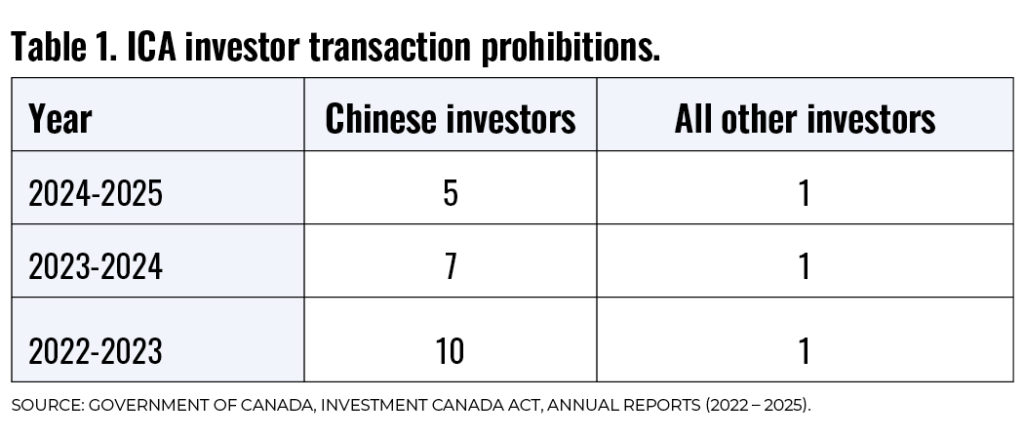
While the Critical Minerals Policy largely succeeded in reducing ICA-reportable Chinese investment in Canadian critical minerals, it also contributed to a decline in Chinese investment in Canadian mining generally, including in the less sensitive base and precious metals sectors. Capital still flowed from China in smaller, non-ICA reportable formats, but macro-level transactions with producers and late-stage developers dried up, as exemplified by Zijin Mining’s aborted investment in Solaris Resources in 2024 over ICA regulatory risk.
Healthy traffic in other sectors
Despite the policy tone and continued scrutiny, ICA filings by Chinese investors have remained steady outside of mining, with capital being directed into sectors viewed as less strategically sensitive. China continues to rank among the top countries for inbound investment in Canada.
Table 2. Chinese inbound investments.
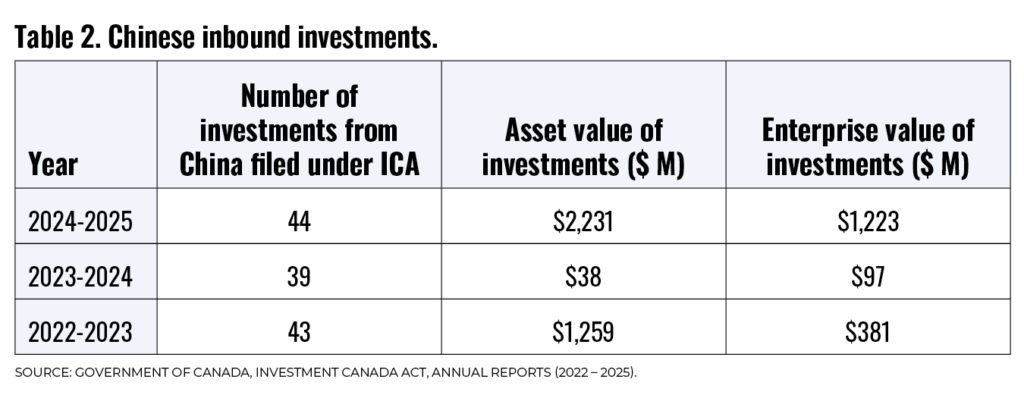
These filings reflect sustained Chinese investment and interest into Canada, despite the restrictions surrounding critical minerals and ICA transaction prohibitions. In a more favourable regulatory environment, it is likely that Chinese capital and interest could be directed back into the mining sector in a meaningful way.
New roadmap: Looking ahead
The new roadmap may signal that the Canadian government is aiming to curtail the Critical Minerals Policy’s deterrent effect across the mining sector and is open to Chinese investment, even from SOEs, in less strategically sensitive mining areas. This shift is already reflected in real transactions. Though ultimately abandoned owing to Chinese regulatory issues, Zijin Gold International’s proposed $5.5-billion acquisition of Allied Gold notably cleared the ICA’s national security review process earlier this year.
Questions remain about how broadly the roadmap will be interpreted and whether it will permit investments in sectors previously considered sensitive. The most strategic policy evolution would maintain rigorous investment scrutiny for national security risks while creating a clearer pathway for allied capital. Ultimately, future policy will be driven by the balance of strategic concerns against Canada’s goal to become an attractive destination for mining capital.
Christopher Doucet is a partner at Bennett Jones in Toronto. Zirjan (Zee) Derwa is a partner at Bennett Jones in Toronto.
Related Posts
The critical minerals race is becoming a race for talent
October 16, 2026
The critical minerals race is becoming a race for talent
The future of mining requires drones: A new way to inspect, survey and map

The lifesavers keeping modern mining moving
October 16, 2026
The lifesavers keeping modern mining moving
Beyond the mine: The multidisciplinary approach shaping Eastern Canada’s mining future

Comments