A tale of two gold mines: Yellowknife’s mining history

When the Robertson headframe was slated for demolition after Con Mine had closed in 2003, Yellowknifers fought to preserve a structure that, at 76-metres tall, had become an important monument to the city’s gold mining history. Although the mining heritage advocates lost their battle in 2016, when the headframe was destroyed with a controlled explosion, the debate reflected Yellowknife’s indelible pride in its gold mining history. Other signs of the city’s mining heritage are everywhere, including the relatively new Yellowknife Historical Museum (located on the old Giant Mine site with lots of mining heritage displays), plaques commemorating local history, and a bookstore full of oral histories and other popular works that concentrate on the vibrant local community and esprit de corps that grew along with the mines. So intwined is Yellowknife with the geological formations that contained the gold, a local saying refers to it as the “city where the gold is paved with streets.”
But Yellowknife’s mining history also has a darker side. Most notoriously, in the early 1990s Giant Mine was the scene of a bitter and divisive labour dispute that included the murder of nine replacement workers. Recent podcast series and a new edition of Lee Selleck and Frances Thompson’s classic investigation of the strike, “Dying for Gold,” have brought new attention to this tragic episode. Since Giant’s closure in 1999, it is gold mining’s long-term environmental legacies in Yellowknife that dominate public concern and debates. Beginning in 1942, Consolidated Mining and Smelting Co.’s Con Mine began to roast arsenopyrite ore, spreading toxic arsenic trioxide dust throughout the local landscape. Although this was a small operation, and roasting ceased as the gold mines shut down during World War II, arsenic trioxide pollution accelerated greatly when Giant Mine began roasting in 1949 because most of this mine’s ore required roasting prior to cyanide treatment. At its peak between 1949 and 1951, the two gold mines were emitting as much as 22,000 lbs. of arsenic trioxide dust from their roaster stacks. Con started treating its emissions with a wet scrubber in 1949, an approach that dramatically reduced air pollution but created a more concentrated water pollution problems as contaminated liquid seeped out of a holding pond. Even the oral histories that celebrated the early days of the community contained testimony from several people recalling the loss of the local dairy supply as Bevan family’s cattle herd died in 1949 from drinking contaminated water because of Con Mine.
The advent of gold mining in Yellowknife also carried dire consequences for the areas original inhabitants — the Yellowknives Dene First Nation (YKDFN). Elders from the YKDFN communities of N’dilo and Dettah recall the sudden arrival of prospectors and exploration crews in the 1930s, and the eventual, rapid development of the mines proceeding without any consultation. The gold mines disrupted important hunting, fishing, and berrying areas, but it was the arsenic that carried the greatest danger because the Yellowknives Dene still relied on snowmelt for their water in winter. Although public health specialists within the federal Department of Health and Welfare warned their counterparts in Northern Affairs about the danger, the latter refused to act, citing the economic impact of a roaster shutdown. In April 1951, however, the impact of the arsenic pollution burst into plain site with the poisoning death of a child (the community says three more passed away), and reports indicated widespread sickness in the communities.
At the government’s urging, Yellowknife proceeded to install a Cottrell Electrostatic Precipitator to capture the arsenic dust. However, it took six months to complete the project owing to shipping delays, while arsenic pollution continued unabated. The Cottrell only captured about half the arsenic, though the installation of a second Cottrell and a baghouse greatly improved the pollution control system by 1959.
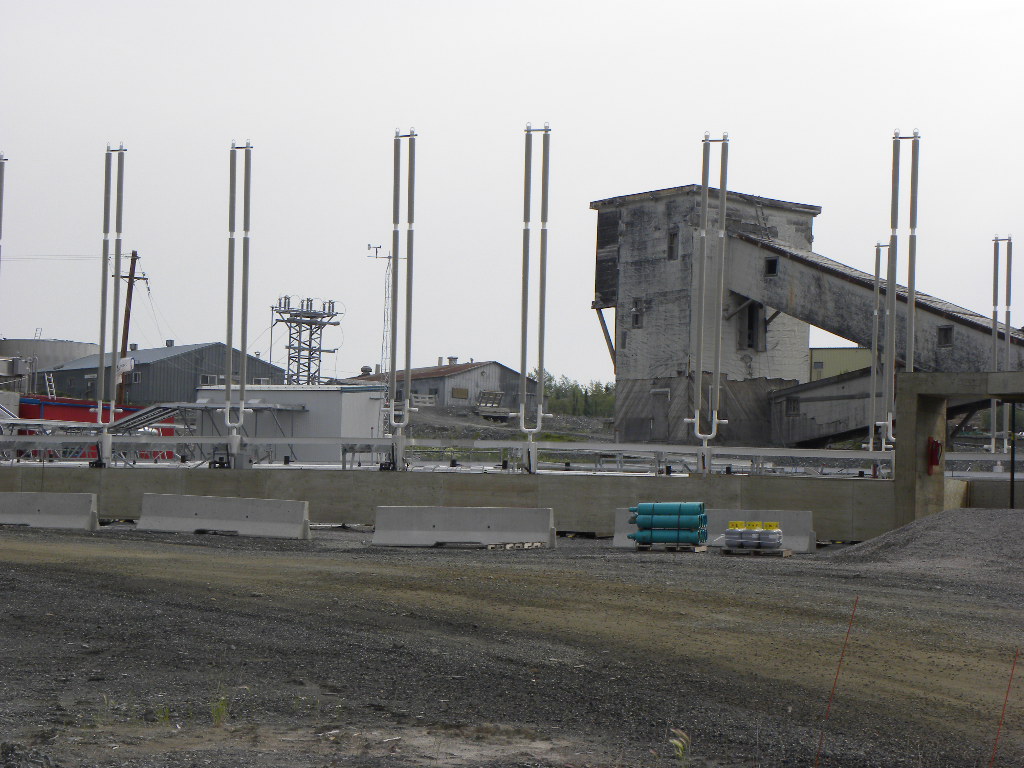
The pollution problem may have improved (though it did not disappear), but there was one major problem with the control system: the arsenic trioxide dust did not disappear but was deposited in fifteen abandoned stopes and purpose-built chambers, leaving 237,000 tonnes of the material by the time roasting ceased in 1999. Currently the federal government, which inherited most of the environmental liabilities at the mine, is freezing the arsenic chambers so the arsenic cannot be mobilized by underground water. Initially a “freeze it and leave it” project, the City of Yellowknife triggered an environmental assessment that mandated the government remove the material when a safe approach to doing so can be developed. The Giant Mine Remediation Project is no small undertaking — the freezing and surface cleanup will cost a staggering $4.3 billion, and the project has a mind-boggling 100-year to find a permanent solution to the underground arsenic problem.
Yellowknifers, and indeed all Canadians, are still reckoning with this environmental legacy and our new book, “The Price of Gold: Mining, Pollution and Resistance in Yellowknife,” aims to contribute to this dialogue. Our goal with this work was not to diminish the more celebratory histories produced in the community, but to paint a more complex picture. As at many other mining sites, Yellowknifers were not just mining boosters, but often among the biggest critics of the companies. Through their unions, workers pushed back on high levels of occupational exposure at Giant Mine, and the broader problem of arsenic pollution. Indeed, anti-pollution activism led to a remarkable collaboration between Indigenous and non-Indigenous residents in the 1970s, as the unions at Con and Giant, the United Steelworkers of America, worked closely with the National Indian Brotherhood to conduct a research program and national media campaign on arsenic exposure at Giant Mine. Yellowknife’s proud mining heritage includes a history of local activism devoted to mitigating pollution and improving public health.
Why do these stories matter today? Some in the industry suggest places like Giant Mine represent the “bad old days,” hardly indicative of the improved community consultations, environmental performance, and occupational health records of today’s mines. While it is true that there has been important progress in all these areas, sober reflection on the legacy of Giant Mine carries important lessons about the long-term costs and consequences of short-term thinking, the fundamental importance of environmental assessments, and the potential for community oversight bodies to help mitigate potential negative consequences of development. Places such as Giant Mine also help to explain the opposition of many Indigenous leaders to Bill C-5, their negative experience with past developments stoking the fear that contemporary “fast-tracked” developments in the national interest might turn their lands into environmental “sacrifice zones.” In this sense, our book underlines the importance of cautionary tales alongside commemorations of mining history and heritage.
John Sandlos is a professor in the History Department at Memorial University of Newfoundland and the co-author (with Arn Keeling) of “Mining Country: A History of Canada’s Mines and Miners,” published by James Lorimer and Co. in 2021. His new book, “The Price of Gold: Mining, Pollution and Resistance in Yellowknife” (also co-authored by Arn Keeling), will be released with McGill-Queen’s University Press in September 2025.
Arn Keeling is a professor in the Department of Geography at Memorial University of Newfoundland and the co-author (with John Sandlos) of “Mining Country: A History of Canada’s Mines and Miners” and “The Price of Gold: Mining, Pollution and Resistance in Yellowknife.”
Related Posts
PDAC JV Video: FireFox drills toward first Mustajärvi resource
PDAC JV Video: Bold bets on low-cost Ontario drill trio
March 13, 2026
PDAC JV Video: Bold bets on low-cost Ontario drill trio

JV article: Deloitte targets mid-tier miners managing complexity

JV Q&A: Dundee Sustainable eases processing risk
March 13, 2026
JV Q&A: Dundee Sustainable eases processing risk
PDAC JV Video: Amex targets March bulk sample at Perron
March 12, 2026
Comments