Creating a culture of maintenance safety, training, and profitability
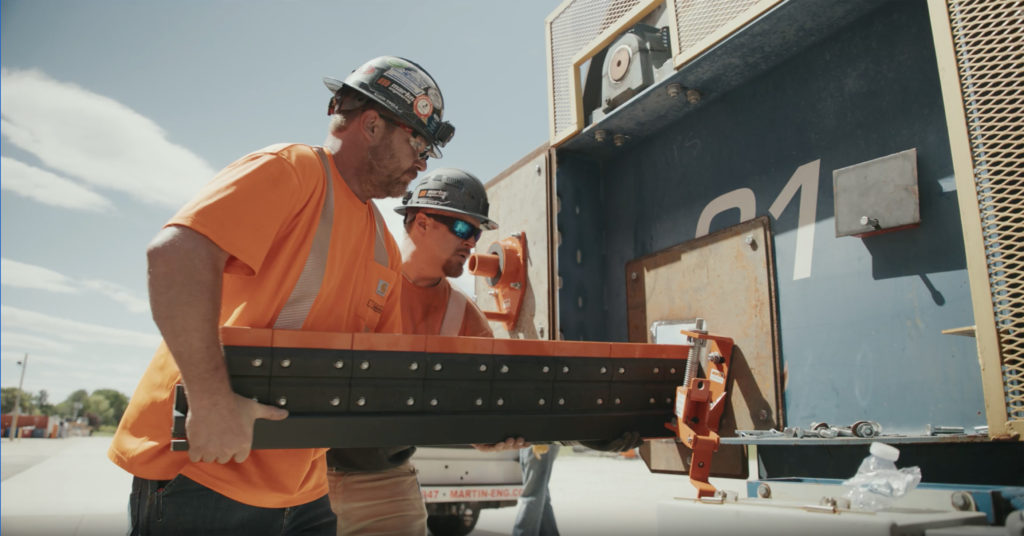
In bulk handling and processing, production uptime and meeting projected targets are naturally some of management’s primary goals. In some instances, quarterly or annual bonus structures can be tied to these targets. Although this bonus structure seems like an incentive program, it can harm long-term profitability and safety.
Fixating on production can lead to a culture of running the “equipment to failure,” which inevitably results in serious safety issues. Failure on a conveyor belt could mean (i) equipment detachment, causing belt damage and sparking, or (ii) components freezing, leading to belt damage from friction and heat. Both instances can result in a belt fire spreading quickly throughout the facility, putting every employee in danger, as the operation’s future goes up in smoke.
A “Production Done Safely” approach results in longer periods of uptime and greater production over the long term. When devising the conveyor production schedule, managers should allow ample downtime for necessary maintenance with proper lockout/tagout procedures and updated employee certifications for specified procedures, such as confined space entry and hot work. Scheduled shutdowns facilitate these maintenance activities.
However, a safety-focused production schedule is only the first step. Belt conveyors are some of the most essential and powerful production systems in a bulk handling operation, so this article will focus on conveyor systems.
Observation and logging
Whether it is an internal “belt boss” or a contracted service expert, system inspectors walk along the conveyor system, observing its function. A trained and experienced technician will use sight, sound, and even smell to detect changes and issues in the system. Martin Engineering’s program is called “Walk the Belt,” where a trained service technician will perform a routine inspection and servicing of conveyors within an operational facility.
During this process, they inspect its operation, make minor adjustments or perform cleaning activities, and note any significant issues requiring further attention. It indicates the approximate life expectancy of wear parts, informing managers of windows in which to schedule a full or partial shutdown.
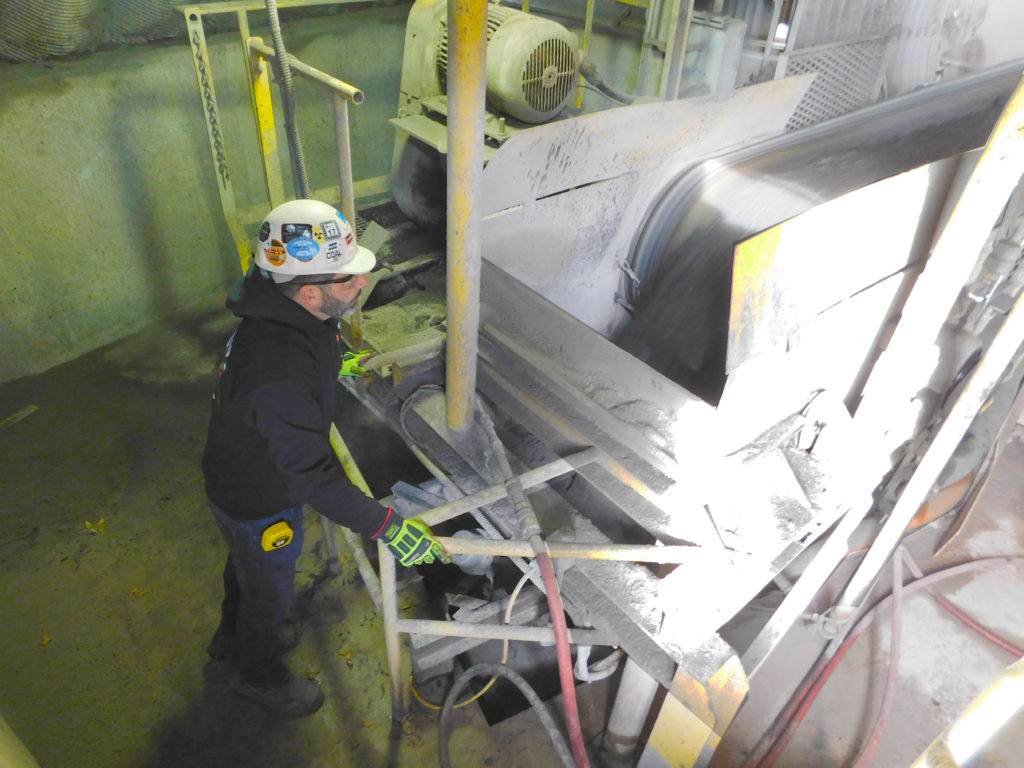
The belt inspector should document observed problems, for instance, they might note issues like “The centre roller on idler number 127 on Conveyor B is not turning.” It is crucial to immediately record these observations and use a digital camera or smartphone to capture photos for evaluation.
At certain points, particularly at the head pulley and tail pulley, the inspector should hold and carefully observe the belt’s operation for at least one full revolution, preferably empty. This allows for a thorough examination of the belt’s condition, including its edges, splices, top cover, and tracking.
- Edge damage indicates mistracking. Either the belt is not centered on the tail pulley entering the loading zone, there is a significant shifting of cargo after the loading zone, or mistracking during discharge and return. If none of these factors exist, there may be bowing or camber in the belting.
- Splice damage from direct material impacts or edge wear needs to be remedied immediately once it is detected. A broken splice can cause dangerous contraction on a fast-moving and tensioned belt that could kill a worker who happens to be nearby.
- Gouges and dents in the top cover can hide fines that surpass the primary cleaner and spill along the return path of the conveyor, causing dust and spillage. This may require a secondary or tertiary belt cleaner to adequately clean the belt, improve air quality, and avoid the extra labour for cleaning.
- Most systems come with “belt tracking,” but those are usually mere shields that prevent contact with the stringer, resulting in friction damage and the belt folding over upon itself. There are well-tested tracking systems that detect slight variations in the belt and use the belt’s energy to pivot a specialized troughed idler and redirect the belt back to the centered position.
Mean time between failures (MTBF)
MTBF is the average uptime between unscheduled outages. It is a vital performance metric to measure safety and equipment design. MTBF also shows the relationship between maintenance and uptime. From an accounting perspective, it aids in determining the new equipment’s return on prevention (ROP) as compared to existing equipment.
To calculate MTBF, review the history of the system or equipment, compile the times between each failure, add them together, and divide them by the number of periods. For example, six failures have five periods of uptime between, so if the total uptime is 22 days, dividing that by five makes the MTBF 4.4 days. To increase the impact of the dataset, add the number of workers and man-hours for each downtime period and calculate the direct cost in labour.
Human factor engineering
Engineering decisions for retrofitted system changes are supposed to consider spatial restrictions, production limitations, bulk material traits, and workplace safety, and designers should account for those factors. However, they often inadvertently contribute to maintenance challenges.
Managers could point out the creation of a production schedule that includes shutdowns, causing designers to engineer systems around major service events. Unfortunately, this may cause designers to overlook the routine maintenance tasks like idler lubrication or belt cleaner upkeep, which may require short stints of downtime here and there to avoid dangerous maintenance around a moving belt.
“Human factor engineering” and ergonomics optimize the interaction between people and machinery, enhancing safety and operational efficiency. Although it might raise installation costs, consider how the long-term benefits of features such as walkways, platforms, and easy access to utilities like water, electricity, and compressed air can significantly enhance maintenance efficiency.
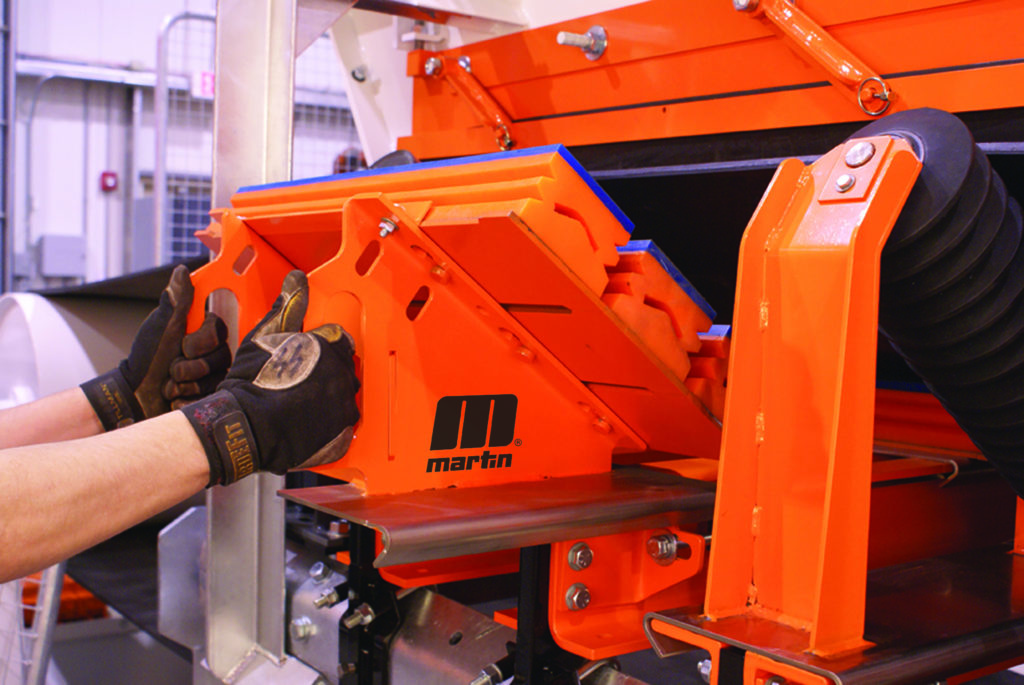
A conveyor system’s optimal performance is tied to the performance of the people who maintain it. Components designed for easy adjustment or replacement, such as track-mounted idlers, cradles, and belt cleaners that pull away from the system, can promote routine maintenance and lower the cost of operation because they take the pain out of servicing. This reduces the number of people needed for the task and drastically cuts the maintenance time.
Safe maintenance
Martin Engineering’s Center for Innovation in Illinois develops methods to enhance the safety, longevity, and efficiency of existing equipment. Accessibility plays a significant role in this, prompting Martin Engineers to introduce the “Trac-mount” system for conveyor components “Track mounted” conveyor equipment is a key innovation. The lockout/tagout (LOTO) procedure should always be observed. Installing a track-mounted component means it slides away from the system into the accessible walkway allowing for easy service. This prevents workers from having to slide under or precariously reach into the system.
Wear components that should be track-mounted include the following:
- Belt cleaners: Primary, secondary, and tertiary cleaners dislodge stuck-on material to ensure it does not carry back and spill along the belt path, creating dust and requiring cleanup.
- Idlers: When they seize, friction damage can rapidly erode the unprotected side of the belt and potentially lead to a conveyor fire.
- Cradles: Used at transfer points, they are bumpers that help seal the enclosure. Although designed to minimize drag and friction, they eventually erode and require flipping or replacement.
Credit: Martin Engineering
Rolling components on conveyor systems depend on proper lubrication to ensure longevity and avoid seizure. Follow manufacturer recommendations and avoid over-lubrication.
Storage strategies for reduced downtime
As tempting as it may seem, no facility has the space to accommodate all the components it needs at once. However, maintaining a stockpile of spare parts is essential for minimizing downtime. With effective inspection reporting, operators can identify commonly damaged parts and worn components, such as belt-cleaner blades, impact bars, idlers, and emergency belt fasteners, that can be stockpiled for quick access.
Using the same manufacturer for your conveyor components makes creating a ”boneyard” for storing decommissioned parts an excellent resource for replacement items. If kept clean, organized, and sheltered from the elements, these components can potentially carry the operation through to the next scheduled shutdown.
Keep in mind that some wear parts, such as polyurethane blades and rubber skirting, can have a shelf life of as little as two years, so maintaining a simple dating and rotation schedule is recommended.
Not everything can be planned
Maintenance managers often struggle to stay ahead of breakdowns in older facilities where improvements are incremental owing to budget constraints. If an employee identifies a risk, such as a tramp iron lodged in the structure, an overheating idler, or a fire hazard like smoldering material buildup, the first action should be to activate the belt stop switch. Safety always takes precedence over downtime.
Fostering a culture where staff have the autonomy to act without hesitation to ensure their own wellbeing and that of their colleagues is essential for “Production Done Safely.” Their ability to respond based on their experience and sound judgment should be sufficient to earn trust in the authority to shut down a system.
Training staff for prevention
Comprehensive training is crucial for the system’s longevity and the staff’s wellbeing. While having an intimate knowledge of your OEM’s equipment is beneficial, it is important to select a training course that provides a broad understanding of conveyor and bulk handling safety and operations.
Good morale = better operations
One universal truth in bulk handling is that the easier a job or task is to accomplish, the more likely it is to be completed consistently. The result is higher morale and a clean, efficient operation with only brief hiccups of unscheduled downtime. Believe it or not, this approach to “Production Done Safely” represents a cultural shift for many companies. 
Mike Estes is EPC manager at Martin Engineering.
Comments