Modernizing mining in Quebec: Key reforms introduced by Bill 63

In the last year, Quebec’s mining sector experienced significant regulatory changes. The government enacted Bill 63 (An act to amend the Mining Act and other provisions), reforming the Mining Act (c M-13.1) (the act) to reconcile mining development with other land uses and promote coexistence among users, responsible resource exploitation, and tighter environmental controls. Bill 63 received Royal Assent on Nov. 29, 2024, with most provisions taking effect immediately. Additional regulations to complete the reform are anticipated in the next year.

This article highlights some of the major changes introduced by Bill 63 and their implications for environmental protection and Indigenous rights, as of Sept. 2025.
Reform of the act
Modernization of terminology
Bill 63 replaces the term “claim” by “exclusive exploration right” (EER). An EER is valid for three years and may be renewed in two-year periods if conditions are met, including the exploration work of the nature and cost as determined by regulation.
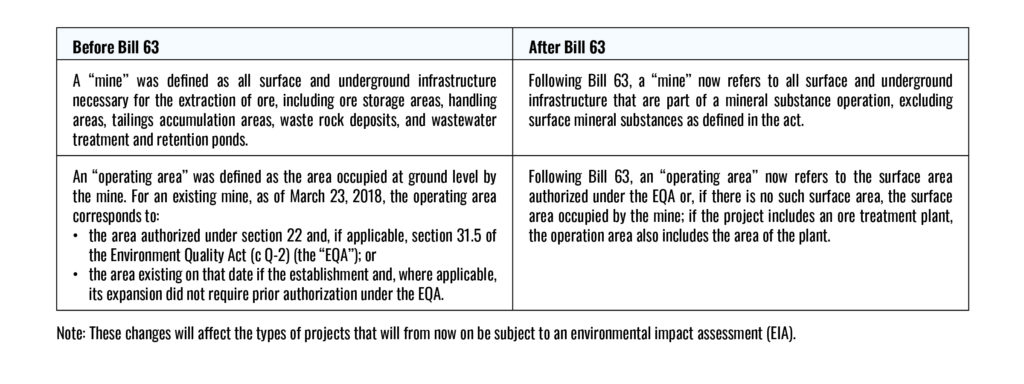
Bill 63 also amends the definitions of “mine” and “operation area” in section 22 of Part II of Schedule I of the Regulation respecting the environmental impact assessment and review of certain projects (c Q-2, r. 23.1) (the EIA Regulation) as follows:
Changes to the procedures regarding EERs
Bill 63 introduces significant changes regarding the rules governing the EERs. Section 9 introduces section 18.1 to the act, allowing any person who meets regulatory conditions to apply for and hold a mining right. Section 18.1 formalizes eligibility criteria to obtain a mining right, providing a regulatory framework to better regulate access to mineral resources, curb speculation, promote responsible land use, and strengthen the credibility of the mining regime for the benefit of Quebec’s economy. Section 18.1 is not yet in force and will take effect when the government establishes new regulations under the act.
Ministerial discretion and territorial oversight
The new section 52.1 of the act authorizes the minister to impose conditions on holders of an EER. These may concern the work to be performed and may be imposed notwithstanding other provisions of the act, either for public interest reasons, particularly to prevent or limit impacts on local and Indigenous communities or to enable prioritization or reconciliation of uses and preservation of the territory.
Bill 63 also amends registrar’s duties regarding the refusal of a notice of map designation. Under the amended section 52, the registrar must refuse a notice of map designation in cases including where the land has been designated by a person who does not meet the conditions set out in section 18.1 of the act. This expands the registrar’s obligation, strengthening regulatory oversight of land use for mining purposes.
Prior to Bill 63, section 101 of the act allowed the minister to grant a mining lease without proper EQA authorization in cases where delays in obtaining such authorization were deemed unreasonable. This “unreasonable delay” exception has been removed in the amended legislation.
Bill 63 introduces a new version of section 101.0.1 of the act, granting the minister authority to impose conditions or obligations when granting a mining lease. These conditions may be applied (i) to enable prioritization or reconciliation of land uses and preservation of the territory, (ii) for public interest reasons such as limiting impacts on local and Indigenous communities, (iii) where the lease concerns land with mineral substances reserved to the province, or (iv) to maximize the economic benefits of the mining project within Quebec.
The removal of the “unreasonable delay” exception, combined with the new discretionary powers under section 101.0.1 of the act, represents a significant change in the legal framework governing the granting of mining leases.
Under section 164 of Bill 63, section 22 of Part II of Schedule I of the EIA Regulation has been replaced by a new provision subjecting certain mining projects to an environmental impact assessment procedure under the EQA (EIA procedure). Under this provision, the EIA procedure now applies to
- Work required for the operation of a new mine;
- Where the operation of a mine was authorized under section 31.5 of the EQA before Nov. 29, 2024 or is the subject of such an authorization as of that date, work required for any expansion of 50% or more of the mine operation area; and
- For mines not authorized under section 31.5 of the EQA before Nov. 29, 2024, any
- work required for any expansion of 50% or more of the mine operation area.
- work required for any project to increase the maximum daily extraction capacity by 50% or more.
- work that increases the maximum daily extraction capacity of a metal ore mine to 2,000 metric tonnes or more.
- work that increases the maximum daily extraction capacity of an ore mine other than a metal ore mine to 500 metric tonnes or more.
- work required to resume the operation of a mine that underwent dismantling or restoration work after its operation stopped.
The replacement of section 22 of Part II of Schedule I of the EIA Regulation introduced by Bill 63 aims to ensure greater predictability and transparency regarding impacts on the territory.
Regarding rehabilitation and restoration of the site, Bill 63 introduced the notion of “harm caused to the environment.”
Consultation with Indigenous communities
Consultation mechanisms
As part of modernizing the legal mining framework, the government has expanded its regulatory mechanisms to, among other things, enable prioritization and reconciliation of uses and preservation of the territory and ensure greater transparency and predictability for Indigenous people regarding mining activities.
To reconcile mining activities with the Indigenous people activities, the act now allows the government of Quebec to enter agreements with Indigenous communities to determine the boundaries of a parcel of land where any mineral substance forming part of the domain of the government is reserved to the government, on the conditions fixed in the agreement, or withdrawn from prospecting, mining exploration, and operations.
Bill 63 also establishes an obligation for the minister to notify, within 60 days of the registration of an EER, any Indigenous nation or community concerned by the existence of such right.
Additionally, to enhance predictability and transparency for Indigenous people, EER holders are now required to submit an annual work planning, using the prescribed form, to each affected Indigenous nation or community, at least 30 days prior to the commencement of any exploration work and, subsequently, on an annual basis for as long as the work continues. Any Indigenous nation or community concerned may also request that the holder conduct an information session concerning such annual work planning.
The annual work planning must be published on the holder’s website or by any other means authorized by the minister. Where an information session is to be held, a summary thereof must also be published.
Finally, Bill 63 grants the minister, under certain conditions, the authority to require a holder of a mining right to remove or move, within the timeframe determined by the minister, any property or extracted ore or surface mineral substance located on the land subject to mining right to enable prioritization or conciliation of uses, preserve the territory, or for reasons of public interest, including, notably, the mitigation of impacts on Indigenous communities. Should the holder fail to comply with such a requirement, the minister may proceed with the removal or relocation at the holder’s expense.
Recent jurisprudence on Indigenous consultation in mining
The intent to strengthen communication, transparency, and predictability regarding mining activities affecting Indigenous communities aligns with the principles reflected in the 2024 Superior Court of Quebec decision in Mitchikanibikok Inik First Nation (Algonquins of Barriere Lake) versus Procureur Général du Québec. The Algonquin First Nation alleged that the government failed to fulfill its duty to consult regarding mining exploration activities on territory over which the Nation asserts Indigenous title or rights.
The court declared that a decision to be made under the act, whether or not to accept the designations of claims on territory subject to asserted Indigenous titles or rights known to the Crown in right of the province, engenders a duty to consult prior to the decision being made. It further emphasized that the application of the act requires a more robust approach to the implementation of the duty to consult Indigenous communities, including, where circumstances justify, distinct consultations.
Both this judgment, issued before Bill 63 came into force, and the amendments enacted through Bill 63, illustrate a distancing from the traditional free access regime, reflecting a transition towards a more inclusive framework for mining governance that considers the concerns of Indigenous communities. The Attorney General of Quebec appealed the decision on Nov. 22, 2024. The outcome of this appeal, still pending as of Sept. 2025.
Conclusion
Bill 63 marks a turning point in Quebec’s mining governance. By modernizing terminology, tightening eligibility, expanding ministerial discretion, and strengthening environmental and Indigenous consultation obligations, it significantly modifies the legal framework that has long characterized mining development in Quebec. While many regulatory requirements remain to be set, the direction of the reform is clear: Quebec is moving toward a more structured, transparent, predictable, and accountable regime.
As of Sept. 2025, it is our understanding that some regulations are expected in the Gazette officielle du Québec by the end of 2025, with a public comment period, their coming into force is anticipated for next year. 
Mira Gauvin is a partner in Dentons Canada’s Corporate Group, with a focus on environmental law. She is also a member of the Firm’s Environment and Natural Resources and Climate Change Strategies groups. Jade Lemieux is an associate in Dentons Canada’s Corporate group in Montréal. Chloé Bourque is an associate in Dentons Canada’s Corporate group in Montréal.
Comments