More mines join federal fast-tracking program: PART 1
The federal government’s announcement could hardly have been designed to quicken the pulse of Canadian mining. Created in August 2025 under the Building Canada Act, the new Major Projects Office (MPO) promised to streamline the project approvals process for LNG development in western Canada, nuclear in Ontario, and in Montreal, shipping.
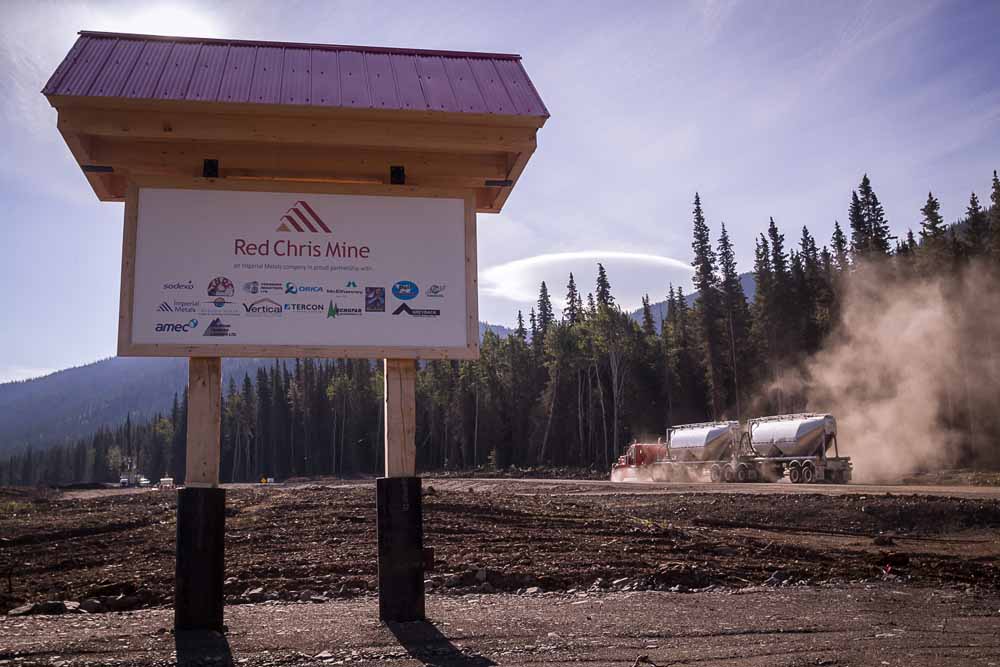
Almost an afterthought, two mines were added to the fold — Foran’s McIlvenna Bay copper mine in Saskatchewan and Newmont’s Red Chris Copper Mine in B.C. for having met the MPO’s key selection criteria for projects already underway.
McIlvenna Bay is near completion and is scheduled to begin operation in 2026. Red Chris Mine represents $60 billion in opportunities for “critical minerals development, clean power transmission, and Indigenous project leadership,” Ottawa said. Work there has been ongoing for more than a decade.
In October, Ottawa and Ontario went further by promising to pony up $3 billion to support construction of four small modular reactors (SMRs) at Ontario’s Darlington New Nuclear Project. Mining’s second win came in November when Ottawa lowered to 50% the eligibility for the clean technology manufacturing investment credit.
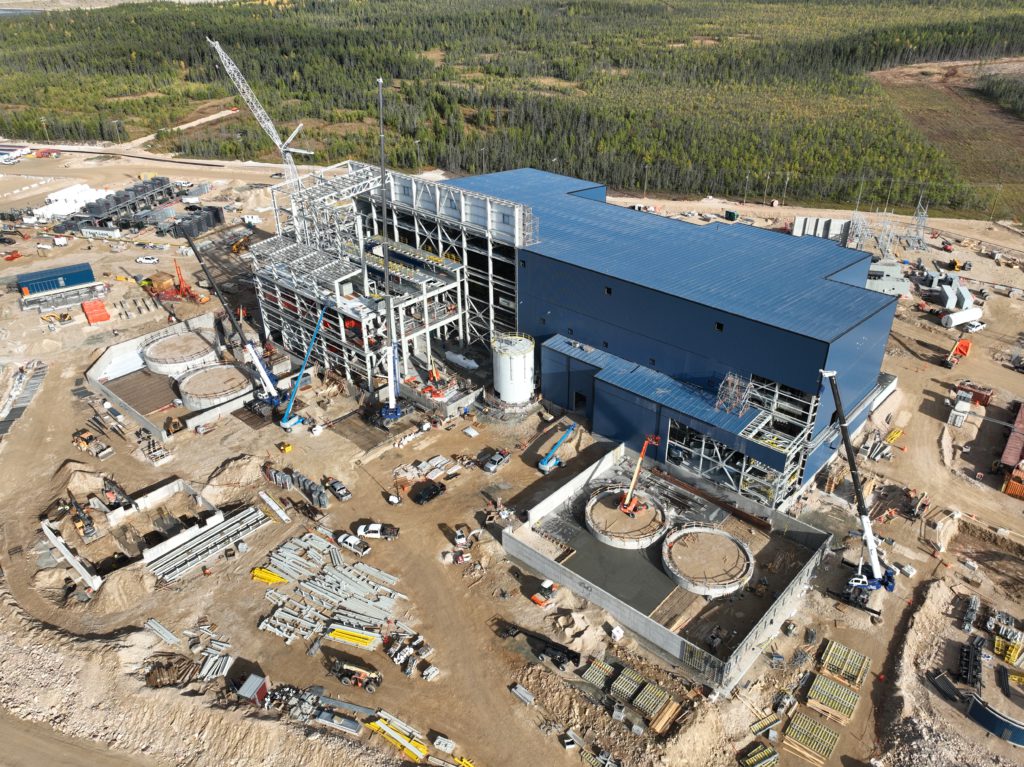
Credit: Foran Mining
According to Photinie Koutsavlis, vice-president, economic affairs and climate change, for the Mining Association of Canada, the previous 90% production threshold restricted eligibility to companies mining a single qualifying mineral such as copper, lithium, or cobalt.
“It was not possible for most Canadian projects to reach that threshold of 90% because our geology is polymetallic. Copper, for example, comes with gold, with silver, and zinc,” said Koutsavlis, who vigorously lobbied for the change this past year. “We could not be more pleased by Ottawa’s decision,” Koutsavlis said in November.
That month, Northcliff Resources learned its proposed Sisson tungsten and molybdenum mine project had also passed muster at the MPO. Ottawa previously awarded the New Brunswick project $8.2 million for a feasibility study, this after the U.S. War Department awarded the company $20.7 million in May.
Also tagged for inclusion in MPO’s fast-tracking program was the Crawford nickel project just north of Timmins, Ontario, and one of the largest nickel deposits in the world.
The MPO also coordinates financing for major projects, linking proponents with federal programs, such as the Canada Infrastructure Bank and the Indigenous Loan Guarantee Program. Consultation with Indigenous peoples is also a central criterion for inclusion in the program.
McIlvenna Bay: Why is copper critical now?
Situated in East-Central Saskatchewan in one of Canada’s richest mineral belts, the McIlvenna Bay Project, Ottawa’s initial announcement said, will supply copper “to strengthen Canada’s position as a global supplier of critical minerals for clean energy and advanced manufacturing.”
The copper will be smelted in Quebec and is expected to be the first net-zero copper project in Canada aimed at supplying battery metals for anything electrical (e.g. grid upgrades and zero-emission vehicles). According to Koutsavlis, it cannot come too soon, citing a 20% decline in Canadian copper production.
“Canada has lost its place in copper production globally,” she said. Foran’s vice-president of capital markets and external affairs, Jonathan French, does not disagree. “Over the last decade, we have definitely declined and just as importantly it has been impacting downstream. We have had smelters also shut down in Canada,” he said.
One of the most recent is the July 2023 shutdown of Flin Flon’s Triple 7 smelter; owner Hubday Minerals opting for an agreement with a Japanese company to do more mineral exploration west of the city. “If we want to build a self-sustaining economy, we need to be investing in those projects,” said French.
One advantage which led the MPO to put McIlvenna Bay Copper Project on the fast-track list was Foran’s completion of its permitting process, which, along with financing and execution, is a major risk in new mines development. Hence Foran’s decision several years ago to forego open pit mining because of the time and effort required to obtain permits for this mine type.
Once full permitting was completed, almost simultaneously Foran struck a collaboration agreement with the Peter Ballantyne Cree Nation. “If you do not have a social license you do not have a business,” French noted. Its FID announced in July 2024 and already 64% complete, McIlvenna Bay Copper Project is expected to finish construction by mid-2026.
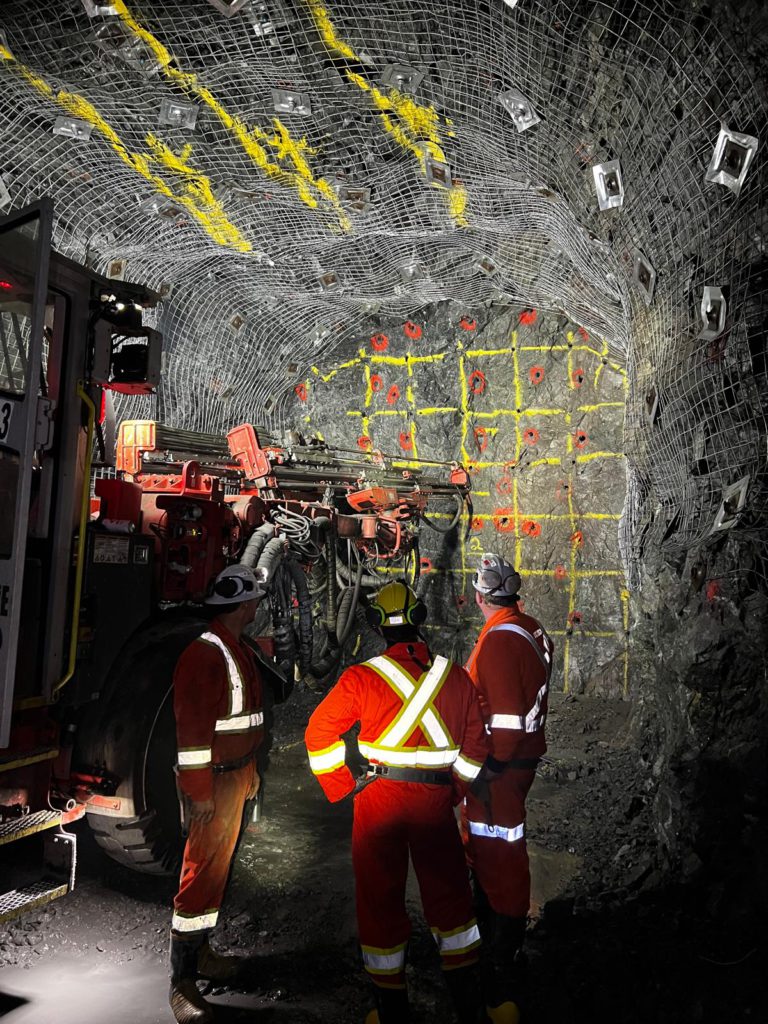
Supporting this is a large fleet of equipment aimed at both block and underground mine development, said French. “The exciting thing about McIlvenna Bay is the use of underground battery electric vehicle fleets like Sandvik electric scoops and trucks, as well as bolters and jumbos,” French explained.
On the labour side, approximately 800 staff are on site, which is close to peak construction numbers. This will be reduced to just over half that number once the mine’s operation is in full swing next year.
“But the real beauty of its Phase One underground operation is a deposit that starts about 20 to 25 metres below surface. We have done the decline; we are over 200 metres deep from surface, so we are already in the ore body,” said French.
Investment decisions await everyone
Along with Agnico Eagle, Foran’s largest shareholder at just over 28% is Fairfax Financial, supplemented in May 2025 with an investment by the Canada Growth Fund. That fund along with the clean technology manufacturing investment credit is one of the few tools Ottawa has to compete with the U.S. Inflation Reduction Act under Joe Biden and now with Trump’s regressive tariff assault on Canadian metal industries.
More than tariffs impeding Canadian mining and the economy overall is how badly Canada is dwarfed by the U.S. government’s aggressive equity investments strategy. Notable are stakes by the U.S. in MP Materials’ auto magnets production (including a U.S. loan and price guarantee), Lithium America, and Critical Minerals Corp.
In Canada, it was Quebec that got into government investment in mining first, notably $965 million in 2018 in Nemaska Lithium, a 50% stake that was matched by Rio Tinto and intended to build up the battery industry. This was followed by a more recent provincial injection into the project of $150 million.
Meantime, Investissement Quebec also invested in Nouveau Monde Graphite Inc. to support the Matawinnie open pit mine and a battery material plant in Bécancour. The Canada Growth Fund brought the total federal-provincial investment there to $50 million in Dec. 2024. That project is envisioned as the largest fully integrated natural graphite facility in North America.
The Canada Growth Fund has also taken out a 10% stake in Foran’s McIlvenna Bay Copper Project. But for all the fund’s worthy investment there and in Quebec, it “has been slow out of the gate,” says Koutsavlis. On a positive note, she added, “They are now building their own capacity as a team to better assess and also develop their internal knowledge of the mining sector.”
The Red Chris story
The impulse for investment continues to be felt not by government but primarily by private industry, including Newmont Gold. Following a 2010 Supreme Court ruling in favour of development, Red Chris copper and gold mine today is operated as a joint venture between Newmont (a 70% ownership stake) and Imperial Metals, which acquired the property in 2007.
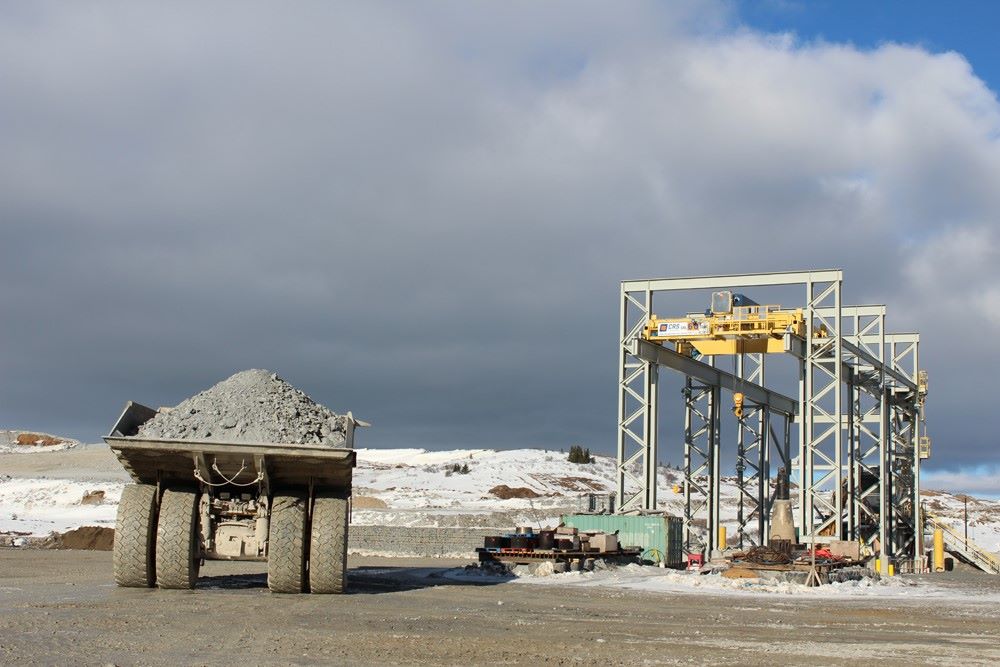
Spurred on by diamond drilling between 2007 and 2012, rich veins of copper and gold discovered at a depth of one km led to a $634 million project opening in 2015. Estimates put copper production at approximately 11 million t/y, with gold production expected over a 28-year mine life.
In 2020, highlights from drilling by Newcrest Mining at the mine’s east zone included 276 metres of 3.3 g/t gold and 1.7% copper from a downhole depth of 684 metres. It also revealed 0.54% copper from 570 metres and 0.46% copper from 458 metres. Enough for Newmont to closely follow further drill programs and acquire Newcrest in 2023 in a $16.8 billion deal to expand the copper operation into 2025.
While easily outshined in size in Canada by Hubday Minerals, Yamana Gold, and B2Gold, the MPO included Newmont’s Red Chris mine’s plan to transition from its current open pit copper operation to a large scale, underground block cave mine.
This could not have come at a better time following the rescue of three miners below surface at Red Chris in summer 2025 and B.C. government fines for repeatedly failing to monitor ground water at the site — this at a time when the MPO had only signaled its possible inclusion in the fast-track infrastructure programs.
According to Koutsavlis, the company is seeking to amend its provincial environmental assessment certificate to transition from open pit to a large-scale underground block-cave mine. Assuming it passes that hurdle and affirms an FID, the site and processing plant could boost Canada’s overall copper input by 15%.
As part of the proposed Northwest Critical Conservation Corridor, Newmont’s expansion is also expected to extend the lifespan of the mine by over a decade, putting the peak construction workforce at 1,800 and cutting greenhouse gas (GHG) emissions by over 70% once in operation.
The Indigenous factor
Newmont’s consideration for the MPO fast-tracking designation was bolstered by another key criterion: under the Declaration on the Rights of Indigenous Peoples Act, a co-management partnership with B.C.’s Tahltan Nation ensures local Indigenous peoples not only benefit materially from the mine but also have a significant say in how the expansion project proceeds.
“That approach ensures Indigenous consent is central to the process, extends the mine’s life, boosts Canada’s copper output, and sets the stage for a final investment decision by Newmont,” said Koutsavlis.
The mine is located 80 km south of Dease Lake, B.C., in the traditional territory of the Tahltan First Nation, which is no stranger to strategic partnerships. It earlier joined with engineering company Allnorth to provide engineering, design, and construction services in northwestern B.C.’s mining and infrastructure sectors.
Newmont, like other mining companies, is looking at projects around the world for a global portfolio. They assess properties against the jurisdiction they are in, the regulatory environment, and political stability.
According to Koutsavlis, the way Canada demonstrates its appeal on taxation and other factors will be critical in any company’s final decision, including Newmont’s. “Let’s get these projects permitted but getting them financed and built is the most important part,” French added.
French noted that a “one project, one review” and the amended tax credit are fine, but it is about getting private capital involved. And if the government can support these projects so a company only must raise 80% or 90% of the capital instead of 100%, that makes even those smaller differentials palatable for investors.
Always in the background: China
China is fiercely competing for the global nickel market. Ontario’s Energy and Mines Minister Stephen Lecce called the Crawford Nickel Project “very important” for that reason, to disrupt China’s monopolization of the sector.
“We have got the highest-grade nickel, a business operation that represents 1,000 permit jobs, 3,000 construction jobs, a 40-year operation with billions of dollars of gain to Canada’s economy. So, we certainly would hope it will be prioritized on that list,” said Lecce.
For all the fanfare, Ottawa hoped its fast-tracking process would garner — and done so quite successfully — within days of the three new mine announcements the feds declared it will take a more circumspect approach unveiling new entrants to the program. No more large block, single-day announcements; more likely single winner selections “every couple of months” made from the MPO.
Koutsavlis concluded, “We have had five mining projects to date. The MPO will be assessed on the successes of these projects under its program.” “How many get to an approved FID and to construction will be the litmus test for the MPO capacity to assist critical minerals development in this country,” she added.
“The government is listening, and putting these policies into effect can be significant for the industry,” noted French. 
David Godkin is a Canadian freelance mining writer.
Related Posts
Strategic Resources approaches final approval for Port Saguenay pellet plant
Newfoundland and Labrador leads Atlantic mining investment rankings

Nova Scotia tops provinces in mining policy gains
March 2, 2026
Nova Scotia tops provinces in mining policy gains
JV Video: Automation rises as drilling faces safety pressure
Canada Nickel confirms high-grade awaruite at Midlothian
March 2, 2026
Comments