The role of AI agents in modern mineral exploration and processing
Credit: Metaspectral.
Global demand for critical minerals is accelerating, with the International Energy Agency (IEA) projecting a sixfold increase in global demand for critical minerals by 2050, making the search for new deposits and efficient extraction of them one of mining’s most pressing priorities. Traditional exploration and processing rely on experts who require years of geological knowledge, extensive field campaigns, and costly, often speculative drilling.
Hyperspectral imagery is becoming increasingly recognized as a strategic tool for unlocking unprecedented levels of geological insight; however, the sheer scale and complexity of the data have historically made it difficult and costly to leverage.
In recent years, artificial intelligence (AI) has begun to play a transformative role in that process. Data and images that once required months of interpretation by specialized experts can now be analyzed in seconds. A new generation of AI-driven systems trained on geological and environmental data can now ingest the spectral signatures of minerals, vegetation, and soils and identify areas of interest in seconds.
The introduction of new AI agents now means that this expert skill is accessible to even more individuals, even those without a specialized background or training. Anyone can now simply load a hyperspectral image on a platform, ask an AI agent questions in plain language, and watch as it performs deep analysis and runs background research to deliver insights without the need for manual analysis and expert interpretation, enabling domain-expert answers on demand.
Understanding hyperspectral imaging
Traditional cameras capture just three-color bands: red, green, and blue. Hyperspectral sensors, by contrast, record hundreds of narrow spectral bands across a wide range of both visible and invisible wavelengths. Each material on Earth interacts with light differently, reflecting and absorbing specific wavelengths that form a unique spectral signature that is captured in hyperspectral imagery. By analyzing these signatures, it is possible to determine a material’s composition with extraordinary precision.
This technique has long been utilized in research and defense, but it has only recently become practical for industrial applications. Advances in data compression, cloud computing, and AI-driven interpretation now allow hyperspectral datasets to be processed almost instantaneously. This, combined with the growing number of Earth-observation (EO) satellites equipped with hyperspectral sensors and the increasing availability of data from companies like SpecTIR and Planet Labs, is ushering in an era of unprecedented geological visibility.
Why satellite proliferation creates opportunity
A decade ago, only a handful of satellites capable of capturing hyperspectral imagery orbited the Earth. Today, the number of these continues to surge thanks to both national agencies and private companies. These sensors collect terabytes of data daily, covering minerals, vegetation, water, and even atmospheric gases.
This expanding data supply poses its own challenge: interpretation. Simply storing and processing these volumes is difficult enough; extracting meaningful insights requires new analytical methods. AI agents help bridge that gap by automating background research, applying domain-specific models, and delivering insights.
But AI is not a replacement for the scientific process; our team at Metaspectral believes that it should instead be a tool to structure and accelerate it. It is essential to thoroughly document and clearly outline the logic, providing relevant references and datasets used as supporting material. This transparency is essential, especially when the use of AI agents is so new; it is important not to operate with black-box analysis.
From data to discovery: AI in mineral exploration
Locating ore bodies has traditionally involved labour-intensive fieldwork, sampling, and expert interpretation that can take months or years before drilling can even begin. With AI analysis of hyperspectral imaging, geologists can now pinpoint mineral alteration zones with precision before even setting foot in the region.
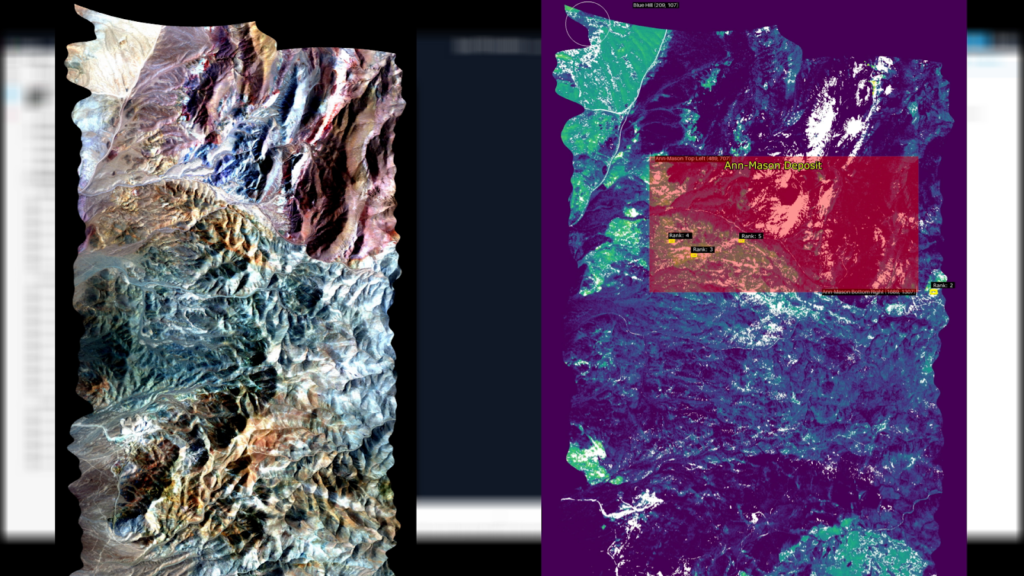
To illustrate, consider the following example, which shows an area in Yerington, Nevada, a region renowned for its copper deposits.
It is now possible to input hyperspectral imagery, such as this, alongside mineralogical data from the site, and simply ask an AI agent, “Where should I look in this image to find copper?” The AI agent can then complete a step-by-step analysis based on established geological principles.
In this example, it identifies the following two key patterns typical of large porphyry copper systems:
- A phyllic zone rich in illite (indicating intense hydrothermal alteration), and
- A surrounding propylitic zone containing chlorite (signifying cooler, peripheral conditions).
By mapping these features and calculating their thermal gradients, AI delineates the most favourable zones for copper mineralization. These AI-generated targets corresponded closely with the Ann Mason copper deposit, which is already documented in the district.
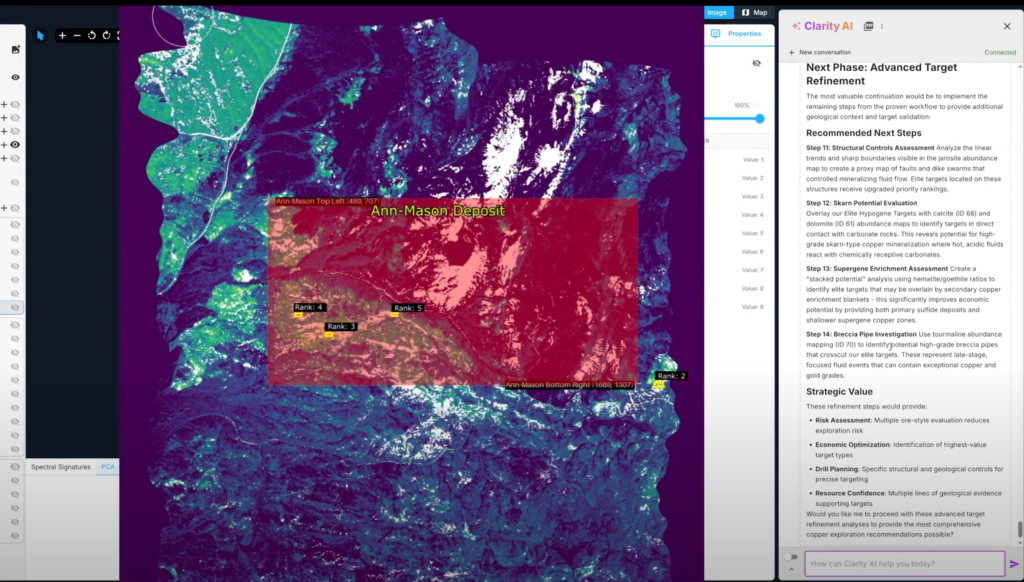
This example illustrates an important point: AI is not replacing geologists. Rather, it is augmenting their capacity to explore larger areas, test more hypotheses, and focus resources where the data shows the strongest evidence for potential mineral deposits.
Efficiency and accuracy in ore processing
Once a deposit is found, a different challenge emerges: efficiently characterizing and processing the ore. Conventional sampling techniques analyze small, discrete points along an ore stream, offering only limited snapshots of composition. Hyperspectral sensors, however, can continuously scan ore on conveyor belts, capturing complete data for every fragment.
AI platforms and now AI agents can interpret this visual data in real-time to determine ore grade, mineral composition, and the presence of impurities. This enables instant feedback to mill operators, ensuring that only material of sufficient quality is processed, resulting in reduced environmental impact and improved yield, lower energy consumption, and better overall operations.

Credit: Metaspectral.
New AI technology can perform these analyses at industrial speeds, analyzing gigabits of information per second. This benefit also extends beyond operational performance: continuous, non-destructive analysis also reduces human exposure to hazardous materials, thereby significantly improving worker safety.
Environmental and climate applications
Mining operations today are under growing pressure to demonstrate environmental responsibility. Hyperspectral imaging provides a powerful means of monitoring environmental impact with unprecedented precision, both during and after extraction. Now, even subtle environmental changes can be detected remotely.
Examples include the following:
- Monitoring acid-mine drainage by identifying sulfate and iron-oxide signatures in nearby soils and waterways.
- Tracking vegetation recovery after reclamation through changes in chlorophyll absorption bands.
- Detecting dust or contamination plumes that may affect local ecosystems.
AI-driven analysis enhances these capabilities by comparing satellite scenes and quantifying the evolution of conditions over time. With the growing availability of hyperspectral satellites from both government and commercial operators, this approach could enable continuous environmental oversight of mining regions worldwide.
This approach can even provide early warnings of potential failures, such as tailings dam leakage or soil instability, allowing for proactive mitigation. In an era of growing environmental accountability, technologies like these may soon become standard practice across the industry.
Toward a more sustainable mining future
The mining industry’s next phase of innovation will likely focus on precision, utilizing data to extract more value with less environmental impact. Hyperspectral imaging, paired with AI, aligns perfectly with that vision. It enables smarter exploration, cleaner processing, and more rigorous environmental monitoring, all of which are essential components of the industry’s shift toward sustainability.
Sustainable critical minerals extraction to power clean energy
This matters especially in the context of critical minerals, which are a key material for the development and operation of clean technologies growing in usage worldwide. As global demand for copper, nickel, lithium, and rare earth elements accelerates, the ability to find and extract these materials responsibly is a crucial aspect that will contribute to a cleaner future and shape both industrial competitiveness and climate progress. AI agents can play an increasingly significant role in realizing a more sustainable future. By narrowing exploration targets, hyperspectral AI can help reduce the environmental footprint associated with the discovery process. By improving ore characterization, it can help optimize resource use and reduce waste.
Mining has always depended on our capacity to interpret the world beneath our feet. The combination of hyperspectral imaging and AI, facilitated by the implementation of AI agents, makes this capability accessible to a broader range of end users worldwide.
This means that anyone, with or without technical expertise in hyperspectral data, can detect chemical fingerprints, track changes over time, and make more informed decisions from exploration to reclamation. -web-resources/image/1.png)
Francis Doumet is the CEO and co-founder of Metaspectral.
Comments