The role of AI in driving mining’s next evolution
Unlocking productivity and innovation from contributor to organization

As mining reclaims its position at the heart of economic development and national security, the sector faces unprecedented challenges and opportunities. The new digital economy — spanning transportation, energy, and artificial intelligence (AI) — depends on critical minerals that, at present, cannot meet projected demand. To remain competitive, the mining industry must adapt to constraints in capital allocation, regulation, and a scarcity of qualified talent. AI is rapidly emerging as a transformative force, already shaping mining operations and poised to play an even greater role in the future.
As the leader of an AI-focused research team at Seequent, a leading technology provider for the mining sector, I am motivated to share insights into how AI is poised to address these challenges and redefine our interaction with data, technology, and decision-making. AI’s impact will be felt by individual contributors and organizations alike. Those companies — both miners and technology providers — that achieve productivity breakthroughs vertically and horizontally will set the pace. While current AI applications are primarily at the software level, truly disruptive gains await those who embed AI into organizational workflows.
AI at the contributor level: Streamlining complex tasks
At the individual level, machine learning (ML) and AI tools are already automating and simplifying complex tasks — from geophysical inversion and geostatistical modeling to drilling data analysis. What took weeks to do now can now be completed in days, and software that previously required months of training can become operational in weeks.
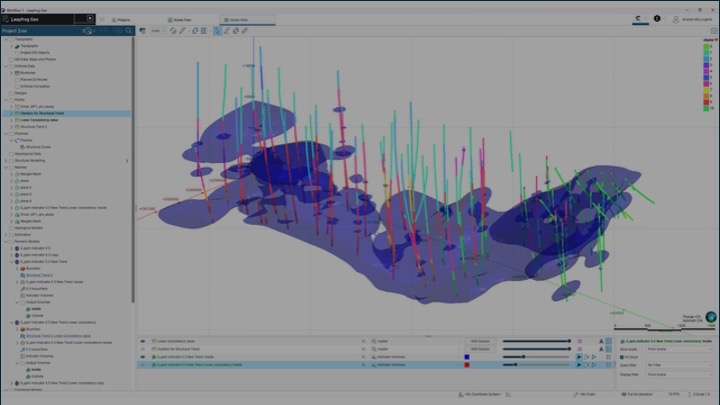
AI-powered applications and add-ons have been available for years, offered by both startups and established providers and supported by innovation from academia. With tools like Python notebooks and open-source libraries, many mining organizations are developing their own intelligent workflows. This trend is accessible, visible, and will only continue to grow in both depth and breadth.
These solutions leverage ML techniques, including neural networks, and the power of cloud computing. In this context, AI helps mitigate the ever-increasing complexity of mining software. As new features are added, what was once straightforward becomes intricate, demanding greater expertise. Generative AI shows real promise in reducing the time required for users to become proficient with advanced tools.
However, while automation at the contributor level is essential, it is not sufficient for industry-wide transformation. Achieving true disruption requires that information, data, and capabilities flow freely across traditional organizational silos.
AI at the organizational level:
Unlocking transformative gains
To harness the full potential of AI, mining organizations must look beyond individual applications and focus on the business. Transformational gains in productivity and accelerated decision-making can only be realized by breaking down barriers between experts, data repositories, and information silos — allowing AI agents to operate across the enterprise.
For AI agents to deliver real value, they must have access to three critical elements: data, contextual information, and computational capabilities. Organizations must therefore ensure the secure dissemination of both explicit data — such as drillholes, geophysical surveys, block models, and reports — and the metadata that provides vital context. Data lineage, for example, records the history and transformation of data objects, enabling AI agents to understand not just the numbers, but the purpose and evolution behind them. This context is what brings true intelligence to agent-driven workflows.
Tacit knowledge — the experience and intuition of the workforce — is more challenging to encode for AI. It can be partially captured from reports and workflow documentation. Where tasks heavily depend on such knowledge and errors carry high costs, AI is best positioned to support, rather than replace, human experts. As more tacit knowledge becomes explicit, AI agents become even more effective.
Finally, AI must be empowered to act, not merely analyze. Agents require access to computational APIs — ideally via cloud platforms — to transform knowledge and data into tangible results. Imagine a future where a block model agent monitors new drillholes via data lineage, updates the block model, and provides real-time validation and executive dashboards — all autonomously.
Getting started: Laying the groundwork for AI adoption
Regardless of personal perspectives on AI, organizations should begin their journey now. The shift to AI-enabled systems will likely be one of the most significant change management undertakings in leaders’ careers. While contributor-level AI changes the work of individuals and teams, organizational-level AI will necessitate broad transformations in digital infrastructure and company culture. Data that was once stored locally and in application-specific silos must be made widely accessible, and reports that were read infrequently may now be routinely accessed by AI agents. Tacit knowledge, often assumed, must be captured explicitly.
At a minimum, every technological decision regarding data format, access, and storage should be made with the assumption that agents will access this information, and that all relevant metadata must be included for efficient AI utilization.
The AI research conducted by our team at Seequent Labs — an innovation team charged with developing breakthrough, industry-transformational capabilities in partnership with customers, research institutes, and academia — has been both enlightening and sobering. There are no “magic bullet” solutions, and no technology partner can undertake the work of data collection and organizational change for you. While AI can be deployed in numerous areas, the best place to start is where knowledge is explicit and the cost of error is low. High-risk, knowledge-intensive tasks should be addressed only once experience with AI agents has been established.
For technology providers like Seequent, preparation means investing in innovations that both augment existing Seequent and non-Seequent products and make them accessible to AI agents. As our clients engage with AI, we must support a new kind of user: the customer agent. These agents will require secure access to data, computational capabilities, and seamless communication with provider-side agents. Seequent Evo, our new cloud platform, embodies this vision: all data is stored with purpose-built open schemas accessible via API, and AI agents can leverage the same computational functions as traditional software — making them true users of the platform.
This AI-ready environment stands in stark contrast to today’s siloed subsurface modeling experience, where distinct domains such as geomodelling, geophysics, and geotechnical engineering operate in isolation. While each software solution should be enhanced with AI, their collective impact will be limited unless unified under a comprehensive, enterprise-wide AI strategy.
It is important to recognize that AI-driven progress is cumulative. Each incremental improvement builds on the last. The sooner organizations begin, the greater the compounding technological and structural benefits they will realize.
Conclusion: Committing to AI for a stronger future
Over the past 18 months, our team at Seequent Labs has been exploring, developing, and testing AI approaches for subsurface modeling, integrated with an open cloud platform designed for AI compatibility. We quickly recognized the benefits of applying AI to routine tasks but also saw that these gains will remain localized without a cohesive, organization-wide data and compute strategy. The potential for AI in mining is immense — but realizing it requires openness to new approaches, a willingness to adapt, and strong leadership committed to lasting transformation. -web-resources/image/1.png)
Dr. Alex Boucher received his PhD in geostatistics from Stanford University, an MPhil from the University of Queensland in mining geostatistics, and a degree in geological engineering from École Polytechnique de Montreal. He was “acting assistant professor” at Stanford University from 2007 to 2010 where he taught and conducted research in geostatistics. Prior of joining Seequent, he was the founder of Advanced Resources and Risk Technology, a geostatistical technology and research company serving mining and energy customers. He has published more than 30 articles in peer-reviewed journals and proceedings and has been a speaker at various conferences.
Comments