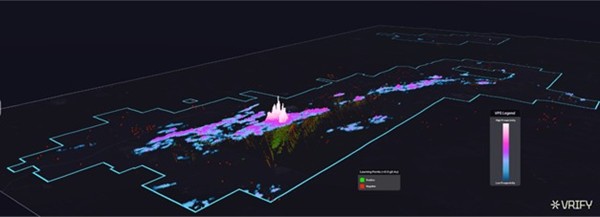
Cartier Resources (TSXV: ECR; FSE:6CA) unveils its new predictive model for the Cadillac project in the heart of Quebec’s Val-d’Or mining camp, created with artificial intelligence through VRIFY’s AI-Assisted Mineral Discovery Platform, DORA. By drawing on robust geoscientific data from the 14,000-hectare Cadillac property, Cartier unlocks value with VRIFY’s proprietary algorithms and feature processing, generating a VRIFY Prospectivity Score (VPS) across the entire land package. This probabilistic value helps Cartier’s team prioritize and guide a portion of the company’s upcoming 100,000-metre drill program using insights grounded in data.
DORA, VRIFY’s AI-Assisted Mineral Discovery Platform, combines proprietary algorithms and extensive datasets, incorporating various exploration features to train predictive models. This platform analyzes complex data relationships to predict promising mineral exploration targets and streamlines the identification of viable mineral systems, which geoscientists can then validate.
The automated target generation lets the team quickly update trained models with new data from ongoing exploration and VRIFY’s expanding database. This iterative workflow improves both accuracy and results over time.
For an interactive view of Cartier’s 3D model showcasing the AI results, please use the link below:
https://vrify.com/decks/18798
Philippe Cloutier, president and CEO, stated: ″ We are very impressed by the results generated from DORA, VRIFY’s AI-Assisted Mineral Discovery Platform. These results reveal potential extensions of known mineralization laterally and at depth, and more significantly, map out new subsurface zones of high prospectivity. We’re particularly excited by the discovery of multiple areas that showed high prospective scores where little to no drilling or modern exploration efforts exist.”
The company and VRIFY have collaborated to aggregate and synthesize extensive data, employing sophisticated AI techniques to extract meaningful insights from a wide range of proprietary and publicly available datasets.
Using VRIFY’s proprietary Feature Processing, the team created and leveraged 148 additional geoscientific products to enhance the predictive modelling at Cadillac. These products provided additional geoscientific insights and demonstrated considerable predictive power for target generation.
By running multiple experiments with different datasets, metal thresholds, and AI parameters, the team fine-tuned a predictive model for the entire land package through the use of DORA. Thanks to Cartier’s robust dataset, DORA also projected VPS results at depth, revealing potential extensions of known mineralization and mapping out new subsurface zones of high prospectivity. This approach enabled Cartier to recognize multiple areas with high VPS scores in locations with little to no previous drilling or modern exploration efforts.
Steve de Jong, CEO and co-founder of VRIFY, said: ″Cartier’s recent results are highly encouraging, particularly within the context of a mature, historically productive mining camp where multiple high-potential zones remain untested. These outcomes highlight the strength of leveraging artificial intelligence as an exploration tool, demonstrating how AI-assisted analysis of geoscientific datasets can systematically identify targets that were previously overlooked by conventional methods. ″
For each generated target, VRIFY delivered a feature importance table that explained the relative weight of influence each geoscientific input had on the prospectivity model for that area. With these unbiased insights into their data’s predictive power, Cartier’s technical team is now incorporating them into strategic decisions for their upcoming exploration campaign.
For more information, visit www.VRIFY.com.


Comments