District Metals (TSXV: DMX; US-OTC: DMXCF) is advancing exploration and economic studies at its Viken uranium project in Sweden after the country lifted its ban on uranium mining.
The legislative change, which came into effect Jan. 1, reopens the jurisdiction to the mineral for the first time since 2018 as nuclear power resurges around the globe. Also, the Swedish government’s geological survey is expected to report within the first half of 2026 whether the project qualifies as a deposit of national interest.
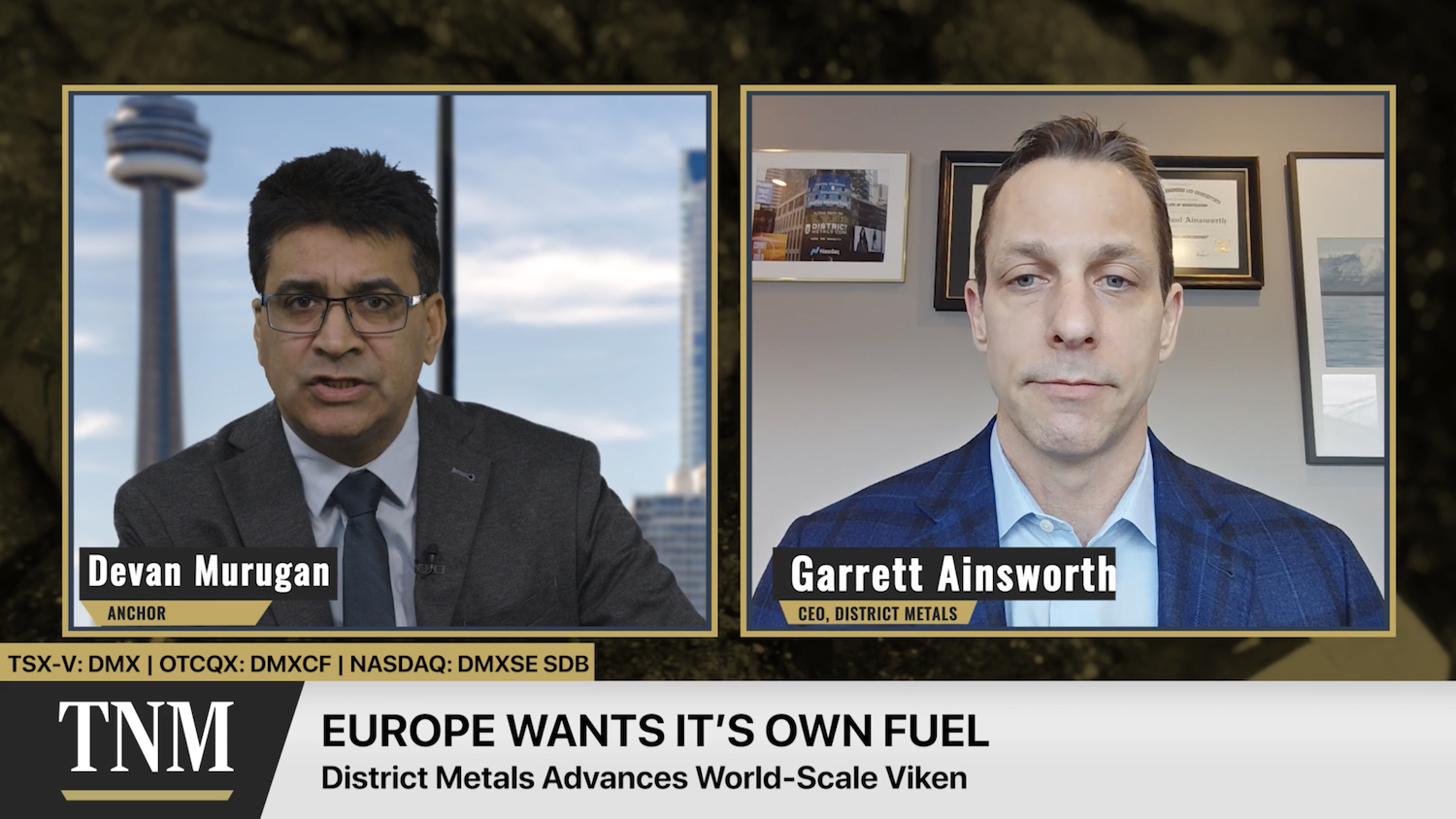
“The Viken alum shale deposit is the largest undeveloped uranium deposit in the world,” CEO Garrett Ainsworth said. “If District Metals receives that designation, it would be a strong signal that the Swedish state wants to see future extraction from that deposit.”
Stockholm’s moves, which could elevate the project if it’s deemed a national priority, come as District plans to release a preliminary economic assessment in this year’s second quarter. The company has operated in Sweden since 2020 and started acquiring uranium projects in 2023 after the government proposed removing the restriction.
Development pathway
The Viken deposit, in Jämtland County about 570 km northwest of Stockholm, benefits from established regional infrastructure, including daily air service, rail and road access, grid power and modern telecommunications.
District is also advancing an economic impact study at Viken as European utilities and governments look to secure long-term uranium supply and extend the role of nuclear power in national energy systems. Sweden’s stable regulatory framework and established infrastructure position the project to benefit from that shift.
The work builds on the scale of the deposit and several years of technical and geological data.
An updated mineral resource estimate completed in 2025 outlines an inferred resource of about 4.3 billion tonnes grading 0.016% U₃O₈ (uranium oxide at 161 parts per million), containing roughly 1.5 billion lb. of uranium oxide.
“It’s low-grade uranium, but the deposit is polymetallic meaning that the deposit hosts several different metals all at once,” Ainsworth said.
Viken also hosts significant resources of vanadium, potash, molybdenum, nickel, copper and zinc, alongside rare earth elements, the estimate shows.
District also flew a MobileMT airborne geophysical survey in 2025 that confirmed the conductive signature of the deposit, and also identified numerous other target areas that have never been previously drill tested.
“It also picked up nine additional target areas within the project,” Ainsworth said. “Three of those target areas have a signature that's larger and stronger than the deposit itself.”
The results suggest potential for additional Viken-style mineralization within the broader alum shale package, positioning the property for continued resource growth. District plans to fly additional airborne MobileMT surveys through the back half of 2026 to identify high-priority targets and guide an expanded drill campaign, with approximately 5,000 to 7,000 metres planned across Viken and the Alum Shale package.
The company also aims to carry out geological mapping, prospecting and geochemical sampling at its non-alum shale Ardnasvarre, Sågtjärn and Nianfors properties to follow up on radiometric and magnetic anomalies identified in 2025.
Municipal veto
Momentum at Viken has unfolded alongside renewed debate in Sweden over municipal veto rights and alum shale mining. In early February, the government outlined plans to remove veto powers for uranium projects, while launching an inquiry into alum shale extraction. This triggered market uncertainty resulting in a pullback in the company’s share price.
“The municipal veto was always there. They're removing one veto, and are now proposing to start an investigation into the relevance of a new one.” Ainsworth said.
He noted that a similar investigation into alum shale mining was conducted in 2020 by the Swedish government.
“The results came back that alum shale poses no greater environmental risk compared to mining of any other type of mineral deposit in Sweden,” Ainsworth said.
Community engagement
Alongside technical work, District has expanded its community engagement efforts as it advances permitting. The company launched a dedicated Swedish-language website under its Swedish subsidiary, Bergslagen Metals, last year to provide information for landowners, municipalities and other stakeholders.
“It’s more focused for landowners and other stakeholders,” Ainsworth said. “It provides information about us and answers questions we’ve been receiving on exploration, on mining, on uranium.”
The company has also begun one-on-one meetings with landowners tied to drill permit applications.
“A lot of it is building relationships,” Ainsworth said. “There’s not really a history of mining in this area — it’s new territory so we are committed to being accessible to the community and stakeholders and providing education around mining exploration that was not available before.”
Renewed interest
Beyond Viken, District is also advancing its other uranium projects that include the alum shale properties Ardnasvarre, Sågtjärn, and Nianfors. The alum shale properties cover over 1,500 sq. km of land with strong potential to host additional Viken-style deposits.
On the Ardnasvarre, Sågtjärn and Nianfors properties, the company is targeting intrusive-related and unconformity-style mineralization that comprises higher grade uranium and lower tonnage uranium occurrences.
Historical work at these advanced stage uranium projects has uncovered high grade uranium boulders, outcropping uranium mineralization, and uranium mineralized intercepts from drilling that has fed into historical resources for Ardnasvarre and Sågtjärn.
With both Viken and the other uranium projects advancing, District is exploring and developing its portfolio of uranium and critical raw material assets in jurisdictions that have seen renewed exploration interest.
The preceding Joint Venture video is PROMOTED CONTENT sponsored by District Metals and produced in co-operation with The Northern Miner. Visit https://districtmetals.com/ for more information.

Comments