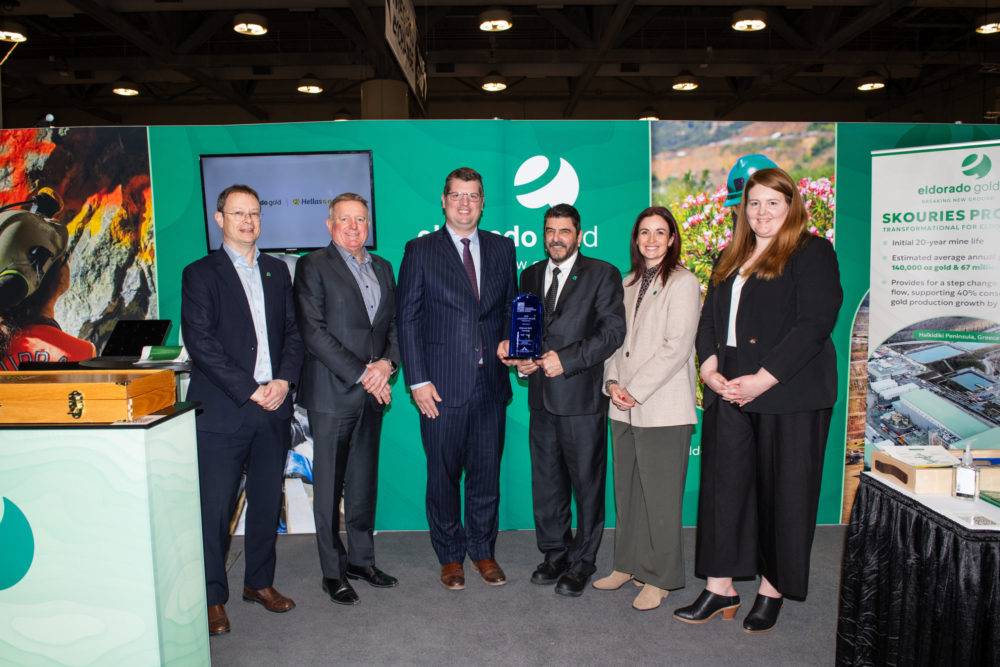
The Ontario government released its updated Critical Minerals Strategy at the annual Prospectors and Developers Association of Canada (PDAC) convention today. Minister Stephen Lecce announced "Fortifying Ontario's Economy: A Plan to Accelerate Responsible Resource Development," which overhauls the province's existing strategy launched in 2022.
The provincial government added high-purity iron and aluminum to its critical minerals list, marking the first expansion since the list's creation. Ontario now includes 35 critical minerals on its list. The government seeks public feedback on the updated strategy to address changing global conditions.
"In the fight for Canadian jobs, we transformed one of the slowest mining permitting systems to one of the fastest, emerging in the top two globally for attracting mining investment," Stephen Lecce, minister of energy and mines, said. "Our new Critical Mineral Strategy will send a signal to the world: Ontario has a serious plan to build mines faster and create more jobs here at home. To better protect Ontario's vital manufacturing workers - from defense, automotive and aerospace – Ontario is also adding high-purity iron and aluminum to the Critical Minerals List. Ontario's new strategy will accelerate momentum, unlock opportunity, and attract the job-creating investments that will power growth across the province."
The original five-year strategy focused primarily on electric vehicle markets and clean technologies. Officials cite escalating geopolitical tensions, supply chain disruptions, U.S. tariffs and rising trade protectionism as reasons for the update. The new strategy aims to reduce foreign dependence and protect Ontario's industries and workers.
The updated strategy outlines six key priorities. These include planning for growth to reduce exposure to global shocks, building a future-ready workforce, delivering regulatory certainty and faster permitting, supporting exploration efforts, building partnerships with Indigenous communities, and scaling up innovation to attract global capital.
"Our updated Critical Minerals Strategy will strengthen Ontario's reputation as a leader in responsibly sourced minerals that power modern economies," George Pirie, Ontario's minister of economic development and growth, stated. "By modernizing the strategy, our government will attract new investment, create thousands of good-paying jobs, strengthen communities, and position the North as a global leader in developing the resources the world needs."
High-purity iron supports the transition to "green steel" manufacturing using electric arc furnace technology in Ontario's steel mills. Aluminum serves as a cornerstone material for the province's automotive, aerospace, and defence sectors. The additions signal Ontario's commitment to investment in exploration and processing of materials vital to advanced manufacturing.
"Ontario's Critical Minerals Strategy has played an important role in advancing our government's economic priorities and attracting job-creating investments in the advanced manufacturing, life sciences, tech, and defence sectors," Vic Fedeli, minister of economic development, job creation and trade, added. "By modernizing the strategy to include new metals and adapting the scope to meet the demands of a changing geopolitical landscape, we're positioning the province for long-term resilience and ensuring Ontario workers stand to benefit from a new wave of industry opportunity."
Since launching its first Critical Minerals strategy, Ontario has implemented the 'One Project, One Process' framework targeting a 50 percent reduction in government review timelines. Three nation-building projects have received designation under this framework, representing more than 5,000 new jobs and $75 billion added to Canada's economy. The province launched a $500 million Critical Minerals Processing Fund and invested $25 million through the Critical Minerals Innovation Fund.
Ontario supported over 213 projects through the Ontario Junior Exploration Program with a $29.8 million investment. The province invested $70 million into the Indigenous Participation Fund and shared nearly $360 million through resource revenue sharing agreements since 2018.
Ontario hosts 40 percent of all publicly listed mining companies worldwide on the TSX and TSX-V, with a combined market value exceeding $1.1 trillion in 2025. The province's mining sector supports 28,000 direct jobs and 46,000 indirect jobs. Ontario currently operates 37 active mining operations, with 33 significant projects in the pipeline.
Comments