From idle to ideal: Cutting fleet emissions and risks with smart vehicle technology
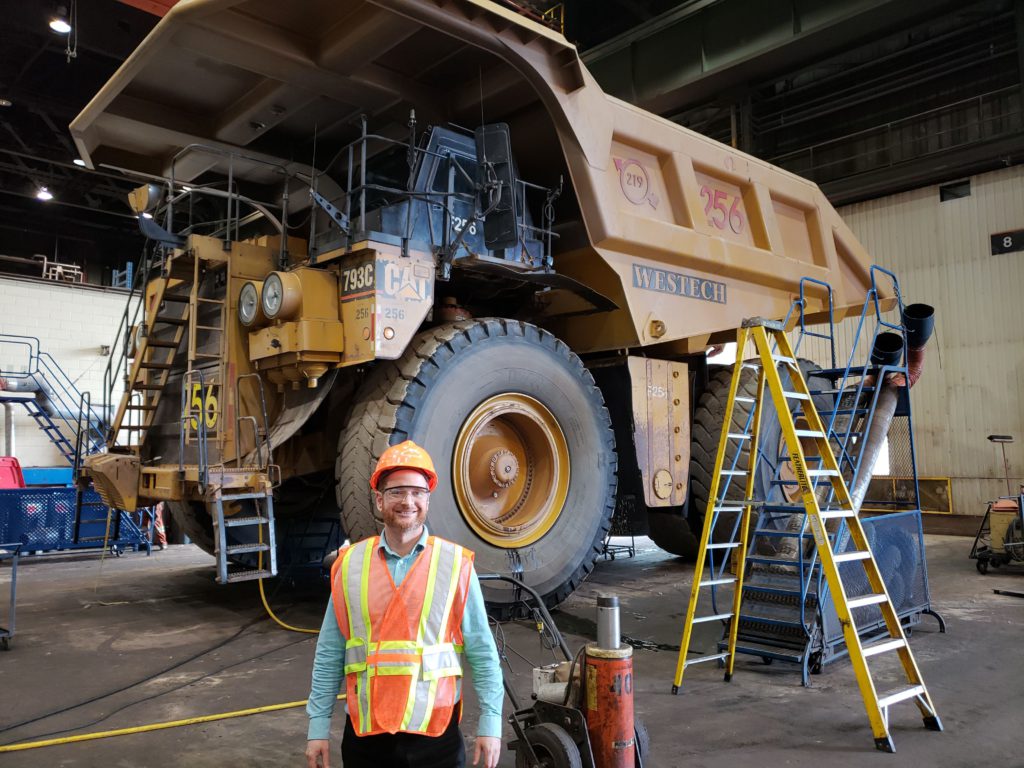
ORCA technology. Credit: Geothentic.
Most mining and construction companies face a commonly over-looked logistical problem that can, when ignored, undermine their environmental and health and safety performance, as well as their operating efficiency. While miners naturally focus most of their attention on mine sites and ore recovery, they and their sub-contractors oversee large and far-flung fleets of light duty trucks that deserve, but often do not get, the same kind of operational attention as heavy quarrying equipment.
In our experience, these vehicles, mainly pick-up trucks, are often left idling when not in use, and may be driven in ways that stress their braking and transmission systems. We also know that miners face steadily increasing scrutiny from investors and customers that want to drive down emissions and improve other ESG-related metrics, including accident-free days. And one important way to achieve these goals is for miners and their subs to take a more active stance in ensuring that these vehicles do not waste fuel, are driven safely, and maintained proactively to prevent breakdowns in remote locales.
Credit: Geothentic.
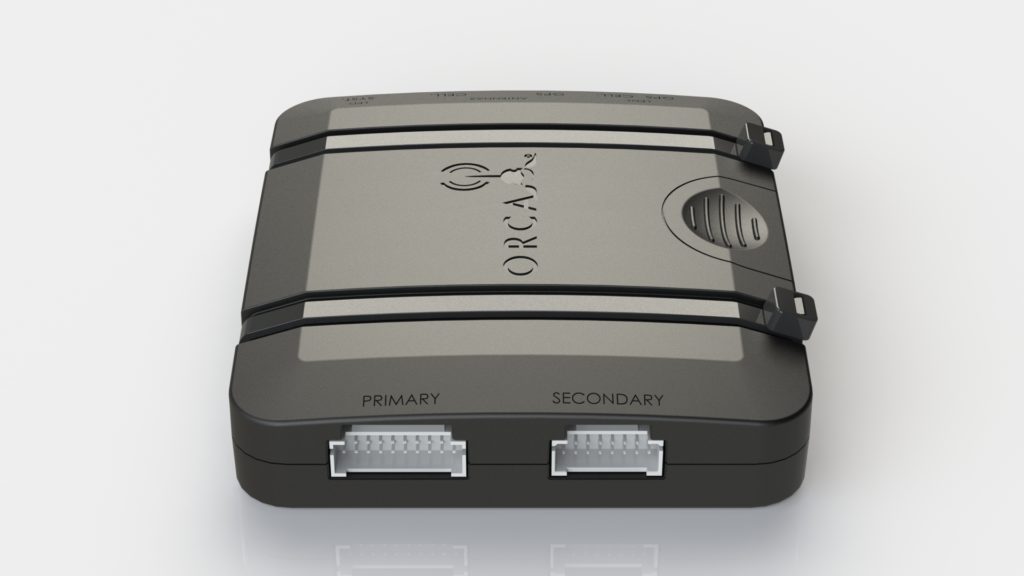
To help miners manage these parts of their operations, Geothentic developed a patented GPS/telematics system, named Orca, that enables our clients to limit unnecessary idling by remotely turning off the engine and unsafe driving with a vehicle-based technology linked via APIs to centralized software tools.
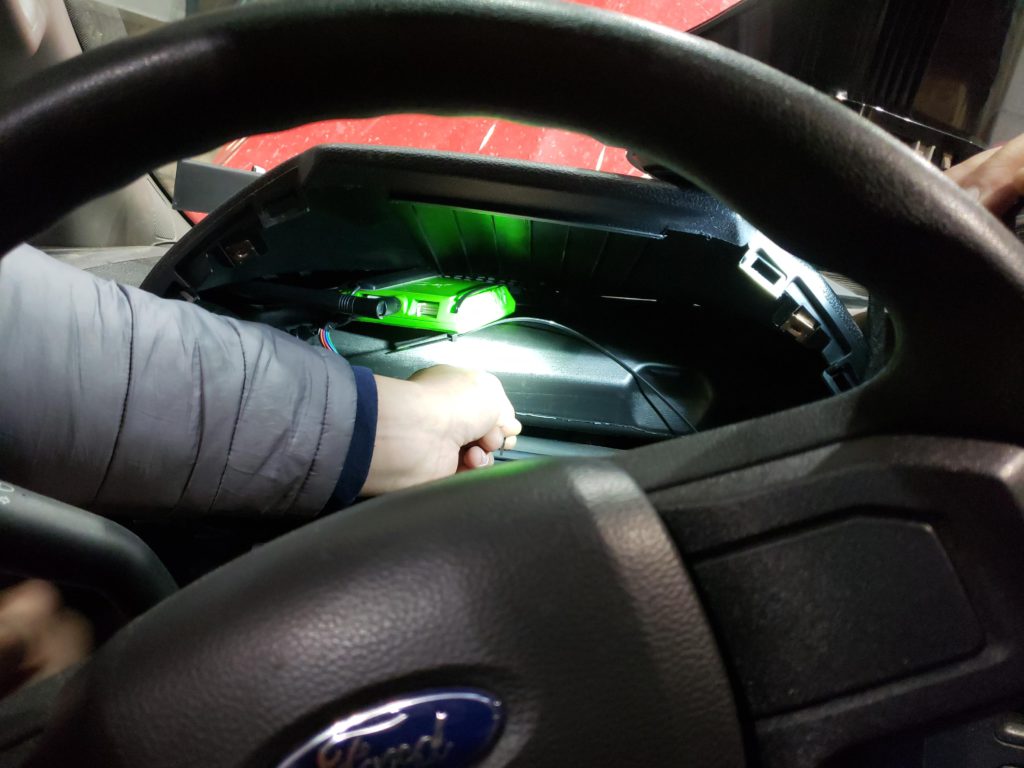
Our Canadian-manufactured box is installed in the vehicles themselves but is controlled remotely by fleet managers who set parameters for individual vehicles. It can distinguish between a vehicle that is idling and one waiting in traffic, for instance, and has been engineered to prevent operators from disabling the device. The on-board functionality includes a sensor-based system designed to detect deterioration in drive-train components that will require maintenance.
The idea behind Geothentic traces back to an irritation of mine. In university, I noticed that a lot of trucks and commercial vehicles were left idling. They spewed fumes and used up fuel unnecessarily, and I could not understand why their operators did not turn them off. After graduating, in 2006, Geothentic was co-founded by me and my brother Pascal, who had the software and programming expertise to build a platform that could remotely control unnecessary idling. It is a bad habit. The drivers let the vehicles idle to ensure they are sufficiently warm or cold, depending on the season. But the employees are not paying for gas.
Our goal was to create a customizable product that would serve fleet managers in all sorts of industries. As we built out the offering, we added features beyond idling control in response to customer needs, which, in recent years, have been driven by steadily rising vehicle costs and the importance of extending the lifespan of existing fleets.
Two years after we set up the company, we secured a deal with a Quebec-based miner to do a pilot project with their fleet. It was a good selling point to do a pilot project, because prospective clients can have real data to be able to decide about deploying the system. The results proved the concept: when we installed the first units, we saw that the vehicles were always running at idle and only turning off the engine when they needed to re-fuel. In other words, these vehicles were logging maybe five or 10 km per day, but the engine was running almost 24/7. That made it easy for us to build the business case.
At the time, there were not many firms offering telemetry-based services to mining fleets, which operated in remote locations and often extreme temperatures. Managing a fleet of urban delivery vehicles is not like dealing with a fleet of light trucks operating on rough roads around very large mine sites.
We have therefore sought to specialize in mining fleets, which operate on private roads. Our solution allows our clients to specify the speed limit for their vehicles. We can set up an alarm for the driver, and a maximum authorized speed. There is no automatic override, so if the driver reaches the maximum speed, they are going to hear an alarm in the cab. But the system also notifies the fleet manager, thus allowing firms to work with their drivers to improve safe and fuel-efficient practices.
We recently launched a new speaker function, where customers can manage their own notifications and create personalized alerts to their drivers. For example, we can use the voice of Arnold Schwarzenegger to say, “Reduce your speed!” It is a more light-hearted way to provide that prompt to the driver to improve their behaviour. In some cases, we have found our clients’ drivers are asking for these tools to help improve their own safety records. Last June, we also acquired an innovative Quebec fleet management software firm, Sinexo, and this deal will enable us to add to our technology stack by providing more tailored solutions to our customers.
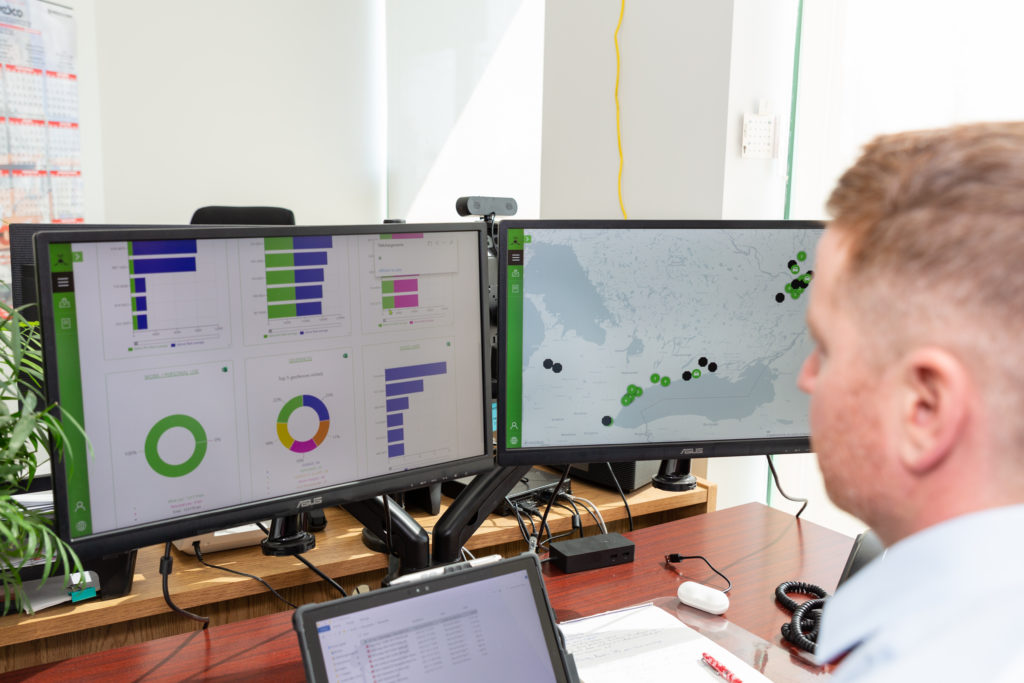
Two important features further differentiate Geothentic from other players in this market. First, because our hardware is installed in the vehicle and then communicates only with our proprietary platform, Geothentic’s system is entirely separate from our clients’ enterprise resource planning (ERPs), thus providing them with a layer of additional cyber-security. Second, we make it our practice to provide our clients with free access to all their fleet data. Other firms insist on owning and retaining all that sensitive operational information, but in our experience, we understand that our clients use it to improve their fleet management practices.
Credit: Geothentic.
Moreover, this solution provides mining clients with the ability to manage their entire vehicle fleet. A growing number of original equipment manufacturers (OEMs), such as Caterpillar and Ford, now provide vehicle-based data and hardware tools, but each has its own back end, which means the client must integrate several software platforms, each geared to the various brands within its fleet. Our theory is that mining companies and other fleet operators prefer to have one technology and one platform instead of six or seven different ones.
One of our newest customers, Blais Industries, a construction firm located in Rouyn-Noranda, Quebec, that serves mining companies around the world, uses Geothentic’s technology to track mileage and speed, limit idling, and facilitate preventative maintenance. Sometimes, drivers will misplace trucks on very large construction sites, and Geothentic’s technology allows them to find their vehicles.
Geothentic is developing a customized solution that also allows Blais’ fleet manager to track tools, such as toolbox or concrete drills, which are used on clients’ sites. The solution involved installing so-called proximity tags on each tool, and these can be detected by Geothetic’s Orca device, a smart phone, and telemetry solutions. This added function that would allow Blais to track lost or stolen tools that may be scattered around large job sites. The other key benefit is that Geothetic’s platform allows the company to improve its sustainability track record. “It is about our values,” according to Blais’ director of internal operations, Véronique Normand.
We agree: every client wants to save money, improve their margins, and reduce accidents. But these kinds of automated systems, which have become ever more prevalent in the mining sector, also enable clients to reduce their greenhouse gas (GHG) emissions. Geothentic’s technology, in effect, delivers both kinds of benefits. 
Guillaume Poudrier is the president of Geothentic.
Related Posts
Suncrest College opens mechanics training facilities, expands scholarship programs
Caudalosa mine restart evaluated as as Silver Mountain reports 569 g/t silver hit
Rock Tech kicks off exploration program at the Victory project
October 22, 2026
Rock Tech kicks off exploration program at the Victory project
Liberty Gold stretches Black Pine’s reach in Idaho
October 22, 2026
Liberty Gold stretches Black Pine’s reach in Idaho

Mining history: A beginner’s guide
October 22, 2026
Comments