Spanish Mountain Gold (TSXV: SPA; US-OTC: SPAUF) says new drilling along the Orca Fault has returned broad, near-surface gold intercepts above the current resource grade at its Cariboo project in British Columbia, advancing it towards feasibility and a potential construction decision.
Recent drilling has extended the Orca Fault target to roughly 530 metres of strike, returning broad intercepts above the current resource grade, including 102 metres grading 0.92 gram gold per tonne, within areas previously modelled as waste inside the proposed open pit.
President and CEO Peter Mah says tighter drill spacing and improved core recovery are revealing continuous higher-grade corridors that could improve mill feed grades and reduce strip ratios. “One of the major headwinds for this project has been the misconception that it’s just a low-grade deposit,” Mah said. “We’ve hit significantly higher grades than previously modelled, and in some areas that material was classified as waste.”
Cariboo, in the burgeoning namesake B.C. gold district that boasts the $890-million capex Osisko Development (TSXV, NYSE: ODV) project, might initially produce 203,000 oz. of the yellow metal a year, according to a 2025 preliminary economic assessment (PEA). Spanish Mountain is due to start a feasibility study within weeks as it heads towards a construction decision by late 2027.
Mine plan
Mah says current drilling is focused on strengthening years six to 10 of the mine plan, where grades are forecast to decline and project value is most sensitive. Improving grades in that period could help smooth cash flow and reduce risk across the first decade of operations, he said.
Drilling under the current exploration program is more than 90% complete, with about 9,300 metres drilled towards a planned 10,000 metres. The company has also implemented split tube core barrels to boost core recovery.
“We’re expecting the two-prong strategy of adding high grade within the deposit and ore sorting to improve and enhance mill feed grades respectively and hopefully scale production,” Mah said.
Golden triangle
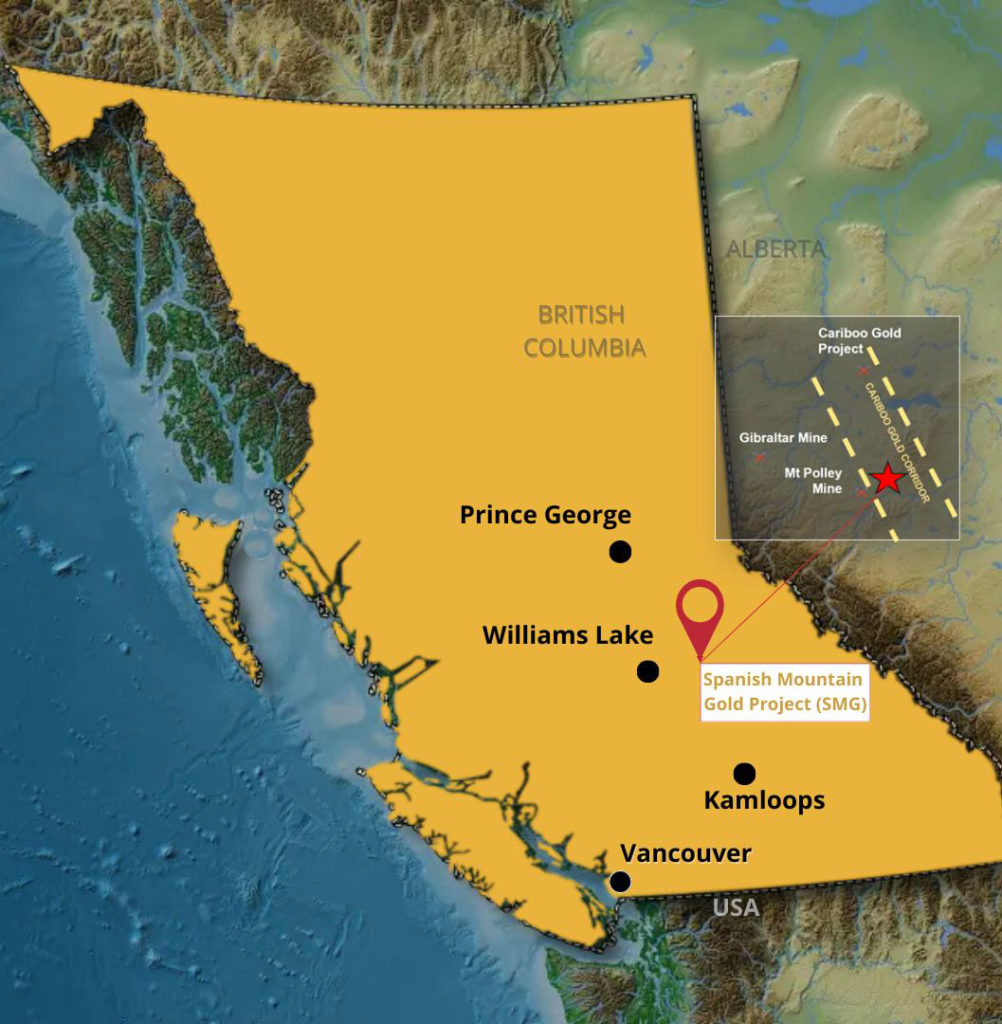
Located near Likely, roughly 550 km north of Vancouver in central B.C., Cariboo benefits from year-round access. The project is part of a resurgent gold district. The region is also home to Artemis Gold’s (TSXV: ARTG) Blackwater mine, which recently achieved commercial production.
Mah said the gentle terrain of the region is more amenable to mining. “It's a mature mining district…the communities and the governments have been approving projects and advancing them,” he said. “This is really the next Golden Triangle.”
Credit: Spanish Mountain Gold
Vanilla base case
In parallel to its drill program, the company is advancing ore-sorting test work on representative samples from the Main deposit and the nearby Phoenix zone, with results expected to underpin a potential update to the project’s PEA. Mah said the approach mirrors Osisko’s use of a similar process at its Carboo project. “We have very similar mineralogy,” he said.
Mah describes the current PEA as a “vanilla base case” that intentionally excluded upside from higher grades, ore sorting and a higher long-term gold price environment.
The PEA was completed using a gold price of $2,450 per oz., Mah noted, and didn’t account for the higher long-term price assumptions now being used across the sector. He said any future update would reflect both the evolving grade profile and the current gold price environment, which has been shaped by heightened geopolitical uncertainty.
“In Q1 of 2025, we hit the highest-grade sample ever in the history of this property,” Mah said.
One hole in the K Zone intersected 0.75 metre grading 719.26 grams gold, part of a wider 139-metre mineralized package averaging 4.18 grams gold within 200 metres of surface. “So it’s not just in the Main zone, there are multiple zones where we see high grade,” he said. “We’re really touching the tip of the iceberg of what’s possible.”
Dry-stack tailings
Spanish Mountain’s PEA also marked a significant shift in tailings management, replacing the conventional valley-fill concept outlined in the 2021 pre-feasibility with filtered dry-stack tailings.
The revised design relocates tailings out of the valley and away from fish-bearing waters, a change the company says materially reduces environmental risk and improves the project’s permitting profile. Compared with the earlier plan, the updated mine layout cuts the water catchment area by about 50%, reducing the volume of water requiring treatment and discharge.
Mah says the dry-stack approach is fully incorporated into the project’s capital and operating cost estimates and provides greater flexibility as the mine plan evolves. Unlike conventional facilities, dry-stack tailings can be reconfigured as new deposits are defined, allowing the company to adapt infrastructure placement as exploration advances.
“We have all the characteristics to do something really special here in terms of sustainable mining,” Mah said.
Phoenix rising
The flexibility of dry-stack tailings is particularly relevant to the Phoenix deposit, located near the Main deposit, which hosts an inferred resource of about 357,000 oz. gold but is not included in the current PEA.
Spanish Mountain is testing Phoenix material as part of its ore-sorting program, with representative samples undergoing analysis in Saskatchewan. Mah says the results will help determine whether Phoenix could be brought forward in the mine plan as a higher-grade feed source, potentially supporting an updated economic case.
Drilling at Phoenix will continue to test depth extensions and better define the geometry of the mineralization in all directions while moving forward at the Main deposit.
“Will we have a double up of a pit? Will they connect? The growth potential here just in that area is massive,” Mah said.
Beyond Phoenix, Mah points to broader discovery potential along the project’s 12-km mineralized trend, much of which has seen limited drilling. To date, most work has focused within about 300 metres of surface, leaving open the possibility of additional mineralization at depth and along strike as the project advances.
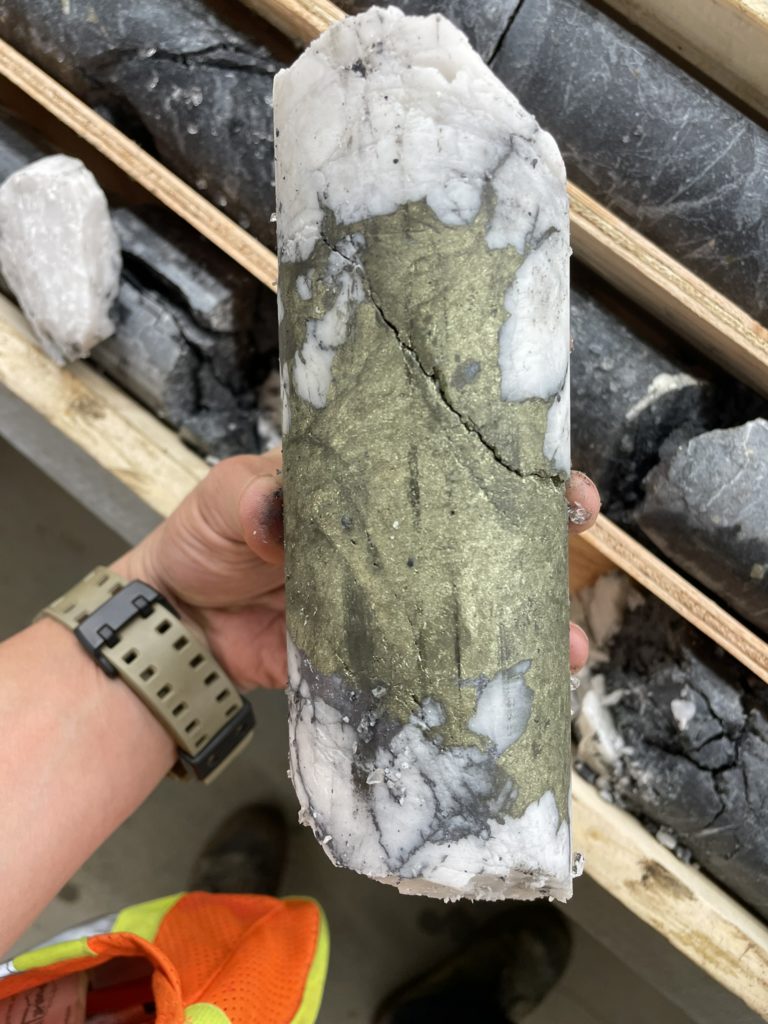
Gold-bearing chalcopyrite-galena-rich vein that occurs close to the Orca Fault. Credit: Spanish Mountain Gold
Studies
Besides prepping for 18 months of feasibility work, Spanish Mountain is also advancing its power studies. The project is now in stage two of BC Hydro’s system impact process for a proposed 230-kilovolt, roughly 60-megawatt grid connection. Mah said that phase is expected to wrap up by the end of March, clearing the way to move into stage three – a key step towards securing power certainty and supporting future project financing.
“We're on track there and already working with BC Hydro on next steps,” Mah said. “They've begun their First Nations and community engagement processes as part of stage two so that’s going well.”
Gold rush
Spanish Mountain has also presented the project’s PEA to local communities and First Nations, building on feedback gathered over the past several years. Mah says the consultation has been constructive, and the company is now working towards a protocol agreement with the Williams Lake First Nation as it advances permitting and project planning.
The company is assessing non-dilutive financing options to fully fund the company through feasibility.
With multiple Cariboo projects now moving through construction and into production, Mah views the district as entering a new stage of consolidation and investment interest.
“We’re going be the third major gold project within a 200 km area in a district that's been sleeping since the Cariboo gold rush in the late 1850s,” Mah said. “This is a new Cariboo Gold Rush, and Spanish Mountain Gold is thrilled to be a part of it.”
The preceding Joint Venture Article is PROMOTED CONTENT sponsored by Spanish Mountain Gold and produced in co-operation with The Northern Miner. Visit: www.spanishmountaingold.com for more information.




Comments