Karen Thompson on Canada’s critical minerals strategy, processing modernization, and workforce challenges
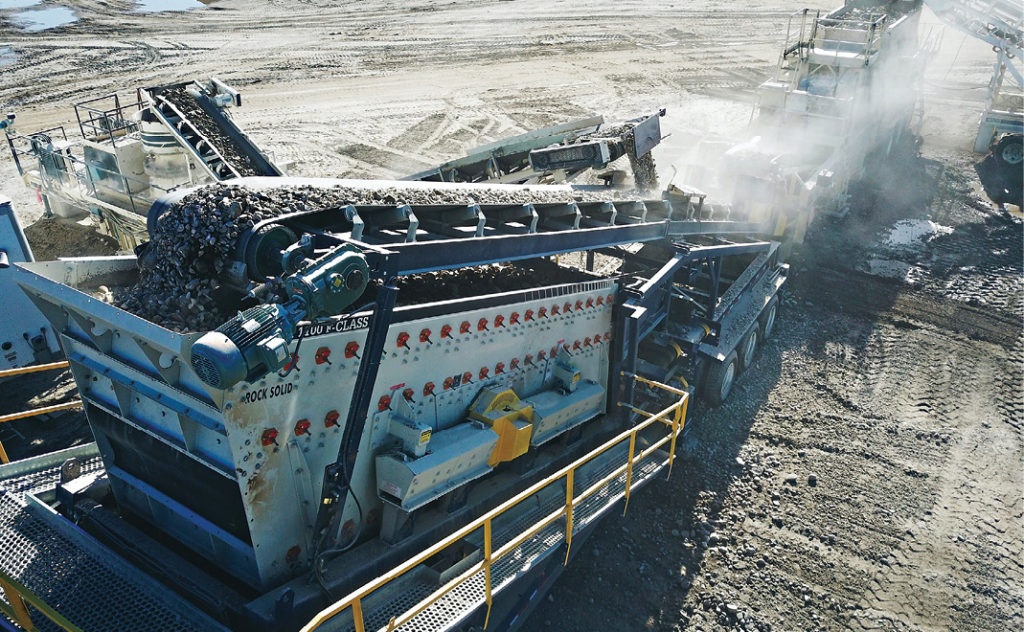
of material that must be recycled through the plant. CREDIT: HAVER & BOECKER NIAGARA
Canada’s critical minerals sector is shifting from policy announcements to real-world execution, but turning strategy into industrial results will depend as much on processing plants and supply chains as on government funding.
In an interview with the Canadian Mining Journal, Karen Thompson (KT), president and CEO of Haver & Boecker Niagara, discusses the practical challenges facing Canada’s mining and mineral processing sector. Those challenges include long permitting timelines, modernization gaps in processing infrastructure, and persistent shortages of skilled workers.
Canada has committed billions of dollars toward developing critical minerals and strengthening supply chains for materials such as lithium, nickel, and rare earth elements (REEs). But Thompson says the next phase of Canada’s strategy will be determined by what happens inside processing plants, equipment supply chains, and workforce training programs.
Turning Canada’s resource potential into reliable industrial output will require faster regulatory processes, plant-level innovation, and stronger workforce development across the mining sector.
CMJ: Canada has moved from policy commitments to funding and execution on critical minerals. From your perspective, what are the biggest gaps between government ambition and what is happening on the plant floor today?
KT: As an equipment manufacturer serving mineral processing operations, we sit within the supply chain rather than the mine development side of the business. Even so, we follow policy discussions very closely because they ultimately shape the projects that move forward.
Initiatives, such as the proposed development of the Ring of Fire in northern Ontario, are certainly areas the industry is watching closely. There is significant potential for Canada to strengthen its position in critical minerals and capture more value from its natural resources.
However, translating policy ambition into operational mines remains a major challenge. The timeline required to move from exploration to mine development is still extremely long.
Our company is often brought into projects during the early engineering stages, which already come after geological studies and feasibility assessments. Even at that point, the process from testing to a mine opening can take anywhere from 15 to 25 years.
If Canada wants to accelerate critical mineral development, governments will likely need to find ways to shorten regulatory timelines and streamline permitting processes. Those delays can create real challenges for companies trying to develop projects.
Commodity markets change over time. When projects take decades to move forward, there is always the risk that prices or demand will shift before a mine reaches production. In some cases that can even change the economic focus of a project after years of work.
CMJ: Processing and equipment modernization are often less visible than new mines but just as important. Where do you see the most urgent opportunities to improve efficiency, reduce emissions, and strengthen competitiveness in Canada’s mineral-processing operations?
KT: Sustainability is now a central focus for mining companies around the world, and Canada is no exception. Many companies operating here are global leaders, and they are under increasing pressure to improve efficiency while reducing environmental impact.
For equipment manufacturers, that means developing technologies that allow mines to process materials more efficiently and reduce waste within the system.
Screening technology, for example, can help separate material more precisely, which reduces the amount of material that must be recycled through the plant. There are also innovations that reduce water consumption by allowing materials to be screened using natural moisture rather than introducing additional water into the process.
Another example is pelletizing technology, which allows fine materials to be formed into pellets. That can reduce emissions later in the supply chain because the material becomes easier to transport and process further downstream.
More broadly, innovation is essential across the industry. Equipment manufacturers and processing partners must continue investing in monitoring technologies, automation, and the integration of artificial intelligence (AI) into processing solutions.
If mines are expected to operate efficiently while meeting stricter environmental standards, the technology supporting those operations must continue to evolve.
CMJ: Workforce readiness is often identified as a major constraint for the mining sector in reports like “Ontario’s Mining Future 2030.” What skills shortages are most acute in processing and equipment operations, and how can industry and educators respond faster?
KT: The shortage of skilled trades is something we see very clearly across the industry. For many years, trades were not emphasized within education systems, and fewer students were encouraged to pursue those career paths.
At the same time, mining continues to struggle with outdated perceptions. Many people still picture traditional underground coal mining when they think of the industry, and that image does not reflect modern operations.
Mining companies could do a better job communicating what the industry looks like today and the kinds of careers it offers. These are well-paid, highly skilled jobs that involve advanced equipment, engineering, and technology.
We also see a gap developing between generations of workers. Historically, many employees developed strong practical skills through years of hands-on work in plants and mines. Today, we see more engineers entering the industry, which is positive, but sometimes there is less hands-on mechanical experience.
Remote mine locations create additional challenges. Many operations are far from major population centres, which can make recruitment more difficult. Fly-in, fly-out work arrangements have been common in mining, but they can make it harder to build a stable workforce, especially for employees with families.
Education will be key to addressing these shortages. Our company supports several Canadian universities with mining programs, and we often see students being recruited before they even graduate.
That level of demand shows just how limited the supply of skilled workers is. If the industry wants to attract more talent, it will need to engage students earlier — even at the high school level — and show them what modern mining careers look like.
CMJ: Canada wants to be a reliable supplier in global critical mineral supply chains, not just a resource exporter. What will it take for domestic processing and manufacturing capacity to scale quickly enough to meet that goal?
KT: Timelines again play an important role. For companies within the supply chain, it can be difficult to determine when to invest in new service hubs or manufacturing capacity to support planned mining projects.
Suppliers must anticipate where new mines will be built and when they will move forward. That requires long-term planning and a certain level of confidence in project timelines.
That said, Canada has significant advantages. With recent global trade disruptions, there is increased interest in strengthening domestic supply chains and supporting local manufacturing.
As a Canadian supplier ourselves, we have always tried to source materials locally when possible. That simplifies supply chains and reduces exposure to exchange-rate fluctuations or international disruptions.
Canada also has strong capabilities in areas such as steel fabrication, engineering, and technical education. Those strengths provide a solid foundation for expanding domestic manufacturing and processing capacity.
Importantly, the development of critical minerals will not happen all at once. These projects typically unfold over many years of engineering and planning. That gradual timeline gives the supply chain time to expand alongside new mining developments.
CMJ: Finally, as one of the few women leading in mining, engineering, and industrial technology, how do you view leadership and culture as factors in modernizing Canada’s resource sector and attracting the next generation of skilled workers?
KT: The industry has changed significantly over the past two decades.
Twenty-five years ago, it was common to attend industry events where I might be one of only one or two women in a room of more than a hundred people. Today, we are seeing much higher participation — perhaps 20% to 25% women in some settings. While that is still a minority, it shows that progress is being made.
Part of that shift is tied to the modernization of mining itself. Automation, digital technologies, and advanced equipment have expanded the types of careers available in the sector.
Mining today involves engineering, environmental science, data analysis, and advanced manufacturing. Those roles appeal to a broader range of professionals than traditional perceptions of mining might suggest.
Ultimately, leadership in this industry is no different than in any other. It is determined by education, skill, attitude, and the desire to contribute to an industry that plays a vital role in the global economy.
Mining will remain essential to the future, particularly as demand grows for the critical minerals required by clean energy technologies. As the sector evolves, it will continue to attract new talent and create opportunities for more diverse leadership. 
To watch the full interview,
visit https://youtu.be/biQHGlDKukU?si=0L_-Wp59P5N1rYqK
Related Posts
Troilus nails down US$850 million for gold-copper mine redevelopment
September 28, 2026
Troilus nails down US$850 million for gold-copper mine redevelopment
Ore sorting tests slice CAPEX for EDM’s Scotia lead-zinc mine by 57%
September 28, 2026
Ore sorting tests slice CAPEX for EDM’s Scotia lead-zinc mine by 57%
Sponsored video: Isometrix says shared data can flag mine risks early
September 28, 2026
Sponsored video: Isometrix says shared data can flag mine risks early

Team TS^2 wins AI4SafeMines student competition
September 28, 2026
Team TS^2 wins AI4SafeMines student competition
Hudbay lifts Snow Lake gold output estimate by 60%
September 28, 2026
Comments