[caption id="attachment_1003732533" align="aligncenter" width="450"]
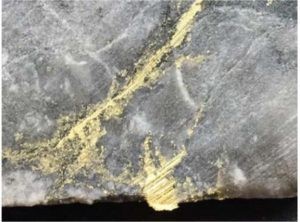
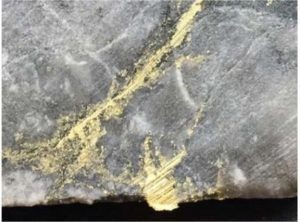 Visible gold in core from the Lynx zone at the Windfall Lake project in Quebec Credit: Osisko Mining
[/caption]
QUEBEC – The latest results from seven holes completed on the Lynx zone at
Osisko Mining’s Windfall project have returned a number of high-grade intercepts.
Drill highlights include:
- 4.6 metres of 1,475 g/t gold from an infill hole at the 313 section of the Lynx zone;
- 2.8 metres of 179 g/t gold; and
- 3 metres of 94.6 g/t gold.
The latest release incorporates work focused on both infilling Lynx as well as expansion of the mineralization.
The Lynx 313 portion remains open down plunge with additional drilling planned to test its extent.
“The recently announced Lynx bulk sample results and our infill drill program are demonstrating the strong continuity of grade inside the known mineralized zones, which remain open down plunge,” John Burzynski, Osisko’s president and CEO said in the release.
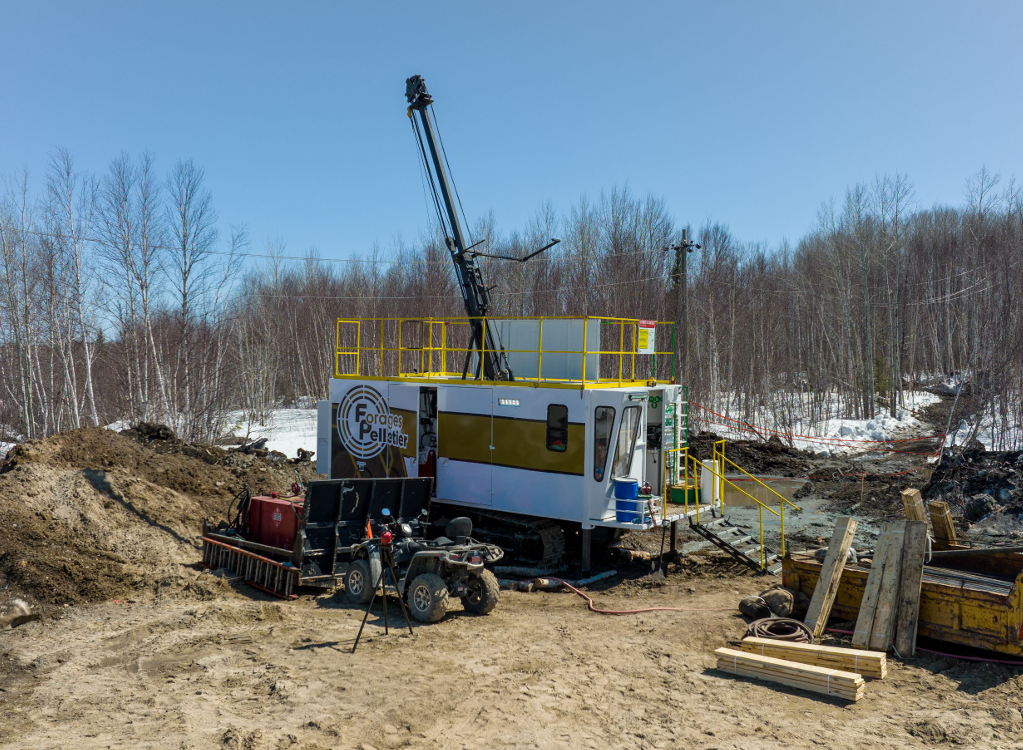
At Windfall, 21 drills are currently working on the Lynx and Triple Lynx zones with a focus on infill, expansion and exploration drilling with an additional three drills working on infilling and expanding other zones.
Bulk sample results released last week from the Lynx 311 zone suggest head grades averaging 17.8 g/t gold.
Current indicated resources at Windfall stand at 2.9 million tonnes grading 8.17 g/t gold for a total of 754,000 oz. with additional inferred resources of 10.4 million tonnes at 7.11 g/t gold for a total of 2.4 million oz. The Lynx zone hosts 1.7 million indicated tonnes grading 8.13 g/t gold and 2 million tonnes in the inferred category at 9.7 g/t gold.
A resource update for Windfall is expected in February, to be followed by a feasibility study.
For more information, visit
www.OsiskoMining.com.


Comments