Saving energy in mine ventilation through thermal balance
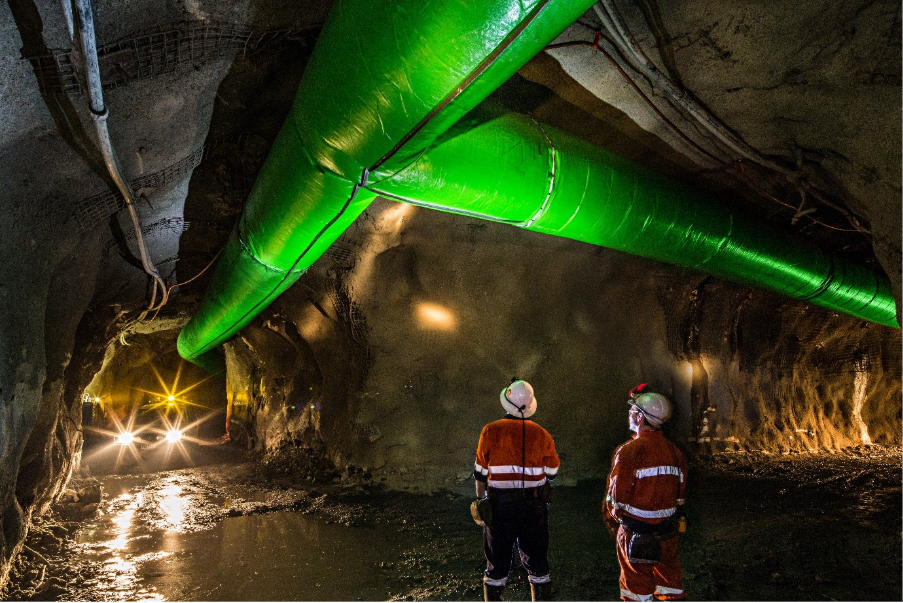
The mining industry has long approached mine ventilation as a cooling challenge, but it is more accurately described as a problem of thermal balance. This distinction is more than semantic — and has major implications for energy consumption, operational efficiency, equipment design and the long-term sustainability of mining operations. Ventilation alone accounts for up to 50% of an underground mine’s total energy consumption, while cooling and refrigeration systems can account for as much as 25% of total electrical energy in deep-level mines. Mining environments are rarely thermally stable.
Deep-level mines generate substantial underground heat from machinery, rock strata and process equipment, creating large cooling demands. Yet, at the same time, surface infrastructure in colder climates may require extensive heating.
In some operations, fossil fuel burners are used to heat intake air volumes reaching one to two million cubic feet per minute. This means mines are often heating and cooling simultaneously across different parts of the same operation.
Two thermal directions
Heating, ventilation and cooling (HVAC) systems on many mines are still designed around a single operating condition, which is usually peak summer cooling. However, mines operate within a constantly changing thermal environment shaped by seasonal shifts, daily temperature swings and fluctuating operational loads.
The thermal envelope that is served by a mining HVAC system is not a single design point. It is a continuously moving target, in two directions; but most installed systems are designed for only one of these directions, creating inefficiencies that significantly increase operating costs.
Inefficiencies within fluid systems compound this problem. Many conventional systems still rely on fixed-speed pumps sized for maximum demand. During part-load operation, these pumps often work against throttled valves, wasting energy and generating excess heat.
In underground environments, excess heat from inefficient pumping directly increases ventilation demand. That, in turn, increases auxiliary power consumption across the facility. So, thermal inefficiency does not remain isolated within the HVAC system — it propagates.
Orchestrated system
The answer lies therefore not just in improving isolated pieces of equipment, but in orchestrating the thermal system as a whole — through intelligent control architecture. The optimal approach focuses on integrating control architecture across cooling towers, chillers, pumps and process loads — to create a continuously adaptive thermal management system.
Rather than allowing each subsystem to function independently, our solutions coordinate the entire thermal network in real time. Armstrong’s System Envelope (SE) platform, for example, optimizes the performance of cooling equipment by using demand-based algorithms and parallel sensorless technology. The system aligns cooling tower operation with changing ambient wet-bulb conditions rather than relying on fixed operating schedules.
The result is continuous adjustment rather than periodic correction. This helps prevent the common failure mode of over-cooling during mild conditions and under-cooling during peak demand. The Envelope platform operates as a plant-wide orchestration layer, coordinating chillers, cooling towers, pumps and process systems into a unified thermal management architecture.
Importantly, this platform is designed to integrate with equipment from multiple manufacturers; it is not limited to a fully proprietary Armstrong installation.
Real-time tracking
Within this system, fluid management station (FMS) dynamically manages fluid flow and pressure while providing real-time performance verification, lifecycle tracking and predictive analytics. This creates a closed-loop thermal control system capable of adapting efficiently across seasonal and operational transitions.
Another area where we see opportunity for mines to drive efficiency is in reconsidering redundancy design philosophies within mine HVAC systems. Traditionally, mines ensure reliability through standby capacity — having additional pumps or cooling tower cells held in reserve for failure scenarios.
While this approach is dependable, it introduces significant capital costs and embodied carbon through idle infrastructure. Armstrong’s Design Envelope philosophy instead distributes loads dynamically across active equipment, embedding resilience directly into the operating architecture.
This allows energy savings of up to 75% compared with traditional constant-speed installations. The system accommodates fluctuating demand and seasonal transitions without switching to standby units, as it is designed to absorb variation.
For mining operations facing rising energy costs and increasing pressure to improve sustainability performance, the implications are significant. Thermal management can play a role as a strategic operational asset rather than merely a utility service.

Divyanshu Shrivastava is global product manager at Armstrong Industrial. For more information visit https://armstrongfluidtechnology.com/en/armstrongindustrial.
Related Posts

NVRO Metals closes $35M private placement, plans Northern Territories acquisition
Sponsored: CAUR aims to take guesswork out of deep drilling
November 11, 2026
Sponsored: CAUR aims to take guesswork out of deep drilling
Carbonix, SGS partner on lower-emission iron testing
November 11, 2026
Carbonix, SGS partner on lower-emission iron testing
ACEC recognizes two BBA projects with national awards
November 11, 2026
ACEC recognizes two BBA projects with national awards

Altius to buy TNR Gold in $122-million royalty deal
November 11, 2026
Comments