Smoothing the peaks: How large-scale BESS is redefining mine energy economics
The modern mining operation is caught in a structural tightrope walk. On one hand, operators face deep foundational mandates to reduce carbon footprints and align with aggressive ESG metrics. On the other hand, the physical realities of extraction, processing, and crushing demand immense, unyielding, and frequently volatile amounts of electrical power.
Whether drawing power from an overburdened provincial grid or operating on an isolated island microgrid reliant on heavy fuel oil, mines are highly sensitive to power delivery structures. As electrification sweeps across mine sites — from hauling fleets to ventilation systems — the strain on energy infrastructure is compounding.
Historically, mining operations managed these power spikes by over-specifying local generating capacity or absorbing massive Global Adjustment and demand charges. However, that option is becoming increasingly difficult with the exponential growing energy demand across industries.
Today, the rapid maturation of large-scale battery energy storage systems (BESS) coupled with advanced, real-time energy management systems (EMS) introduces a highly sophisticated technical alternative. By integrating utility-scale stationary storage, mines can shift from passive energy consumers to active grid participants, optimizing the three core pillars of modern industrial energy management: peak shaving, load shifting, and demand response.
1. Peak shaving and flattening the demand curve
Mining is inherently a business of transient, heavy loads. The starting of massive sag mills, the simultaneous activation of deep-well hoisting mechanisms, or the sudden ramp-up of crushing circuits cause momentary but extreme spikes in power demand.
For grid-tied mines across Canada — particularly in jurisdictions like Ontario with stringent peak-demand pricing or Alberta and B.C. with high demand-charge thresholds — these transient peaks dictate utility billing for months or even years. For remote mines, these spikes require keeping secondary and tertiary diesel gensets spinning on hot standby, consuming fuel and generating emissions purely to handle a brief surge.
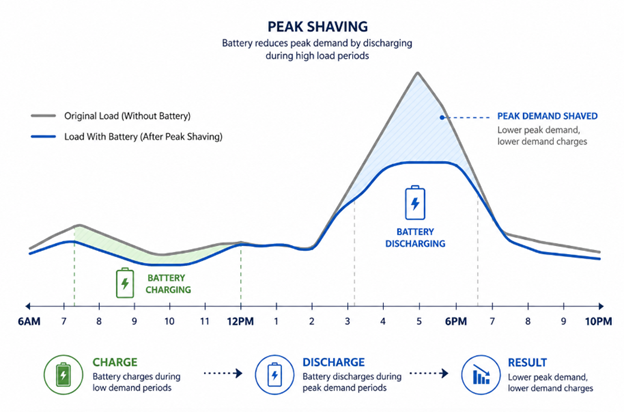
Large-scale BESS provides a buffer against this volatility. Controlled by an EMS running low-latency monitoring loops, the system tracks real-time power draw down to the millisecond, understanding exactly when to supply energy to support on-side demand. When mill operations push total consumption past a predetermined financial or physical threshold, the BESS instantly discharges behind-the-meter energy. It effectively “shaves” the peak.
Credit: Generated by Polaron Energy via ChatGPT
By satisfying the brief, intense surges with stored battery energy rather than drawing from the utility or starting an idle generator, the mine drops its peak demand profile. The financial return is direct and substantial, immediately reducing the fixed demand penalties that inflate industrial utility bills.
2. Load shifting to capitalize on the clock
Electricity pricing is fundamentally cyclical. Under time-of-use (TOU) tariffs or volatile wholesale market dynamics, the cost of a kilowatt-hour can fluctuate dramatically over a 24-hour window. Compounding this is the variable nature of co-located renewable assets; solar arrays and wind turbines produce energy based on atmospheric conditions, which may not line up with a mine’s milling schedule.
Load shifting utilizes the scalable capacity of a BESS to decouple the “generation” of electricity from its “consumption.”
During off-peak hours — typically overnight when grid demand is low and electricity is cheap, or during midday periods of intense solar abundance — the EMS directs power into the storage array. When the grid enters peak pricing windows or when renewable generation dips, the battery system takes over the site’s base load or auxiliary operations.
For a mine, this means energy-intensive processes like tailing pumps or secondary processing can effectively run on inexpensive, stored power, maximizing the internal rate of return on renewable assets and shielding the bottom line from volatile daily energy markets.
3. Demand response: Generating revenue from versatility
Beyond internal cost mitigation, large-scale energy storage transforms a mine asset into a valuable grid stabilizing tool. Provincial system operators constantly struggle to maintain grid equilibrium amidst extreme weather events and an increasingly decentralized energy mix. To combat this, they offer lucrative financial incentives through demand response (DR) programs, paying large industrial users to shed load on short notice.
Historically, participating in DR meant halting production — a non-starter for operations where hourly downtime is measured in hundreds of thousands of dollars.
A commercial BESS completely alters this equation. When a provincial grid operator triggers a DR event, the intelligent EMS reacts autonomously. Instead of shutting down operations, the mine seamlessly transitions a significant portion of its grid draw to the battery array. The utility sees a major drop in grid demand, the mine receives substantial capacity payments from the system operator, and the mill continues to grind uninterrupted.
Engineered for the harshest environments
Advocating for large-scale energy storage within the mining sector requires acknowledging the rugged parameters of the job site. Industrial BESS architecture has advanced well beyond standard commercial enclosures. Modern units deploy precision liquid-cooling systems and advanced thermal management capable of keeping cell temperature differentials tight (often within 5°C), ensuring stable, repeatable performance whether operating in sub-zero northern winters or high-temperature summer environments.
Furthermore, integrating multi-protocol communication structures (such as Modbus-TCP, IEC104, and MQTT) allows these systems to mesh seamlessly into pre-existing mine SCADA infrastructures. Safety protocols have similarly matured, featuring multi-tiered sensor arrays, explosion prevention mechanisms, and localized fire suppression built directly into modular, scalable enclosures.
Battery storage system’s solidifying role in mining
Energy is becoming a concerningly dynamic variable that needs to be managed and optimized. As the Canadian mining landscape navigates the complexities of electrification and carbon accounting, relying solely on traditional power infrastructure introduces an unnecessary layer of financial exposure.
Large-scale battery energy storage systems offer the precise operational flexibility that modern mines require. By smoothing out peak demand, shifting loads to optimal financial windows, and monetizing grid interaction via demand response, a robust BESS deployment converts energy infrastructure from a major operational expense into a strategic, resilient advantage.
Tony Moore is the director of commercial sales at Polaron Energy.
Comments