The sacred story of minerals
What have you done today that did not involve a mineral? Part 8
The basis of life on Earth depends on minerals, which reinforces our ongoing theme: “What have you done today that did not involve a mineral?” Minerals form over immense spans of time, because Earth does not follow our daily clock. Its history is written in rock layers that record a story stretching back four billion years. Geologic time is organized into eons, eras, periods, and epochs, each marked by major shifts such as the formation of the first crust, the rise of oxygen, mass extinctions, and the appearance of complex life. Understanding this deep timeline helps us appreciate the order of Earth’s evolution. It also sets the stage for considering how minerals connect to broader human perspectives, including the roles of scientists, people of faith, and stewards of the planet.
From a mineral perspective, Earth’s story is not linear. Minerals follow life cycles that moves from formation to alteration to reintegration within the Earth system. This progression reflects the staged evolution described by Downing and Beneteau (Canadian Mining Journal, 2025, several articles in this series), where human understandings of minerals develop from denial to integration. Extending this idea, similar progressions can be traced in religious traditions and cultural interpretations of minerals.
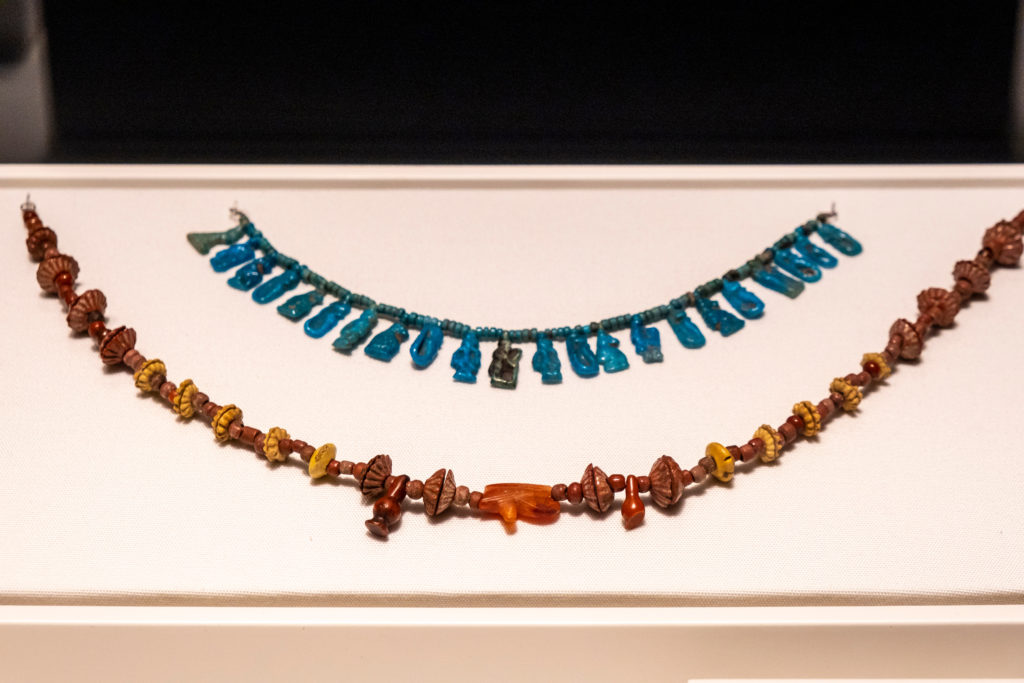
Across world cultures, minerals have long carried spiritual, symbolic, and practical roles. Gemstones, crystals, and ores have been used for trade, pigments, ritual objects, adornment, healing practices, spiritual connection, tools, and weapons. By the time the Bible was written more than 2000 years ago, extensive trade networks were already well-established, and minerals played active roles in daily life, ritual practice, and symbolism. The concept of birthstones, associated with each month of the year, further illustrates how minerals accumulated layers of personal and cultural meaning over time. Many scholars trace the idea of birthstones back to the Breastplate of Aaron, described in Exodus 28, which held 12 gemstones representing the tribes of Israel.
The Bible reflects the importance of elements, minerals, and rock. According to the article “Minerals & Metals in the Bible” from Rockngem.com, minerals and metals appear more than 1,700 times. Gold alone is referenced more than 400 times, along with mentions of elements such as silver, lead, copper, iron, and tin. Mineral references include alabaster, soapstone, brimstone (sulfur), limestone, salt, pitch, natron, clay, salt, and and a wide range of gemstones such as onyx, beryl, jasper, and carnelian. In Matthew 16:18, Simon is nicknamed Peter (translated into French as Pierre, meaning “stone”), and Jesus states, “and on this rock I will build my church.” In a Youtube video by Got Questions Ministries that explains Matthew 16:18, it is stated that Christ is the life-giving rock. In 1 Peter 2:6-7, Christ is referred to as the chief cornerstone.
Another well-known mineral reference is the story of Lot’s wife in Genesis 19:26, who was turned into a pillar of salt after looking back at the destruction of Sodom. Salt, the mineral halite, already carried strong symbolic meaning in the ancient world, representing preservation, purity, and covenant, but in this narrative, it also becomes a symbol of judgment and consequence. The larger account, described in Genesis 19:23–25, explains that Sodom and Gomorrah were destroyed together by fire and brimstone, meaning burning sulfur. This account of salt and sulfur shows how earth materials appeared in scripture to communicate themes of warning and moral responsibility. It further shows how minerals were used in scripture to convey cultural values and connect human experience to earth materials.
Biblical explanations for the presence of minerals often point to divine provision: God created minerals and metals as resources for human life. The creation story itself reinforces this connection, describing how God formed Adam from the dust or clay of the ground, linking human origin directly to Earth materials. Minerals also appear in narratives of worship and celebration. The gifts presented to Jesus at his birth, including gold and frankincense, were Earth-derived materials that had both symbolic and monetary value. These early references show how minerals have long served both practical and spiritual purposes in Judeo-Christian traditions.
Building on this idea of spiritual meaning, the Quran also highlights metals and minerals, not only as materials but as signs of Allah’s power and generosity. Iron, gold, silver, copper, pearls, and rubies are highlighted for their utility, beauty, and symbolic significance. They serve as reminders of provision and gratitude. This parallel reinforces how minerals function across faiths as markers of divine care and human dependence.
Moving beyond written scripture, Indigenous traditions, often transmitted through oral histories rather than written texts, also show strong relationships with minerals. Minerals and hence rocks appear in ceremonies, tools, pigments, clothing, and cultural objects, reflecting both practical and spiritual identity. These examples illustrate that mineral symbolism is not limited to major world religions but is woven throughout human culture. In many Indigenous cultures, rocks are revered as living, animate beings, often called “Grandfathers” or ancestors as they are considered the oldest, wisest, and most enduring elements of the Earth, holding memories, stories, and the spirits of those who came before. Rocks tell stories.
These cultural connections lead naturally to a comparison between theology and geology. The word theology comes from the Greek theos, meaning God, and logos, meaning word or rational thought. Geology comes from geo, meaning Earth, combined with the same root. Both fields explore origins, meaning, and creation, one through spiritual narrative and the other through physical evidence. Recognizing this shared interest in beginnings helps bridge scientific and religious ways of understanding minerals.
Theology is traditionally defined as the study of religious belief, divinity, and the history of religion. By analogy, a theology of the Earth can be seen as the study of geological concepts from the perspective of minerals, their formation, and their histories. A theology of minerals, therefore, involves examining their formation, identification, alteration, and processing, as well as the rules for naming and recognizing new mineral species. This analogy provides a structured way to link geological processes with theological categories.
This framework can be organized into the following four types of mineral theology that parallel classic categories of biblical theology:
1. Biblical Theology: The study of minerals and rocks as they appear in sacred texts and the roles they hold in religious contexts.
2. Historical Theology: The examination of how minerals formed and evolved through time, and how humans have used and interpreted them.
3. Systematic Theology: The naming and classification of minerals follow conventions like the naming of religious orders. Mineral names often use Greek or Latin roots or descriptive terms, and are based on chemical composition, crystal structure, and physical properties, such as hardness and color. Rock naming conventions also reflect mineralogy and chemistry. No known minerals are named after biblical figures.
4. Practical Theology: The processing of minerals and refining of minerals to extract elements essential for humanitarian, technological, and sustainable uses.
Viewed together, these forms of mineral theology show how minerals and rocks carry different meanings depending on cultural or religious tradition. In the Bible, rock imagery symbolizes refuge and stability. Psalm 62:7 states, “My salvation and my honour depend on God; he is my mighty rock, my refuge.” Many world religions and cultures use minerals in similar symbolic ways. Hindu traditions associate gemstones with deities such as Kubera. Christianity and Judaism use minerals symbolically while cautioning against using crystals for superstition. Islam values gemstones like carnelian for their protective symbolism. Buddhism uses gemstones in prayer beads and sacred relics. Ancient civilizations, such as the Mayans, Egyptians, Greeks, and Romans incorporated crystals in rituals, amulets, and burials. Mining communities around the world have developed belief systems centered on underground spirits and Earth deities. Stone monuments such as Stonehenge, the Easter Island statues, and the pyramids reflect deep spiritual and cultural connections to rock. Even the Ten Commandments are described as carved on stone tablets.
Although geology and religion operate on very different timescales, they have influenced one another. Many early geologists, including William Buckland and Adam Sedgwick, were clergy members who sought to reconcile observations preserved in rock with spiritual understandings of creation. Their work highlights how scientific inquiry and religious interpretation have often developed in dialogue rather than in conflict.
Minerals originate from the arrangement of elements in magma as well as through metamorphism, evaporation, biological activity, and other Earth processes. These origins can be compared, metaphorically, to doctrines of creation found in many faith traditions. Laboratory-created minerals such as synthetic diamonds add a modern parallel to secular or non-theological interpretations of creation. Together, these perspectives show how the concept of creation, whether sacred or scientific, is deeply tied to the materials of the Earth.
Together, these ideas build the foundation for a religion and theology of minerals, grounded in the continuing question: What have you done today that did not involve a mineral? 
Bruce Downing is a geoscientist based in Langley, B.C. Donna Beneteau is an associate professor in geological engineering at the University of Saskatchewan. The authors thank Carmen Huggins, a retired chaplain, for generously providing guidance and perspective.
Comments