Flush with a recent A$350 million ($246 million) investment, Arafura Rare Earths (ASX: ARU) is looking to a September construction start at its Nolans mine in Australia’s Northern Territory that would position it as the country’s first vertically integrated rare earths complex.
The May decision to start building the $1.23-billion-capex project came the same month its total equity financing reached $887 million, while Arafura said it also met its 80% contracted offtake target. It signed 500 tonne-per-year agreements with Australia’s Critical Mineral Strategic Reserve (CMSR) and metals supplier Traxys North America. Arafura had previously raised about $1 billion in debt from nine domestic and international lenders. Nolans is about 1,140 km southeast of Darwin.
“Arafura is excited to be in a position to deliver Australia’s first fully integrated rare earths mine and refinery,” Managing Director and CEO Darryl Cuzzubbo told The Northern Miner in a video call this week. “We have deliberately pursued the ore-to-oxide model as a point of differentiation.”
Arafura’s production milestone could make it the first rare earths mine in Australia where the ore is mined, processed and separated on site, marking a major step towards a domestic mine-to-oxide supply chain. The company’s efforts come as Western countries continue working to build rare earth supply chains outside the control of China, which dominates the mining and processing of the metals.
Expected to start production in 2029, Nolans has a post-tax net present value of $1.73 billion and an internal rate of return of 17.2%, according to Arafura's July 2024 updated project economics, released as part of its debt financing package. The mine could produce 4,440 tonnes of neodymium-praseodymium (NdPr) oxide annually as well as heavy rare earths and phosphoric acid over a 38-year operating life. Its output could represent about 4% of the world’s NdPr.
Global oxide trio
Nolans could become one of few mines outside China producing an oxide instead of a concentrate or carbonate, which requires a final processing step to eliminate radiation from thorium and uranium, Cuzzubbo said. The others are MP Materials’ (NYSE: MP) Mountain Pass mine in California and Lynas Rare Earths’ (ASX: LYC) Mount Weld in Western Australia.
While Lynas has higher production capacity than Nolans, its rare earths are processed and separated at the company’s facility in Malaysia. Mastering the processing and separation steps remains one of the largest challenges facing the West’s efforts to catch up with China’s lead.
“We go a step further so we can be an alternative supply chain to China,” he said. “Other projects have an issue with not being able to bypass China as they still need processing capability which is largely there, and they can only send it to a country that can receive, process, and dispose of radioactive waste.”
Arafura will be building its oxide processing plant as part of stage one construction this fall. That facility and its related infrastructure represent 90% of Nolans’ total cost, Cuzzubbo said, underscoring how the economics of rare earth projects are driven more by the costly chemical processing and separation requirements to produce market-ready oxides than they are by mining.
“The inclusion of on-site downstream processing is a key reason the Australian government has supported the project,” Cuzzubbo added.
Significant tailwind
Nolans received a boost earlier this month from Australia’s Significant Project framework, which empowers a Territory Coordinator to shepherd strategic projects through the regulatory approvals during construction and expansion. The status assists with secondary approvals needed by Arafura and covers future development at the site.
“We also need potential service providers to build out infrastructure,” Cuzzubbo said, such as doubling the container capacity at the Darwin Port. “They need to get approvals and all that needs to be done in the next three years before we go into operation. So that Project of Significance applies to them as well.”
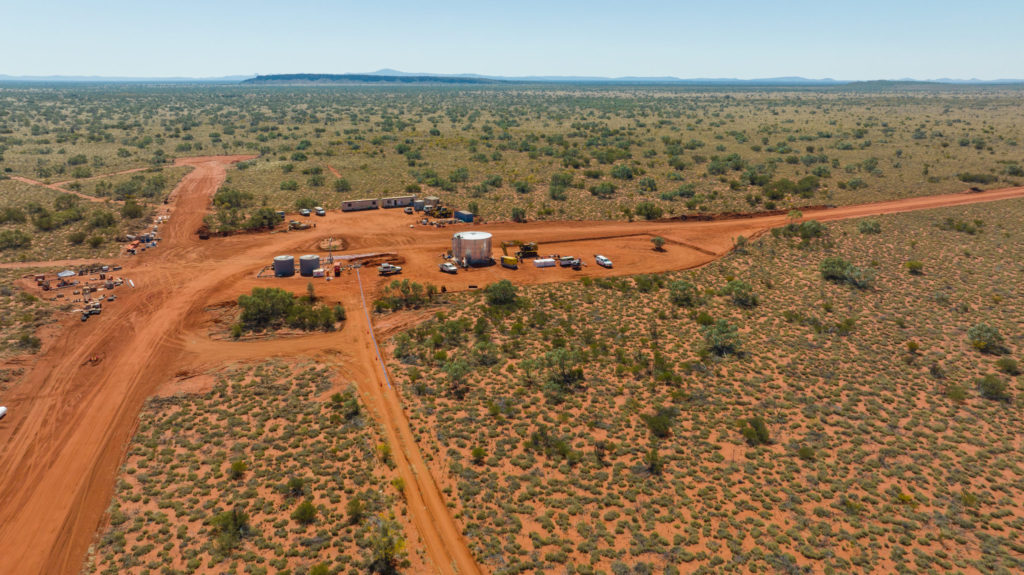
Arafura has already started recommissioning Nolans’ onsite camp and water lines and upgrading the roads in preparation for construction, Cuzzubbo said. The company aims to start ramping up commercial production in late 2029.
Australian billionaire Gina Rinehart’s Hancock Prospecting is Arafura’s largest shareholder, with a 17.5% stake. After providing A$125 million in Arafura’s A$481 million financing in late 2025, Hancock chipped in A$85 million of the company’s May A$350 million equity raise.
Nolans’ equity financing will be wrapped up with A$430 million in binding equity commitments from the German Raw Materials Fund, Export Finance Australia and the National Reconstruction Fund Corporation, once approved at its shareholder meeting early next month.
Arafura secured its $1.01 billion in debt financing in 2024 with loans and guarantees from international lenders in Australia, Canada, Germany, Singapore and Korea.
Korean, German offtakes
Arafura has signed 1,500 tonnes per year in offtake deals for its NdPr oxide with automakers Hyundai and Kia in South Korea, 520 tonnes per year with wind turbine manufacturer Siemens Gamesa RE in Germany, and 300 tonnes and 500 tonnes per year with Traxys’ European and North American operations, respectively. In addition to the recent offtake agreement with Australia’s CMSR, Arafura is in final negotiations with German offtakers for 250 tonnes to 500 tonnes per year.
“It is probably going to take towards the back end of this year before that concludes,” said Cuzzubbo of the discussions with German manufacturers. “We’re working with multiple layers of the supply chain to get agreement on pricing for rare earths and pricing for magnet manufacturing. Europe is building an alternative supply chain and they’re doing it physically and commercially at the same time, and it is quite iterative.”
If Arafura secures an the 500-tonne German offtake agreement currently under negotiation, contracted volumes would rise to 3,820 tonnes per year.
Cuzzubbo said Nolans’ contracts with Australia’s CMSR and Traxys North America do not include price floors and are instead pinned to a rare earth index that excludes China’s domestic pricing, like those recently established by Benchmark Minerals Intelligence and S&P Global’s Platts North America.
The move is part of a broader Arafura campaign against price floors and in favour of producers and buyers outside China moving to the newer indices, in the hope of establishing transparent market prices.
“The reason we at Arafura can prosecute this argument is we’re at the bottom of the cost curve because of the phosphoric acid,” Cuzzubbo said. “We want price floors but we don’t really need it.”
That approach contrasts with U.S. government support for MP Materials, where last summer a government-backed pricing mechanism was introduced to encourage domestic rare earth production.
Phosphoric acid leverage
Nolans cost profile ranks it in the global first quartile, or among the lowest by expenditures, in part due to its byproducts. Arafura aims to produce 144,000 tonnes annually of fertilizer-grade phosphoric acid. Its feasibility study assumed Arafura would sell merchant-grade acid into the fertilizer market. The company has established pricing benchmarks with India’s sector, where it could sell the acid, Cuzzubbo said.
“That’s what we assumed but that was never the plan,” he said.
The phosphoric acid produced at Nolans will be much higher purity than is typically sold for fertilizer, Cuzzubbo said. However, it isn’t quite high enough grade for lithium-ion phosphate (LFP) batteries, another key end use.
“We would like to engage with LFP battery manufacturers to see if any of those parties would do that additional processing so they can secure a non-China phosphoric acid for LFP batteries,” he said. “This will get us a better price and we haven’t assumed it in the economics.”
Heavy bonus
Arafura also plans to produce 573 tonnes per year of samarium-europium-gadolinium/heavy rare earth oxide at Nolans, containing about 25 tonnes of dysprosium oxide and 8 tonnes of terbium oxide. Those heavy rare earths are used in wind turbines, electronics and defence applications. While its output would be much smaller than Lynas’, Nolans could become one of only a handful of non-Chinese sources of dysprosium and terbium.
“At the moment, we predominantly produce light rare earths – NdPr – there’s more we can do,” said Cuzzubbo. “Heavy rare earths pricing has gone through the roof with magnet manufacturing moving out of China.”
Magnet manufacturing outside China requires more heavy rare earths because the manufacturing technology differs, Cuzzubbo said. Following its final investment decision (FID), Arafura is advancing a separate project that aims to begin processing additional heavy rare earth products when its NdPr oxide goes into production at the end of 2029.
Arafura received a non-binding letter of intent in October under which the U.S. Export-Import Bank may provide up to $300 million in financing for the heavy rare earths separation project. Cuzzubbo described the capital need of this project as relatively minor compared to Nolans’ oxide mine and processing plant.
Huge expansion plan
Arafura’s FID also opens a path to prefeasibility study work on a stage two expansion of the Nolans oxide project, under which the company aims to more than double annual NdPr output to 10,000 tonnes.
Arafura plans to complete the prefeasibility study early next year and to obtain necessary environmental and other approvals by the time stage one enters operation. Arafura would then build a stage two expansion plant while stage one generates revenue.
Company shares gained almost 2% to A$0.28 on Monday in Sydney, giving the company a market capitalization of A$1.4 billion. The stock has traded between A$0.16 and A$0.62 over the past 12 months.
Comments