Chile's copper production is heading for its lowest level in 23 years as declining ore grades and operational setbacks constrain output, while volatile sulfuric acid prices and growing import dependence add pressure to the world's largest copper-producing nation, according to industry studies.
Output is expected to fall 6.6% to 5.034 million tonnes in 2026, a loss of 354,000 tonnes from last year, Plusmining mining industry analyst Juan José Pardo estimates. That would mark Chile's weakest performance since 2003, when production totalled 4.904 million tonnes, and leave it nearly 800,000 tonnes below its 2018 peak.
Compounding the production challenges, sulfuric acid imports reached a record 3.97 million tonnes in 2025, supplying roughly half of national consumption, the Chilean Copper Commission (Cochilco) said on Tuesday. China accounted for 37% of those imports before restricting exports in May 2026, GEM Mining Consulting project manager Paulina Cáceres said in a separate study.
The findings highlight a vulnerability in Chile's mining industry: reduced smelting activity is cutting domestic acid supplies just as ageing copper operations require substantial investment to sustain production. The combination threatens the competitiveness of leaching operations and adds uncertainty to the country's planned recovery.
Ageing mines
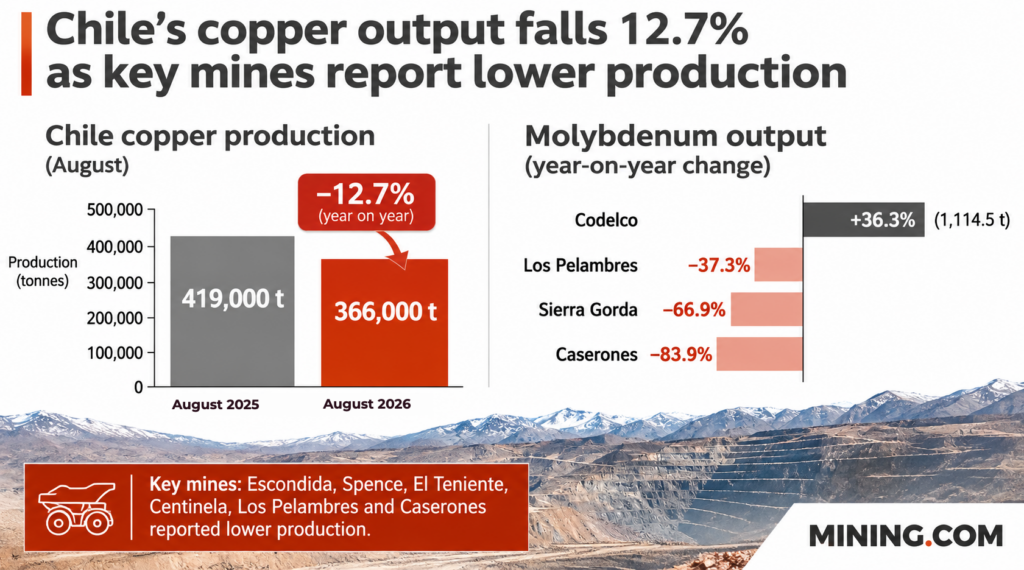
Chile's copper production fell 12.7% year on year to 366,000 tonnes in August, reflecting weaker ore grades, operational disruptions and adverse weather, according to Plusmining.
Escondida and Spence led the declines, while El Teniente continued to contend with the aftermath of a 2025 rockburst. Centinela also reported weaker production, and heavy snowfall disrupted operations at Los Pelambres and Caserones in July.
Performance was similarly uneven in molybdenum, a byproduct of copper mining. State-owned Codelco produced 1,114.5 tonnes of contained molybdenum in September, up 36.3% year on year, according to Cochilco. In contrast, output plunged 83.9% at Caserones, 66.9% at Sierra Gorda and 37.3% at Los Pelambres, highlighting divergent production trends across major operations.
Beyond the recent disruptions, Chile faces a longer-term problem. Mines and expansions commissioned since 2003, including Ministro Hales, Gabriela Mistral, Spence, Caserones, Sierra Gorda and Antucoya, contributed about 1.33 million tonnes of copper in 2025. Much of that capacity, however, has offset losses at older operations rather than delivered sustained national growth.
As deposits mature, miners must process more ore to recover the same amount of copper, increasing energy consumption, equipment demands and costs. Deeper mining also brings longer haulage distances and more complex geotechnical conditions.
Plusmining expects output to recover by roughly 250,000 tonnes in 2027 and potentially exceed 6 million tonnes by 2032, provided planned investments proceed and existing operations meet production expectations.
Mining projects submitted to Chile's Environmental Impact Assessment System through October represented more than $25 billion in proposed investment, an annual record. However, approvals, financing and construction must follow before those proposals translate into additional supply.
Much of the anticipated growth depends on brownfield developments, including Centinela's second concentrator, the El Abra concentrator, RT Sulphides II and the reopening of Cerro Colorado.
Other investments, such as Escondida's planned replacement concentrator, are intended primarily to preserve existing capacity. Greenfield projects, including Santo Domingo, Vizcachitas, Costa Fuego and Marimaca, could add new production centres but account for a smaller share of the investment pipeline.
Acid dependence grows
Chile's domestic sulfuric acid production fell 17.2% to 3.92 million tonnes in 2025, its lowest level since 2002, according to Cochilco. The closure of Ventanas, suspension of Paipote, shutdown of Potrerillos and disruptions at El Teniente left smelters operating at approximately 60% of capacity on average.
Smelters generate sulfuric acid by capturing gases during copper processing. Reduced activity therefore limits supplies for leaching and solvent extraction-electrowinning (SX-EW), which produce about 21% of Chilean copper but consume approximately 88% of the country's acid, according to GEM's calculations using Cochilco data.
GEM estimates that copper production proportionally exposed to imported acid represents roughly 11% of national output, including about 4% exposed to Chinese supply. The calculation allocates acid origins proportionally rather than identifying the actual suppliers serving individual mines.
Supply risks intensified after Ukrainian attacks disrupted Russian sulfur production in 2025 and the Strait of Hormuz closed in March 2026, interrupting a route handling nearly half of global seaborne sulfur trade.
Spot sulfuric acid prices in Chile climbed from approximately $190 per tonne in late February to $485 by mid-June, according to Plusmining. They subsequently retreated to around $340 in early November as demand weakened and supply conditions improved.
The price surge significantly increased costs for leaching operations. Using Chile's 2023 average acid consumption intensity, GEM estimates the input cost rose from $0.42 per lb. of SX-EW copper at the 2025 average import price to $0.73 at July 2026 prices, a 74% increase.
Exposure varies considerably between mines. Acid consumption ranges from 0.78 to 22.4 tonnes per tonne of cathode, according to Cochilco, making some operations far more sensitive to price increases than others.
Capstone responded by prioritizing sulphide processing and reducing leaching at Mantoverde, cutting its projected acid requirements for 2026 by approximately 200,000 tonnes.
Recent price relief has come partly from weaker demand in the fertilizer industry, which accounts for nearly 60% of global sulfuric acid consumption. Higher phosphate fertilizer costs have encouraged producers to adjust output and agricultural users to reconsider nutrient applications.
Supply conditions also improved following the partial reopening of the Strait of Hormuz under an interim US–Iran agreement on June 15. China permitted limited exports despite maintaining restrictions, including approximately 32,000 tonnes shipped to Chile in September.
Nevertheless, Cochilco projects sulfuric acid consumption by copper mining will rise from 6.9 million tonnes in 2025 to 7.9 million tonnes in 2027, an increase of about 15%.
If domestic production remains at its 2025 level, GEM calculates that the gap between national acid output and mining consumption alone could reach approximately 4 million tonnes by 2027. The estimate is illustrative rather than an official forecast.

Comments