By Northern Miner Staff
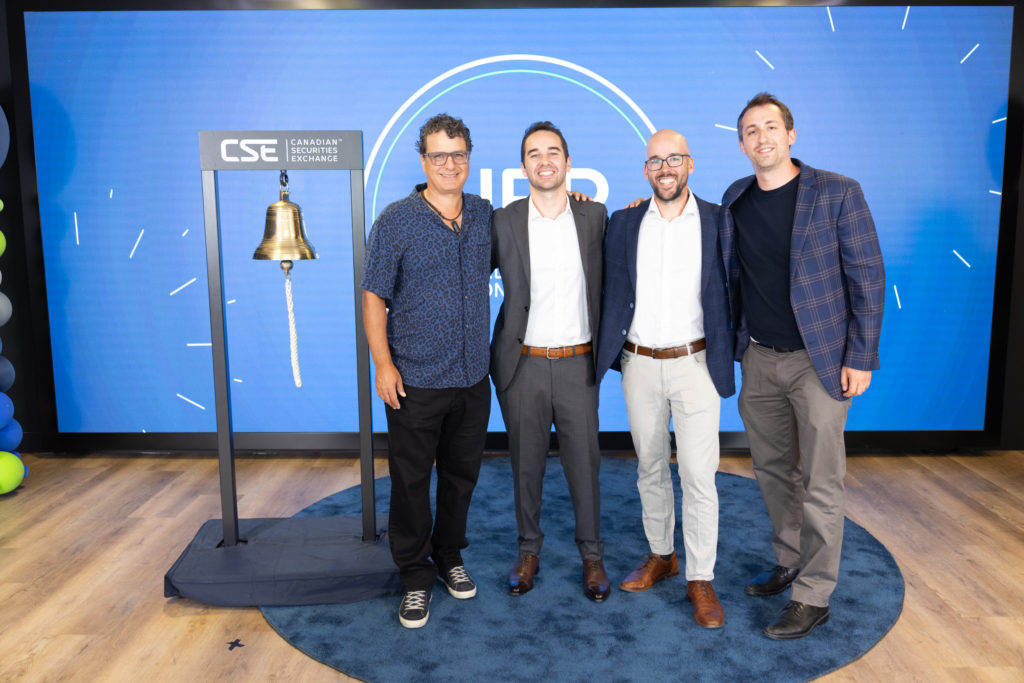
Junior explorer Libra Energy Materials (CSE: LIBR) opened the bell for the first time on Aug. 7, after kicking off its 2025 field season alongside KoBold Metals, a privately held U.S. AI-driven mining and exploration company backed by technology investors including Bill Gates, Jeff Bezos and Silicon Valley venture capital firm Andreessen Horowitz.
The KoBold-backed program, which started in June and focuses on three Ontario lithium projects, positions Libra to scale into a major player in the emerging lithium sector. Under the earn-in agreement, KoBold can earn a 75% interest in the properties – Flanders North, Flanders South, and Soules Bay-Caron (SBC) properties near Thunder Bay – by funding up to CAD$33 million in exploration over six years. Libra also maintains its own portfolio of projects that are not subject to the KoBold earn-in.
“When you look at the big lithium players today, a lot of them quickly went from junior to major lithium producers within a 10-year time horizon, which does not happen in gold or copper,” Koby Kushner, CEO of Libra, said in an interview. “It’s easy to dream big in lithium. Consider that most existing lithium deposits were found by accident; there’s been minimal concerted effort to go out and make new discoveries until recently. By the time a lot of the existing deposits go into construction decision, we think there will be better discoveries made closer to infrastructure, and we plan to be on top of that.”
The exploration program includes expanded geochemical work across regional targets, rock chip sampling, and detailed geological mapping to delineate new lithium-bearing pegmatites. KoBold has also deployed its proprietary HyperPod drone-based geophysics system over the Flanders North and South properties, collecting high-resolution data to support advanced subsurface modelling and target generation.
Kushner believes the collaboration with KoBold is a vote of confidence. “The deal is somewhat unique – there were a lot of companies that they could have gone with, and they went with us, our people, and our assets,” he said. As part of the deal, Libra is retained as an exploration contractor, receiving a monthly sum of C$35,000.
Long-term demand
Lithium demand is surging amidst global electric vehicle (EV) adoption and energy storage needs, driving explorers to secure new spodumene discoveries in stable jurisdictions like Canada. While production is still dominated by a handful of players in Australia and South America, the market remains fragmented — and majors are actively scouting for the next generation of scalable deposits. Ontario has emerged as a key hunting ground, offering supportive critical minerals policy, access to infrastructure, and proximity to North American battery supply chains.
However, despite long-term fundamentals that promise sustained growth, the battery metal has faced headwinds. Lithium hit a record high of about $71,000 per tonne in January 2023, before the ongoing global oversupply of lithium and EV policy uncertainty brought prices back down to around $8,300 this June. “We’re no longer afraid to catch this falling knife – we believe it’s already hit the ground” he said. His timing of a bottom in the market may have proven correct, with spot lithium prices now up over 30% from its June lows.
Kushner, a mining engineer and equity analyst, started Libra alongside David and Mark Goodman, and Benjamin Kuzmich, the company's Vice President of Exploration, in 2022. “We entered the game at a weird time,” Kushner said. “It was during peak lithium promotion. People were saying everything’s staked up, you’re not going to be able to find anything… we learned that that couldn’t be further from the truth. Virtually all known lithium occurrences in Canada were already staked up, we really had no choice but to go out and make discoveries from scratch – but that wound up being the winning strategy.”
Libra’s strategy has been to focus on regions with high geologic potential and explorability, and ignored “closeology” in the process – that is, how far a prospect is from a known showing. Libra capped its 2023 field season with the discovery of the Homer spodumene zone, with pegmatite outcrops up to 35 metres wide and grab samples returning up to 2.86% lithium oxide (Li₂O).
In summer 2024, Libra’s exploration team made a significant discovery at its SBC project near Pickle Lake, Ont., identifying 18 spodumene-bearing outcrops with pegmatites up to 30 metres wide, lithium grades reaching 6.64% Li₂O, and spodumene crystals as long as 0.4 metres. The discovery — achieved in just 12 days of prospecting — earned Libra the 2024 Bernie Schnieders Discovery of the Year Award from the Northwestern Ontario Prospectors Association.
“In under 12 months, we found lithium mineralization across three projects with less than $2 million raised,” Kushner said. “To our knowledge, we have made more lithium discoveries per dollar than any of our grassroots lithium peers, which is a great accomplishment, and we did that by being incredibly lean… we cared a lot about how we spent money.”
Positioned for growth
While the KoBold-funded program on the earn-in projects provides a third-party stamp-of-approval, Libra maintains a broader portfolio of lithium assets across northwestern Ontario and Quebec. The company holds 100% interests in the Toivo project adjacent to SBC, the Nemiscau property in Quebec’s James Bay region near Azimut Exploration’s (TSXV: AZM; US-OTC: AZMTF) ground, and Wegucci, an untested pegmatite target situated along trend of Rio Tinto’s (ASX, LSE: RIO) Whabouchi deposit in Quebec.
Kushner says the downmarket has worked to Libra’s advantage.
“There’s a lot of pessimism in the lithium space — stocks are down 90% from their peaks and there’s a flash sale on assets right now,” Kushner said. “Fortunately for us, we did not have to survive the storm through overly dilutive financings. We managed to keep our cap table intact.” Libra has under 60 million shares outstanding, and insiders own almost half of it. The company has never issued any warrants.
The company has developed a list of targets and found itself a “magnet” for M&A opportunities since going public. “There’s a flash sale on quality assets right now. We want to bank up some quality projects at the bottom of the market and advance them more aggressively once the market starts rewarding good exploration results again,” Kushner said. “I think we’ll look really smart in the next two years by doing just that. But we won’t stop doing what we’re good at either: low-cost, high-impact, exploration.”
The Libra CEO said the company has yet to tap into the flow-through share market but knows the option is there. “There’s money available for critical metals, especially in a well-structured vehicle where insiders are fully aligned with new shareholders coming in.”
As the lithium market recalibrates, Libra plans to focus on exploration and consolidation. “I don’t think it’s that far-fetched to dream big on lithium and aim to be a major lithium company,” Kushner said. “The best deposits have yet to be discovered.”
The preceding Joint Venture Article is PROMOTED CONTENT sponsored by Libra Energy Materials and produced in co-operation with The Northern Miner. Visit: www.libraenergymaterials.com for more information.

Comments