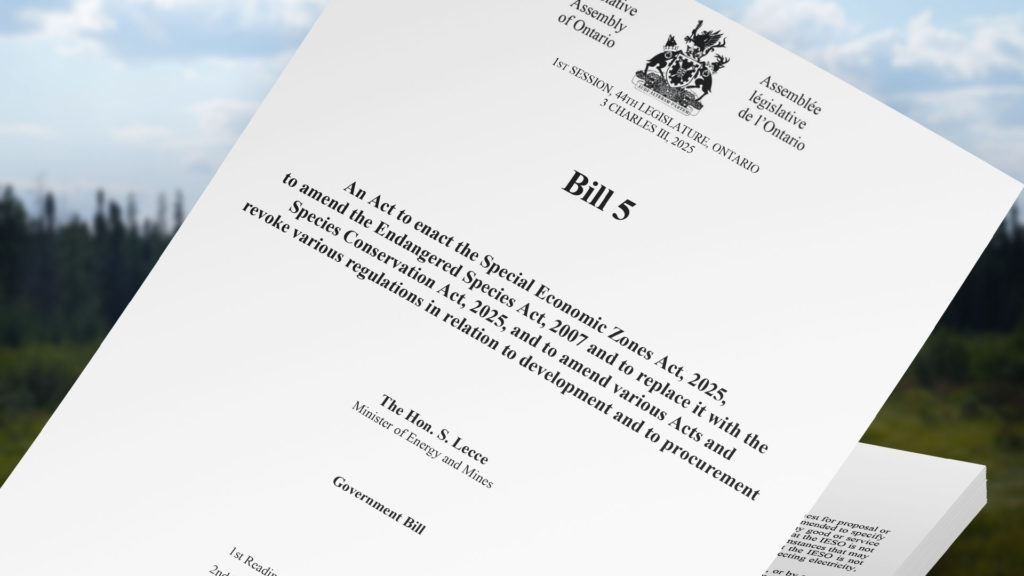
Ontario’s Bill 5, the Protect Ontario by Unleashing our Economy Act, is speeding through the province’s legislative process and could become law before the legislature adjourns for the summer on June 5. The proposed law is a sweeping bill designed to streamline and expedite major project approvals, giving the government the power to suspend several municipal and provincial processes. The government introduced the bill in response to concerns over U.S. tariffs and the perceived need for resource independence.
However, the legislation is receiving mixed reactions from different quarters. Most of the strongest opposition is coming from First Nation groups, as well as environmental activists. Some First Nations have predicted significant protests over the current form of the bill, some even giving ominous warnings of confrontations and blockades.
Although the law would not overcome Aboriginal and Treaty rights, some Ontario chiefs have concerns about the special designations and their impact on the United Nations Declaration on the Rights of Indigenous Peoples (UNDRIP). One chief wrote to the government saying it must first obtain free, prior and informed consent of First Nations before declaring a special economic zone where those nations have unceded title. The Ontario government has pledged the Ring of Fire region will be the first designated special economic zone.
The provincial government has indicated a willingness to adjust the law to accommodate Indigenous concerns but is committed to seeing the law itself passed. Ontario’s energy and mining minister Stephen Lecce told City News that the province is rewriting the law’s preamble to clarify and reinforce the province’s constitutional duty to consult with Indigenous people.
The most significant concern comes over the bill’s provision for the creation of so-called ‘special economic zones.’ This provision would give the provincial cabinet the authority to designate any location in Ontario a special economic zone, where the government can exempt companies or projects from complying with provincial laws or regulations. The bill also proposes to change parts of Ontario’s endangered species law, which has raised the attention of some conservation and environmental groups.
The Ontario Mining Association (OMA) – a prominent voice for the province’s mining sector – has shown enthusiasm for the new legislation.
Priya Tandon, president of the Ontario Mining Association.
OMA President Priya Tandon stated: “Ontario’s mining sector competitiveness is a foundation of collaboration and respect. Our members prioritize protecting people's health and safety, honouring Indigenous rights, and safeguarding the environment for future generations. We believe that this responsible approach not only aligns with our values but also provides a significant competitive advantage in the global marketplace,”
She continued, “We are encouraged to see the introduction of enabling legislation that aims to effectively balance efficiency with environmental and social responsibility to leverage the strategic importance of mining. The government's proposed One Project One Process concept supports moving towards an integrated, coordinated approach to regulating mining. To make this vision a reality, the provincial government should declare mining a strategic priority across all relevant ministries. This cannot be a “side-of-desk” issue. From energy pricing and infrastructure investment to streamlined permitting and strengthened Indigenous relations, mining must be treated as a top-tier concern.”
Challenges in crafting balanced legislation
Some mining policy analysts, however, have offered some concerns about the bill, even as they support the intent of the legislation.
Heather Exner-Pirot – a senior fellow and director of energy, natural resources and environment at the non-partisan Macdonald-Laurier Institute – expressed the frustrations in creating balanced legislation.
Heather Exner-Pirot, a policy analyst with the Macdonald-Laurier Institute.
She said: “We should all want faster project approval and efficiency in our regulatory processes, and we should not allow ourselves to be beholden to a loud minority philosophically opposed to development. But neither is it ideal to create processes that polarize project approvals and entrench opposition and lack of trust. Bill 5 shows just how hard the task to find that middle ground has become in Canada. “
Concerns over government power to limit foreign mining companies
Other mining companies have expressed broad support for the bill, but some have concerns over certain provisions. Glencore - a multinational mining firm – despite its support for the overall bill, expressed reservations. The company made a submission to the committee examining the bill and it was reported in the Trillium media outlet. Glencore expressed concerns about sections that would allow the province to take actions “for the protection of the strategic national mineral supply chain.”
The company was concerned about statement that Minister Lecce made saying the government would use those powers to protect Ontario’s resources from “hostile foreign actors and regimes.”
Glencore wrote that those powers “would vest the minister with broad and undefined discretionary power to effectively seize property interests without compensation in the interests of the strategic national mineral supply chain.”
“Rule of law and security of tenure are vital elements to the development of any large-scale mining project around the world. One of the reasons that Canada has attracted foreign capital in critical minerals (from companies such as Glencore) despite long permitting timelines, is exactly this: security of tenure and rule of law.”
The bill is currently being considered at second reading.




Comments