Beyond trucks: Why mines are rethinking haulage
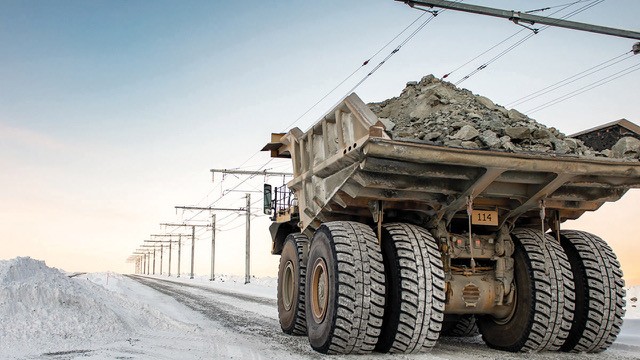
For generations, giant diesel haul trucks have been the backbone of open-pit mining. Today, deeper pits, longer hauls, rising costs and mounting pressure to cut emissions are prompting mine planners to ask a deceptively simple question: Is there a better way to move rock?
Every day, some of the world’s largest haul trucks climb winding ramps from the bottom of open pits, carrying hundreds of tonnes of ore and waste rock to the surface. For decades, these trucks have offered something mines value greatly: flexibility. A truck can be seamlessly redirected as the pit changes and added to a fleet as production grows.
But that flexibility comes at a steep cost. As pits deepen and haul distances grow, trucks spend more time travelling and less time moving material. More vehicles are required to maintain production, which sequentially drives up fuel, tire and maintenance costs. As a result, mining companies are strategically re-evaluating their dependency on traditional trucks to reduce the longest and most expensive hauls and design systems tailored perfectly to their specific mines. “Choosing trucks versus conveyors is not just an equipment decision,” said Anoush Ebrahimi, principal mining engineer at SRK Consulting in Vancouver. “It directly influences pit shape, slopes, access and the long-term mine plan.”
More than equipment: How haulage shapes the mine
Moving rock influences almost every aspect of an open-pit operation, from the geometry of the pit itself to its long-term economics, emissions and productivity.
Truck haulage requires wide ramps with manageable gradients that loaded vehicles can climb safely. These ramps consume valuable space inside the pit, dictating wall angles, the volume of waste that must be removed and infrastructure placement. As a pit becomes deeper, cycle times, including loading, travelling, queuing, dumping and returning empty, increase.
“Longer hauls increase cycle time, reduce truck productivity and drive up fleet size, fuel, tires and maintenance,” Ebrahimi explained.
Conveyors fundamentally alter this equation by moving material continuously. Instead of relying entirely on long spiral ramps, engineers can design dedicated conveyor corridors or steeper conveyor routes. While conveyors support high, steady throughput once built, Ebrahimi notes they are less adaptable than trucks when orebodies, schedules or market conditions shift. This trade-off between flexibility and efficiency sits at the very heart of the modern haulage decision.
The three pillars of modern haulage
The conversation is no longer simply trucks versus conveyors. Mine planners now have a diverse range of technological solutions that can be deployed independently or integrated together:
- Battery-electric vehicles (BEVs): BEVs replace traditional diesel engines with rechargeable batteries. They are particularly attractive for underground operations, where eliminating diesel exhaust drastically improves the working environment and reduces the need for extensive ventilation and cooling. However, Ryan Lafreniere, a mining engineer with Hatch, notes that battery power has logistical limits for massive trucks carrying heavy loads up long, steep ramps, as batteries add weight and introduce operational complexity.
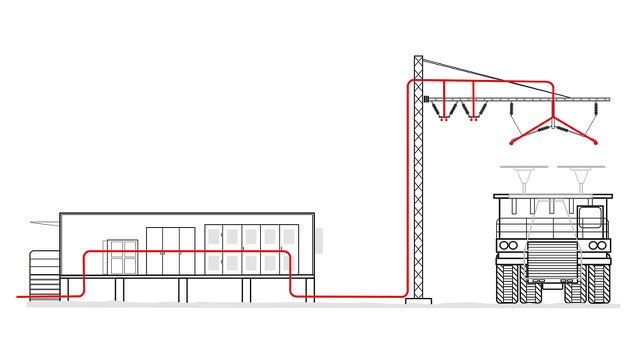
- Trolley assist: Under this system, trucks operate normally away from the trolley line and then connect to overhead electrical wires for the energy-intensive uphill portion of the haul. Electric power allows loaded trucks to climb faster while slashing diesel use. ABB reports that its eMine Trolley system can reduce diesel consumption by up to 90% on electrified sections.
- In-pit crushing and conveying (IPCC): Instead of a truck carrying every load out of the pit, a fixed, semi-mobile or mobile crusher reduces the rock to a size suitable for a conveyor. At Vale’s S11D iron ore complex in Brazil, excavators feed mobile crushers connected to a 68-km network of conveyors. According to FLS calculations, this largely truckless system reduces energy consumption by 67%, carbon dioxide equivalent emissions by 73% and mining costs by at least 15% compared to a similar truck-and-shovel operation.
The rise of hybrid haulage systems
For many modern mines, the most realistic approach is not a complete switch from one system to another but rather a hybrid model.
A mine might deploy trucks near the mining face, then route material through an in-pit crusher and conveyor for the long lift to the surface. Another might retain its truck fleet but install trolley lines on the steepest ramps.
“The deeper and more long-lived the pit, the stronger the case becomes for conveyor-based or hybrid solutions,” said Ebrahimi, provided the project can support the necessary capital cost, complexity and physical layout. Geometry is a critical factor; conveyors are highly practical in elongated pits but difficult to implement in strongly conical ones.
Power sourcing is equally crucial. Electrifying a fleet does not automatically render a mine low-carbon; the emissions benefit heavily depends on how the local grid generates its power. Furthermore, while trucks allow a mine to begin operating with less upfront fixed infrastructure, IPCC and trolley systems require massive initial investments that only pay off via lower operating costs over a long lifespan.
Strategic integration: Planning before pouring concrete
The most costly mistake a mining company can make is treating haulage as an isolated equipment purchase decided late in project development.
Companies are increasingly evaluating emissions and power availability at the scoping or preliminary economic assessment stages. Trade-off studies must look beyond the sticker price of equipment, examining the cost per tonne moved, fleet productivity, construction risk, ramp-up time and the subsequent effects on pit design.
Metso’s IPCC planning approach, for example, begins with a trade-off assessment at the scoping stage and integrates into detailed execution planning at feasibility. The earlier a mine tests its haulage options, the more opportunity engineers have to physically shape the pit around the most efficient system.
Conclusion: Finding the perfect combination
Haul trucks are not disappearing from open-pit mining; their unmatched flexibility remains vital, especially close to the mining face. However, the legacy assumption that every single tonne of rock must travel from the pit bottom to the surface in a diesel-guzzling truck is being actively dismantled.
“Every mine is unique,” said Lafreniere, emphasizing that the best choice relies entirely on the deposit, depth, production rate, climate and a company’s tolerance for risk. The future of haulage will be built from combinations: a truck handling the short distance to a crusher, a conveyor dominating the long climb and a trolley line powering the steepest ramps. The question is no longer if there is one definitive way to move rock but rather which combination works best for each individual mine.
Salima Virani is a freelance mining writer.
Related Posts

Sponsored: Troilus adds scale, certainty to Quebec mine
September 18, 2026
Sponsored: Troilus adds scale, certainty to Quebec mine
SPH Engineering taps Measur for industrial drone distribution
September 17, 2026
SPH Engineering taps Measur for industrial drone distribution
XXIX advances Pluto property option
September 17, 2026
XXIX advances Pluto property option
West Africa key to gold growth, Fortuna CEO says
September 17, 2026
West Africa key to gold growth, Fortuna CEO says

New housing facility opens to support Faro Mine clean-up
September 17, 2026
Comments