The perks of going small: Why ARLYX shrunk the miner
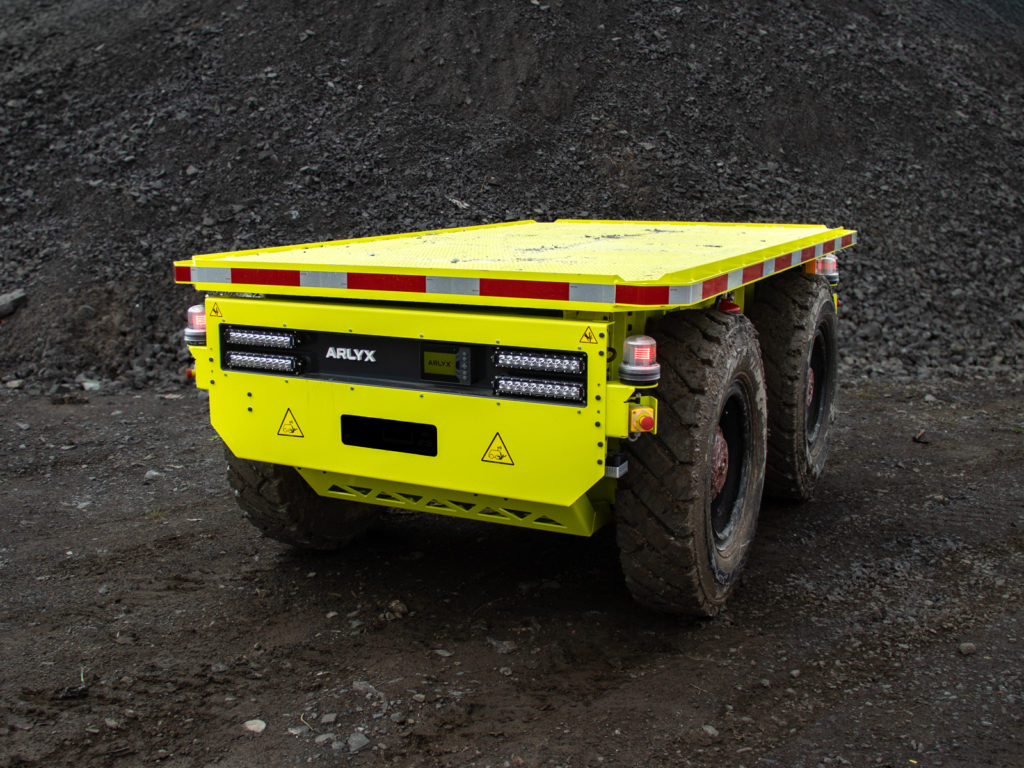
Decades ago, Michael Simard’s grandfather suffered injuries and watched colleagues die in Canadian mines. Although health and safety standards have improved since then, Simard says major risks remain rooted not in paperwork or compliance binders, but in physics.
ARYLX, the company he founded, builds compact autonomous electric vehicles for underground operations. It designs the machines, the software and the cloud systems that run them. The goal is simple: make the miner smaller.
So, why go small? Simard says there are several benefits, ranging from battery-charge times to ventilation logistics, but his company’s key priority is safety. “You can add the biggest brakes you want to a large vehicle, at the end of the day, it is impossible to stop in less than one metre with a big haulage truck,” he explained. In other words: it is a physics problem. Bigger vehicles need more space to stop. In hazardous environments with limited visibility, this can pose a real danger for workers alongside these machines. In conditions where a haulage truck takes 10 metres to stop moving, Simard says ARLYX’s vehicles need as little as 0.3 metre. That can make a huge difference.
Simard sat down with Canadian Mining Journal to discuss his company, its technology and the current needs of autonomous health and safety in mining operations.
CMJ: What is your personal background? How did you get involved in mining?
MS: My dream was to work in the Canadarm2 control centre at the Canadian Space Agency — the robotics arm of Canada space. I managed to do it. I worked in the control room, but I needed more space for creation and imagination, so I decided to build my own company to do autonomous vehicles. All my family is in the mining sector. My grandfather lost many friends and had many injuries in mines. It is funny because I am from Chibougamau, in northern Quebec, I decided to leave Chibougamau to find a more fulfilling career in technology in Quebec City and Montreal, but now, I am returning to that sort of region, Timmins, Sudbury, a full-circle moment.
CMJ: Are there any overlapping skills in space robotics and mining?
MS: In space, you need to manage cold and hot temperatures, and in mining, it is the same. In Nunavut, you can have –40ºC, but deep underground, you can have more than 50ºC. So, you need to manage the temperature.
CMJ: How would you describe the work that you do and the technology behind it?
MS: We are a Canadian manufacturer of autonomous electric vehicles for the mining industry. We design and build vehicles, software, cloud computing, safety, everything. The goal is to offer the mining industry a new kind of vehicle — a smaller vehicle — for transportation. Our philosophy is to have more vehicles, but smaller vehicles.
CMJ: What problems is your technology trying to solve?
MS: I am not a mining guy. I am not from the mining industry. I am a robotics engineer by trade. But I have spoken to many mining operators. I have been underground many times in Australia. And all my family is from the mining sector. I think the biggest problem in the mining sector is human resources. Mines have less people — it is becoming more difficult to hire and more difficult to keep employees inside companies. With less human resources, they need to have the same throughput productivity, so the only way to do that is to increase the vehicle size for haulage trucks. But when you have autonomy, why do you need big trucks? If you have 20 ARLYX vehicles instead of four or five haulage trucks, you will have the same throughput at the end of the day.
CMJ: What are the benefits of smaller vehicles?
MS: There are so many benefits to smaller vehicles. They are safer. They can brake much faster than a big truck. They can also be electric without the battery swap mechanism. With smaller vehicles, you can afford to leave one vehicle to charge when you have many vehicles. Electric vehicles need less ventilation. And the tunnels can be smaller.
That is our vision, but it is also why the big OEMs are not doing it, because there is less money with smaller vehicles. The big companies sell steel, and that is how they make money.
CMJ: What adjustments must be made to increase throughput of smaller vehicles?
MS: We try to optimize the downtimes in the mines. Two times a day, when there is blasting occurring underground, we take advantage of that by removing all the consumables and materials. When the shift starts again, there are less vehicles in the mine — less traffic — so, the big haulage trucks can move the ore more freely to the surface. More ore; more profits.
CMJ: Can you speak about the health and safety components of smaller vehicles?
MS: Two of our core values are safety and intuitivity, and they are correlated. The problem, like I said earlier, is that the trucks are getting bigger. There is progress in safety underground with protection and detection systems, but at the end of the day, the physics are flawed. You have a vehicle that is heavy going downward, and it is impossible to stop it in a way that is entirely safe. It is why ARLYX made a smaller utility vehicle. We are asked every day to build a bigger, more powerful vehicle, but safety is our first objective.
You also need a smaller vehicle to see around. If you have a bigger truck, it is impossible to see around the vehicle with cameras.
I am very confident that we will have a vehicle that can collaborate with other people underground. Right now, there is no autonomous vehicle that can work with other human-drivers or pedestrians.
CMJ: What is the future of ARLYX?
MS: ARLYX’s business model was designed around the zero-entry concept. I believe we are the missing piece for zero-entry. The end goal is to have a mine full of ARLYX. Because the platform is modular, you can put vehicles that transport ore, explosives or a firefighting module; a dust prevention module. It is like an ant farm: many small vehicles are more powerful than a few big ones.
CMJ: What are the roadblocks to getting there?
MS: The mining industry needs to be more open to innovation. I do not want to be too critical, but I know many people in innovative startups, and they are struggling to get attention from the industry. We want to help the mining sector, we have good solutions and we work hard — give us a chance.
David Cassels is the daily news editor at the Canadian Mining Journal.
Related Posts
Sponsored: Troilus adds scale, certainty to Quebec mine
September 18, 2026
Sponsored: Troilus adds scale, certainty to Quebec mine

SPH Engineering taps Measur for industrial drone distribution
September 17, 2026
SPH Engineering taps Measur for industrial drone distribution
XXIX advances Pluto property option
September 17, 2026
XXIX advances Pluto property option
West Africa key to gold growth, Fortuna CEO says
September 17, 2026
West Africa key to gold growth, Fortuna CEO says
New housing facility opens to support Faro Mine clean-up
September 17, 2026
Comments