Separation anxiety: Vibratory screening of bulk materials
The quarrying and mining industries rely on screen vibration for various purposes, but they often encounter similar problems. If the screening rack is properly engineered to accommodate the weight, volume, and type of motion, then the support structure will rarely require maintenance. However, vibration is commonly created by a vibratory motor with moving parts that continually combat resisting forces, as well as the harsh industrial environment of bulk handling, which inevitably reduces the equipment life (Fig. 1).
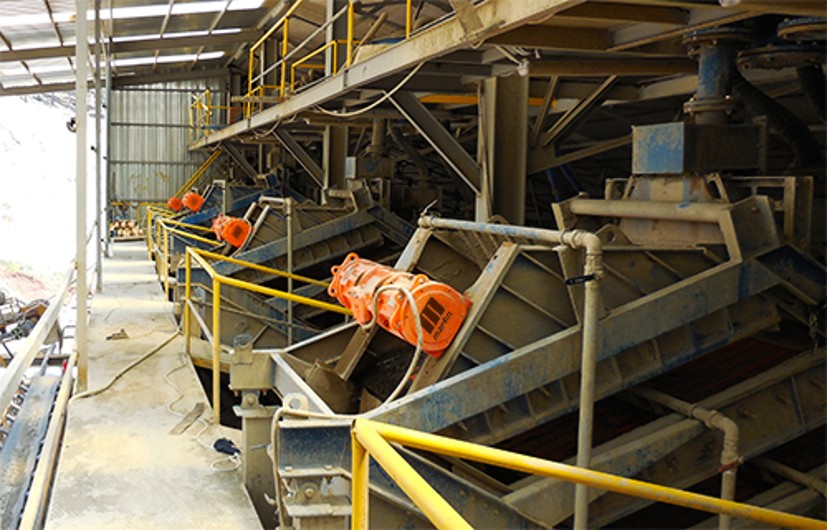
The need for vibratory screening requires operators to ensure the periodic replacement of vibrators is factored into the cost of operation. Increased speeds, high g-forces of acceleration, and power-intensive applications can cause extreme heat and wear on internal components, primarily the windings and bearings.
Punishing processing conditions such as high ambient temperatures, dusty environments, excessive material, and severe weather can also expose this equipment to damage. Even with a sturdy vibrator motor design, the constant motion and high heat can gradually wear down the bearings and winding insulation over time.
The period between potential breakdowns depends on several factors. Some of the most important include the operating environment, centrifugal force requirements, the condition of incoming power, lubrication type and intervals, and the vibrator’s design and build quality. This article will explore vibratory screening applications, how they affect material separation, and how a well-designed vibrator can improve efficiency and reduce operating costs.
Volumes and vibratory screening
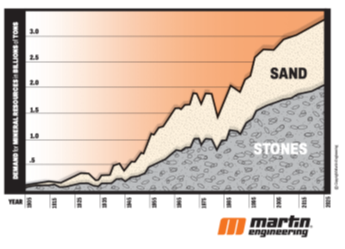
Since the early 20th century, the demand for mineral resources has steadily grown, forcing bulk handlers and material recyclers to continually increase production volumes. When it comes to screening, this can impact the quality and accuracy of the separation process. Simply increasing the volume or speed of throughput might require the material to undergo several passes to achieve proper separation (Fig. 2).
Operators need to consider the following factors in vibratory screening applications:
- Efficiency: The volume of the material stream determines the amount on the screen, which can influence how well it is separated.
- Material: The speed, volume and desired output of screening are dependent on the properties and angle of repose of the application.
- Angle of repose: The angle of repose is how the material spreads naturally across the surface. The loading method and type of vibratory motion assist in even distribution across the screen.
- Screen design: First, the screen must be able to withstand additional weight. Then, whether dewatering or separating, the grid pattern, permeability and type of vibratory motion need to promote the application’s separation.
- Effective slope: The angle of applied vibration determines the speed at which the material moves down the screen. Gravity, amplitude and frequency are factors in the screen’s effectiveness.
- Vibratory amplitude and frequency: Increasing either the amplitude or the frequency will increase the volume of material moving through the system.
- Vibratory motion: There are two general vibratory motions, linear (back-and-forth or up-and-down), and elliptical (rotational).
Failure mechanisms in screen vibration
Although the main topic is vibration, it is not the only failure mechanism in the screening process. According to a comprehensive literature review, “Causes of Failures in Vibrating Screens: A Literature Review,” the definition of failure mechanisms encompasses all factors that can cause or influence structural or component failures. In essence, it refers to any non-conformity that infiltrates the vibrating screen assembly, leading to future issues.
When a screening rack goes out of service, it can significantly impact production. Simply adjusting the volume of material fed to the remaining units decreases efficiency, negatively affects the quality of separation, and accelerates wear and tear, which raises the likelihood of additional breakdowns. This downtime increases labour costs, increases exposure to safety risk and elevates the cost of operation.
The study classified failure mechanisms into the following five distinct categories:
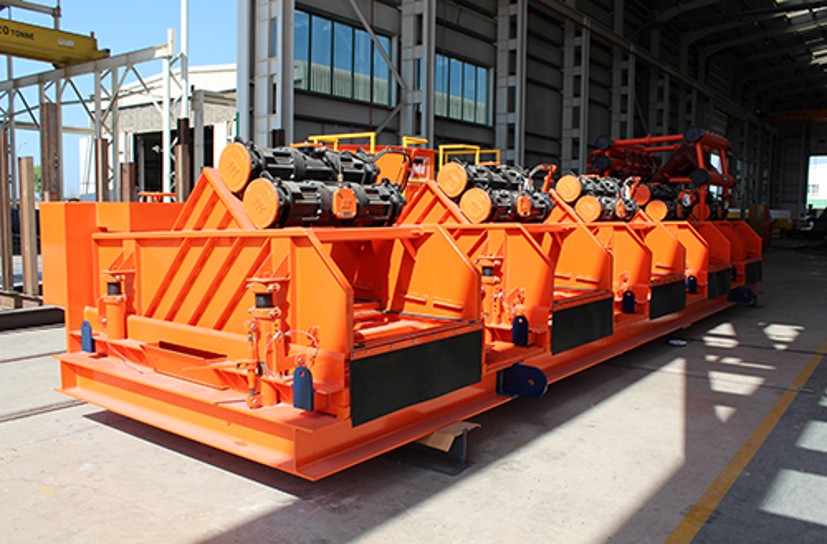
- Design deficiency: Inadequate engineered design either in the screen structure or the vibrator (Fig. 3).
- Manufacturing and assembly process deficiency: Post-installation structural adjustments are common and can change the centre of gravity or increase the machine’s weight, which reduces efficiency.
- Operational deficiency: Increasing volumes that exceed the recommended limits or the miscalibration of vibrators that put an undue strain on units are common operational deficiencies.
- Inadequate maintenance: Neglecting to monitor pads and springs on screening structures, not following lubrication procedures, and not addressing rust promptly are common and costly failure mechanisms.
- Wear and deterioration: These factors are unavoidable, but proper installation and maintenance of quality equipment can extend the system’s lifespan.
Vibratory amplitude and frequency
Amplitude refers to the magnitude or intensity of the vibration, indicating how far an object moves from its resting position. On the other hand, frequency indicates how many cycles of vibration occur per unit of time (measured in Hertz). Higher frequency can increase volume but has the potential to increase screen wear and stress on the frame if force outputs are not considered.
The vibrator’s force can be adjusted and must at least match the combined weight of the isolated rack and the load volume. When the machine is new, the vibrators are typically set to the force output that provides the best performance. Balance throughput volume with reliability. It is important to consider wear and maintenance when changing the vibrators’ force output.
Vibrator motion and placement
In most horizontal screening applications, two vibrators on a rack work in tandem by counterrotating to produce a linear motion. This motion generates a line of force that intersects with the machine’s centre of gravity. The placement and angle of the vibrators influence how the motion occurs. With the correct slope and amplitude calculated, gravity will assist the material down the screen.
Linear side-to-side motion is effective for sectors such as mining and recycling, as it allows material to spread across the screen. Mounting vibrators on the sides of the rack causes larger materials to shift and roll to each side, enabling the heavier ends to face downward. In bulk handling, the rolling and colliding loosen aggregate and assist particles through the grate.
Linear up-and-down motion is highly effective for sand biofiltration and particulate dewatering. With vibrators mounted on rails above the material flow, the internal weights lift and drop a specialized screen made of durable fine mesh. This motion causes the separation of particulates from the screen. With each cycle, air is introduced between the particulates, and water is forced out, allowing only moisture and particles microns in size to pass through. (Fig. 4).
Elliptical rotational motion is prominent in agriculture for the threshing process, but also in recycling and bulk processing. Set in front of or behind the screen, the action causes the material to move forward, then back, using the screen as a tool to not only separate, but also, in the case of grains, remove the husk from seed. This “cheese grater” effect also helps remove loose dirt from quarried rock and fines from mined raw material.
Electric and hydraulic screen vibrators
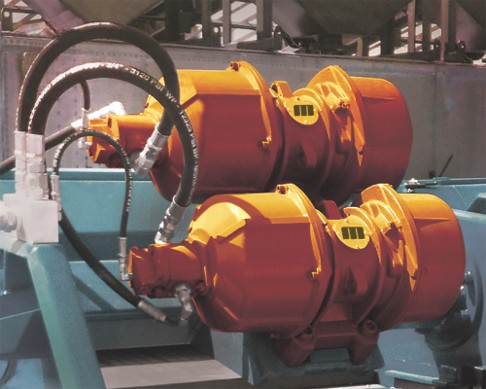
The weight and volume of the bulk handling environment require a powerful vibrator to do the job effectively. While electric screen vibrators are common, hydraulic vibrators are more applicable for portable screen applications where no electricity is available. The movement of a hydraulic screen vibrator is driven by a hydraulic pump that delivers pressurized fluid to the motor. The motor then converts the fluid power into rotational motion, which is transferred to eccentric weights. Eccentric weight is a rotating mass that is offset from the centre of rotation, creating an unbalanced force (Fig. 5).
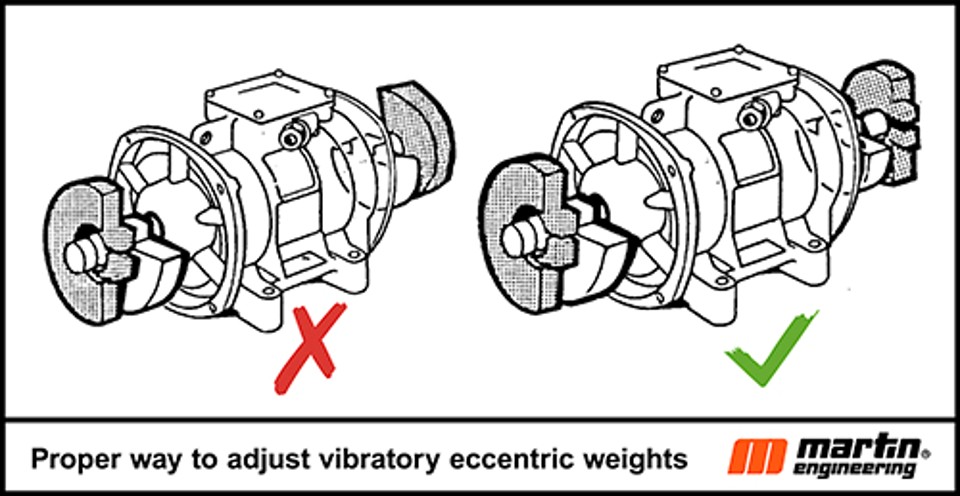
Industrial electric vibrators for material screening should use inverter-duty rated and Class H insulated windings to prevent overheating in continuous-duty environments. Martin Engineering’s screen vibrators produce up to 16,500 lbs (7,483 kg) of centrifugal force. The adjustable eccentric weights tailor performance for 3- or 4-panel screens, featuring low-maintenance, greaseable and long-lasting cylindrical roller bearings. The high-strength cast aluminum cases are IP66 rated for dust and water protection with available explosion-proof models that bear the cETL, ATEX, and IECEx marks for use in hazardous locations.
An example of a hydraulic screen vibrator is the Martin Hydraulic Screen Vibrator, which provides up to 8,300 lbs (3,855 kg) of centrifugal force for efficient material separation. The IP66 enclosure ensures a dry and grit-free internal environment and uses the same mounting bolt patterns as electric vibrators.
Both units are highly effective in punishing industrial constant-duty environments. The low-maintenance components ensure long-lasting performance and peace of mind, backed by an industry-leading 3-year warranty.
Conclusion
As we have demonstrated, proper vibration is essential, but it is also a wear part, so high-quality, durable equipment is vital to prevent excessive downtime. Along with a solid guarantee, the equipment manufacturer or representative should be responsive and able to provide a replacement quickly.
A well-constructed system, along with proper calibration and placement of vibrators for the application, is essential for efficient and optimized screen separation. To further extend the equipment’s life, these systems should be easy to maintain and accessible, ensuring both workplace safety and lower operational costs.
Susie O. Bartoli is an experienced business development and marketing specialist at Martin Engineering USA, where she plays a key role in driving strategic growth initiatives.

Related Posts
Agnico Eagle grows in Quebec: Becomes world’s second largest gold miner
Quebec’s Bill 11: streamlining the Mining Act to accelerate project development
Trelleborg launches pressure-activated sealing solution
October 7, 2026
Trelleborg launches pressure-activated sealing solution

NMG, McGill University partner on low-emission battery coating process

Comments