Koryx Copper (TSXV: KRY; NSX: KYX; US-OTC: KRYXF) has drilled the longest continuously mineralized intersection yet at its Haib copper project in Namibia, adding support for a resource update and prefeasibility study expected before year-end.
Drill hole HM167 cut 969 metres from surface grading 0.23% copper, 84 parts per million (ppm) molybdenum and 0.021 gram gold per tonne. The hole was among 19 reported Wednesday covering 8,586 metres, all of which intersected thick mineralization, the company said.
“With this batch, our infill drilling is nearing completion, and results continue to trend to the upside ahead of the expected late 2026 mineral resource update,” President and CEO Heye Daun said in a release. “These results continue the trend of recent months, with exceptional widths at consistent and regular higher grades above the average resource grade.”
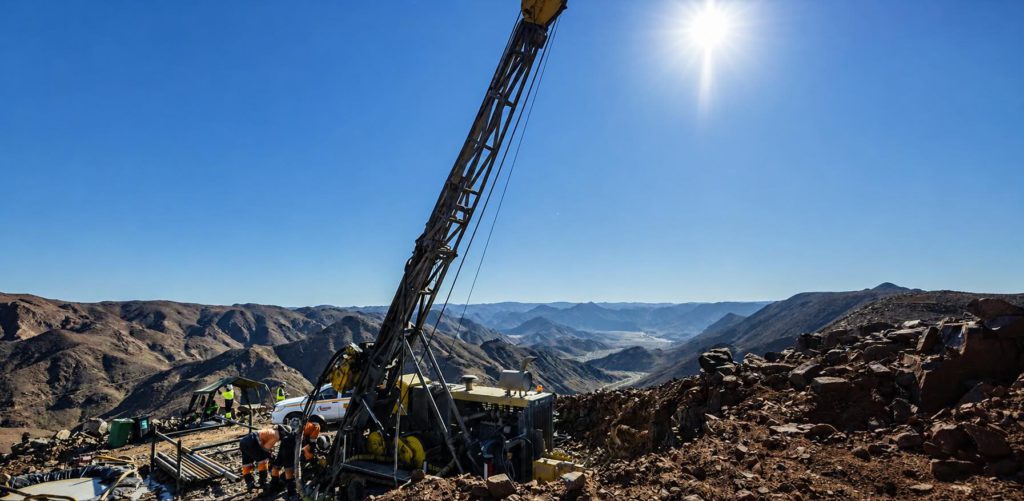
Haib is a large porphyry copper deposit in southern Namibia where Koryx is nearing completion of a 52,000-metre drill program aimed at upgrading and expanding a March resource. An updated estimate is due late this year and will underpin a prefeasibility study expected in the fourth quarter, as the company also advances metallurgical studies and a mining licence application.
Analysts
The results highlight areas for potential tonnage growth as Koryx approaches the resource update, BMO Capital Markets mining analyst Rene Cartier said in a note. BMO rates Koryx outperform (speculative) with a $6 target.
An earlier BMO review this month noted that infill drilling could have mixed effects on the final model. Some holes were extending mineralization beyond or below existing grade shells, while others could locally reduce the shells as Koryx tightens its geological interpretation. BMO also pointed to silver as a possible additional byproduct.
Red Cloud Securities analyst Ron Stewart rated the latest results as positive, saying the nearly kilometre-long HM167 intersection reinforced Haib’s scale and grade continuity and represented another step towards converting resources to higher-confidence categories. Koryx expects to complete its current 52,000-metre drill program during the third quarter.
Stewart also highlighted drill hole HM185 and the high grades near surface in HM177, while pointing to HM171, HM173 and HM162 as possible sources of additional tonnes in the next resource. Red Cloud maintains a buy rating and $5 target, compared with Koryx’s Wednesday close of $3.83. The company had a market value of about $465 million.
Resource
Haib has 744 million indicated tonnes grading 0.28% copper, 63 ppm molybdenum and 0.02 gram gold per tonne for 4.61 billion lb. copper, 103.6 million lb. molybdenum and 487,900 oz. gold, according to a March resource. It also has 579 million inferred tonnes grading 0.24% copper, 66 ppm molybdenum and 0.02 gram gold for 3.05 billion lb. copper, 84.5 million lb. molybdenum and 380,200 oz. gold.
The strong results included drill hole HM185, which returned 236 metres grading 0.51% copper within a broader 413-metre interval grading 0.37% copper. The company called it one of Haib’s best intersections to date by contained metal. HM177 returned 30 metres grading 1.06% copper from 8 metres depth, including two 2-metre intervals above 4% copper.
Several holes also suggest the deposit could grow beyond the current resource model, Koryx said. HM173 showed higher-grade copper extending farther west than modelled, while HM171 hit higher-grade zones outside the resource. HM162 encountered 56 metres grading 0.35% copper in previously unmodelled mineralization. HM181, however, helped establish the southern limit of Target 1.
Studies
The prefeasibility study is expected in the fourth quarter. A 2025 preliminary economic assessment envisioned a large open-pit operation producing an average 88,000 tonnes of copper annually over 23 years.
It estimated US$1.56 billion (C$2.16 billion) in upfront capital and an after-tax net present value at an 8% discount rate of US$1.35 billion, with a 20% internal rate of return using copper at US$9,500 per tonne.
Koryx has also applied to convert Haib’s exploration licence into a mining licence while metallurgical and processing trade-off work continues. Red Cloud expects a definitive feasibility study in 2027, with environmental clearance work and project financing among the other upcoming milestones.
Comments