AI goes prospecting: Can machines unearth the next mineral deposit?
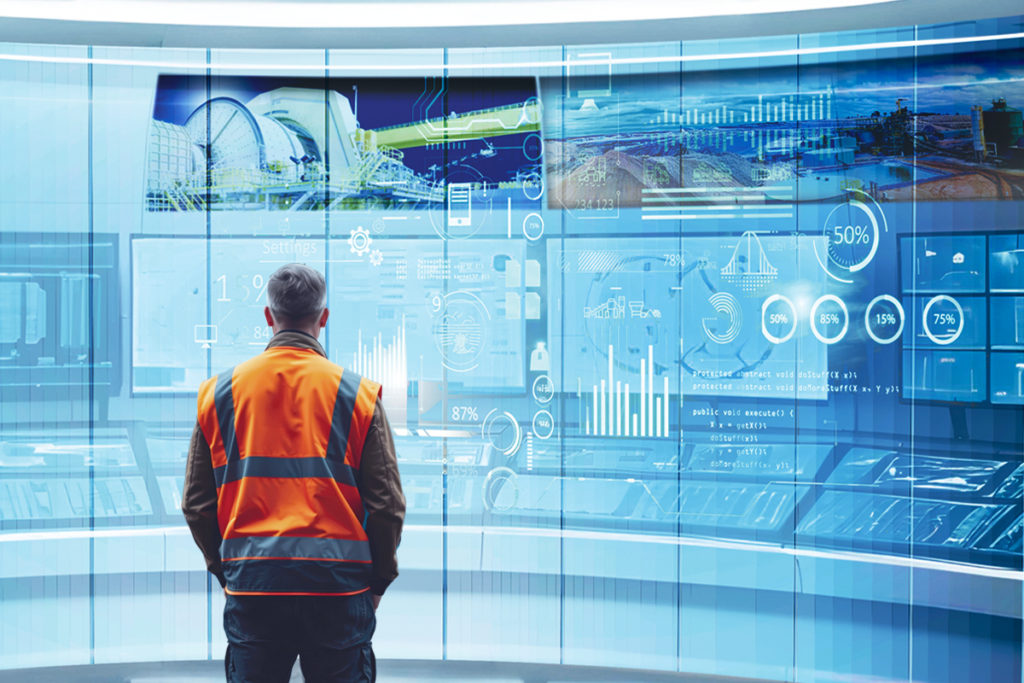
What if an exploration geologist could input a set of coordinates into a system and, within minutes, receive a highly accurate mineral potential score for that specific location?
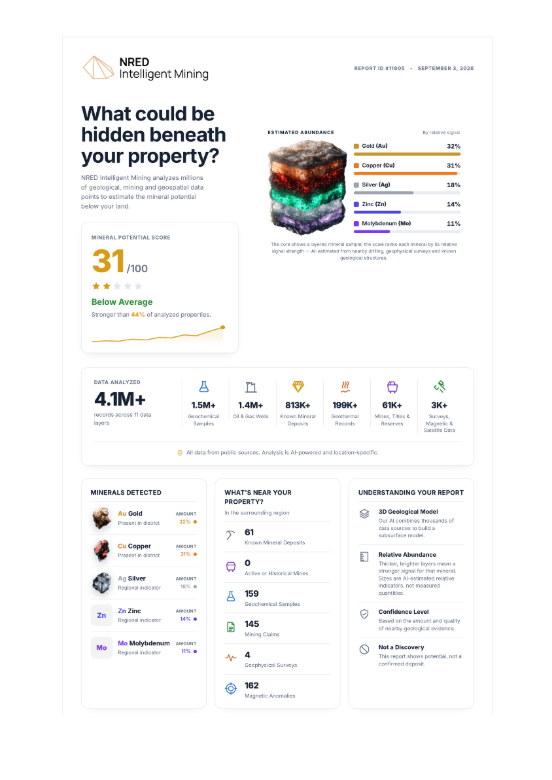
That is the idea behind MetalCore, an AI-assisted mineral exploration platform being developed by NRED Intelligent Mining. The platform pulls together millions of public geological records, including geochemical samples, known mineral deposits, mining claims, magnetic surveys and satellite data, then uses that information to give a location a mineral potential score. For NRED chief technology officer Valentin Saitarli, the problem starts with time.
“The biggest problem we see right now is the time,” Saitarli told Canadian Mining Journal. “It takes on average 15 to 17 years to bring a mine into production.”
To combat this severe bottleneck, NRED is deploying a combination of AI, computer vision and robotics to dramatically accelerate the prospecting timeline.
Teaching AI to see geology
Geological information does not arrive neatly packaged for a computer. It can include assessment reports, maps, satellite images, geochemical results, magnetic surveys and decades of exploration work completed by different people using different methods.
Saitarli describes part of MetalCore’s job as turning that scattered information into something a machine can understand.
“How do you turn a picture into a dataset?” he asked. To explain, he used an unlikely analogy: walking into a foreign supermarket. A shopper may see products they have never encountered before. But the brain still recognizes shapes, labels and packages because it has spent a lifetime learning how to identify objects. An AI model also needs to be taught what it is looking at. Saitarli said MetalCore is being built around domain-specific geological datasets that are meticulously labelled so models can learn to recognize relationships across vast amounts of exploration data.
More data does not always mean better data
Dr. Steven E. Zhang, a research scientist and geodata scientist with the Geological Survey of Canada at Natural Resources Canada, said machine learning (ML) is already being used in mineral exploration, although there is a gap between experimental models and technology proven in the field.
“There is substantial published evidence of the use of ML in integrated data mining and analysis at up to the prototype stage,” Zhang said. “Beyond the prototype stage and into deployment environments, there are far fewer published studies.”
At larger regional, national and continental scales, integrated data mining remains a research topic. The amount of information fed into a model is only part of the equation.
“Quality and labelling are very important for data-driven uses of AI,” Zhang said. “The quality of the outcome is foremost driven by the quality of input data.”
Historical geological records may span decades. Sampling methods change, interpretations evolve and some old samples can no longer be checked. Zhang also noted that historical deposits were often higher grade, shallower and geologically simpler than many deposits explorers seek today.
From 4.1 million records to one score
According to NRED, MetalCore currently searches more than 4.1 million public records across 11 geoscience data layers and 37 government sources in Canada, U.S. and Mexico. The company says users can receive a report in roughly two minutes.
MetalCore’s current 0-to-100 mineral potential score is not an AI prediction that a deposit exists underground. It is a scoring system that looks at how close a location is to different signs of mineralization, with some types of evidence given more importance than others.
Geochemical evidence carries 53% of the score, proximity to known deposits accounts for 35% and nearby mining claims make up the remaining 12%. Signals decrease in importance the farther they are from the location being analyzed. The company makes that limitation clear in every report: “This report shows potential, not a confirmed deposit.”
The score does not estimate a mineral resource, show the probability that a deposit exists or directly measure the rock beneath a property. It is a screening tool designed to help users decide where to look first. A high score may point to an area that deserves a closer look, but it does not replace fieldwork or prove that mineralization is present.
NRED says the next stage of MetalCore will add a geological favourability layer, moving the platform from screening what is already known nearby toward predicting where favourable geology may occur.
Can AI mean less drilling?
Saitarli sees that as the longer-term opportunity. “We are building an engine that gives us the ability to remove false positives and remove unnecessary work that is extremely expensive,” he said. Ultimately, he said, “the goal is to drill less.”
If AI can remove weaker targets earlier, exploration teams could focus more time and money on promising areas. But Zhang said those claims need a clear benchmark. “Any claim must be met with evidence and methodology,” he said.
That includes showing where and how a model was tested, whether predictions were validated and what type of deposit it was designed to identify. A claim of reduced drilling also needs a meaningful baseline.
Without that comparison, it is difficult to know whether AI actually improved the exploration result or reached a conclusion that conventional methods might also have reached.
The Mars Rover approach
NRED’s plans extend beyond analyzing geological data from behind a computer. The company is also evaluating EyeX technology, co-founded by Saitarli, which uses cameras, drones and robotic systems to collect and interpret information in the field. “EyeX turns cameras and robots into one simple system,” he said.
Saitarli compared the concept with the Mars Rover. When scientists want to understand an unfamiliar environment on another planet, they send equipment first to collect information. “You send the equipment first, analyze the ground and run the simulation,” he said.
Saitarli imagines a similar approach at remote exploration sites. A drone could scan an area, build a 3D model and help teams assess terrain, ground movement or other potential hazards before people or equipment move in. “Analyze and know where to drill, deploy boots on the ground and understand where to go,” he said.
He also pointed to space and ocean exploration as examples of industries using technology where people cannot easily go. In NRED’s proposed workflow, MetalCore would identify where to investigate while drones, cameras and other sensors gather information in the field.
Putting AI to the test
NRED plans to use its Wilmac copper-gold project in B.C. as a testing ground for the technology. “We want this to become used across the entire mining sector and NRED’s Wilmac copper-gold project will be the test site,” Saitarli said. NRED has also opened a waitlist for up to 1,000 people to try a test version of MetalCore and evaluate the technology. Testing on a real exploration property matters because identifying an anomaly is not the same as demonstrating a discovery. Results still have to be compared with field observations, sampling and, ultimately, drilling.
For Zhang, that need for proof helps explain why the mining industry tends to be cautious about new exploration technologies. “The mineral industry is very conservative because risks associated with investments are very high,” he said. Without previous success or tangible evidence of current success, he said, claims remain difficult to assess. Reliable results should also disclose the model’s limitations, assumptions and data. His advice is straightforward: “Extraordinary claims require extraordinary evidence.”
Where does the geologist fit?
For all the discussion about autonomous exploration, Zhang does not see drilling disappearing. “Drilling will never be replaced as an activity by non-contact sensing methods, whether conducted by humans or machines, because it is the only way to verify subsurface composition and structure,” he said. Nor does he expect AI to remove the need for geologists anytime soon.
One challenge is that mineral exploration does not provide AI with the enormous volumes of training data available in fields such as autonomous driving. “No two deposits are exactly alike,” Zhang said. A model trained too broadly may miss what makes one deposit unique. Train it too narrowly and it may fail elsewhere. Zhang believes experienced geologists will therefore remain an important check on what AI produces. “I think geologists with their native multi-modal and multi-scaled experience, acquired as part of their pedagogy and work experience, will likely provide the necessary scrutiny for AI models for now,” he said.
Saitarli, despite his enthusiasm for automation, also acknowledged that people remain central to the process. The more machines can do in difficult environments, he argued, the less unnecessary human exposure there may be. But mining will “still need the best minds.”
For now, both sources point to a more immediate role for AI: helping exploration teams process information faster, identify patterns and prioritize where to investigate next. Whether those better targets consistently lead to better discoveries is what testing at projects such as Wilmac will have to demonstrate. AI may help decide where the drill should go next. But the drill core still gets the final vote.
Salima Virani is a freelance writer.
Related Posts
Boreal Orchards signs ‘re:moss’ deal with major Canadian mining company
Sudbury Mining Week returns
October 13, 2026
Sudbury Mining Week returns
Fortuna logs high-grade gold in Senegal, extends depth
October 13, 2026
Fortuna logs high-grade gold in Senegal, extends depth
Eldorado’s Skouries mine wins EU strategic status
October 13, 2026
Eldorado’s Skouries mine wins EU strategic status
Sponsored video: Canagold nears build decision at New Polaris
October 9, 2026
Comments