Sandvik powers the next chapter in underground drilling

Underground drilling brings together several demands: reaching the face efficiently, completing the drilling cycle, following the plan and limiting workers’ exposure to underground conditions. Sandvik’s approach connects these tasks through equipment design, battery technology, drilling data and automation, with productivity and safety running through the discussion.
This article is based on an interview with Johannes Välivaara, president of underground drilling at Sandvik, during the Future of Mining event in Tampere, Finland. Välivaara explained how the DD423i and battery-electric DD423iE development drills fit into that approach. He described larger boom coverage, increased battery capacity and battery-boosted drilling, alongside the role of data, autonomous functions and operator training.
“Automation, digitalization and electrification, the way we see it, they all relate together,” Välivaara said. His explanation linked improvements at the machine level with the wider drilling process, from positioning the equipment to feeding information back into mine planning and carrying out tasks with less operator exposure.
More coverage, less repositioning
One of the changes Välivaara highlighted is the SP75 boom, which provides greater coverage than the preceding SP60. Increased boom extension gives the operator more flexibility when positioning the drill and reaching different parts of the face. The benefit is less time spent moving the machine between drilling tasks.
He explained that an operator would typically position the equipment at the face, drill the lifter holes and then relocate the machine to complete the remaining holes. With greater reach, the operator can drill the whole face, including the lifter holes, from one position, reducing repositioning and navigation time.
The same capability helps when drilling crosscuts, particularly where the booms must reach sideways. Välivaara also described a new dual rollover configuration that allows the operator to manoeuvre the booms in both directions. Together, these changes provide flexibility when drilling to the left, right or in front of the machine.
Battery power beyond tramming
For the DD423iE, Välivaara pointed to the LFP 2.0 battery system and an increase in capacity from approximately 120 kWh to 180 kWh. Välivaara said the increased capacity brings the available range closer to meeting the needs of most mines, addressing the reach achievable in underground conditions. The larger battery addresses a practical consideration for underground drilling equipment: how far the machine can travel between locations under the conditions encountered in a mine.
“Now we have a larger battery capacity on board,” he said. As an example of the increased tramming capability, he described travelling up to nine kilometres uphill on a one-in-seven incline. He identified tramming distance as a traditional limitation for battery-electric drilling equipment and said the increased capacity helps address it.
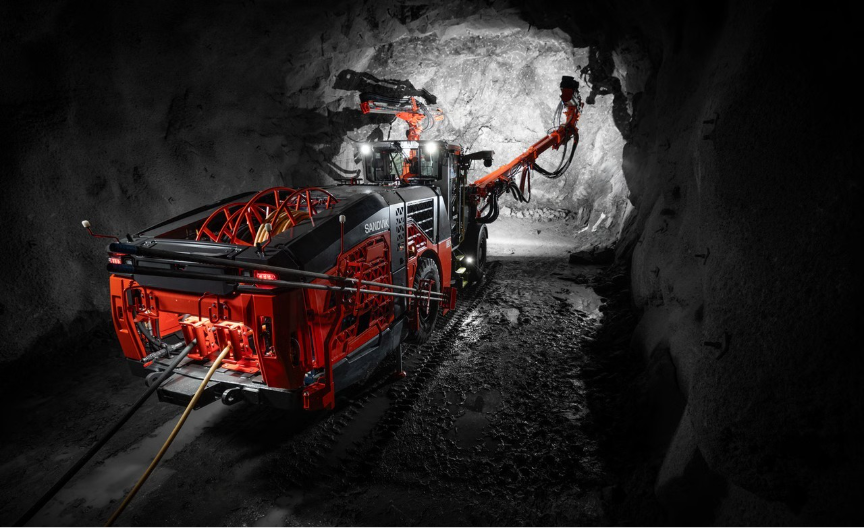
The other change concerns the drilling itself. Välivaara said the difference between diesel and battery-electric equipment had traditionally centred mainly on travelling to the drilling location. The machine could charge its batteries while drilling, then move to the next location. Sandvik is seeking to add a drilling productivity benefit through battery-boosted drilling.
The system compares the power needed for drilling with the power available from the underground electrical grid. When drilling requires more power than the grid can supply, the equipment draws reserve power from the battery. Välivaara said constraints on available electrical power become more apparent as mines extend deeper.
“We are looking to change that now and the feature is called a battery boosted drilling,” he said. He presented the capability as a way to drill faster despite grid limitations. Alongside cleaner air and reduced underground heat load, the productivity improvement helps address customers’ difficulty justifying investment in battery-electric technology.
Putting drilling data to work
Digitalization adds another dimension to the drilling cycle. Välivaara described the telemetry and information available from the equipment, as well as parameters recorded while drilling into the rock. Those measurements can support geotechnical interpretations and contribute information about the conditions encountered during drilling.
He outlined a feedback loop connecting planning tools with the machine. A production drilling plan is created and transferred to the equipment. During execution, the unit records how the holes were drilled and the conditions it encountered. That information can then return to the planning system to complement the mine’s geotechnical model.
The value extends beyond measuring drilling output. By connecting planning and equipment, the process also captures information about the rock being drilled. Välivaara described this relationship as a way for the drilling activity to contribute to the model, while the model and planning tools guide the work performed by the equipment.
Building automation around the drilling cycle
Sandvik’s work towards more autonomous drilling includes individual functions that address tasks within the cycle. Välivaara highlighted bit changing, lifter tube installation and scanning solutions that help navigate the equipment. He described a gradual progression towards more autonomous drilling as these functions develop. Customer feedback helps guide that work, alongside collaboration to prepare the technologies for commercial use. He said the company is working closely with customers on the commercial readiness of these technologies and their introduction into its existing offering.
Automation also has implications for equipment utilization. Välivaara described opportunities to continue drilling during shift changes and blasting or ventilation windows. Using these periods can increase the time available for drilling and produce more drilled metres. He framed the opportunity as moving operations towards a process that can run around the clock.
Consistency is another part of the case. Once a drilling plan has been developed with blasting, fragmentation and drilling control in mind, automation provides discipline in following it. Välivaara said the equipment can execute the plan consistently, helping deliver results from one day or week to the next.
Safety through several layers
Välivaara described zero entry as a long-term target, with activities carried out autonomously by the machine or supervised remotely by an operator. Tele-remote technology and onboard automation can reduce operators’ exposure to underground conditions. Operators can supervise drilling remotely using tele-remote technology. He also emphasized that safety involves several layers of protection on the equipment itself.
Access protection systems are one example. Scanners can detect a person entering the area in front of the drill and stop movement. Another objective is to keep the operator inside the cabin for as much of the work as possible, rather than requiring the person to move to the front of the machine.
Bit changing and lifter tube installation are intended to support that objective by allowing those functions to be carried out from the cabin. Combined with autonomous operation or tele-remote assistance, these capabilities can also help complete face drilling tasks during shift changes. Välivaara linked the combination to both reduced exposure and increased drilling output.
Preparing people for technology
“Everything starts with the people and the change management,” Välivaara said. He emphasized training and upskilling alongside technical development, noting that some job descriptions may change. Välivaara said the industry still has work to do on this transition, even as the technology becomes ready. Successful change management must accompany the equipment’s capabilities. Sandvik’s role includes providing tools, services and capabilities that help people prepare to use technology.
He said work with customers and industry remains necessary to support that transition. The interview connected this preparation with the equipment changes: greater reach, battery-supported drilling, data feedback and automation each address parts of the cycle, while people remain central to putting those capabilities to work underground.
Related Posts
Greenland Mines backs parliamentary approval of US-Denmark security deal
Liebherr releases electric version of 250-tonne-class excavator
November 2, 2026
Liebherr releases electric version of 250-tonne-class excavator

Draslovka secures key IPs to strengthen sodium-ion supply chain
October 29, 2026
Draslovka secures key IPs to strengthen sodium-ion supply chain

Seeq launches first Conneqt EMEA conference
October 28, 2026
Seeq launches first Conneqt EMEA conference
Glencore, CNGR back $380M Brazil nickel mine with $40M
October 28, 2026
Comments