Bridging borders and fostering innovation: The universal language of mining
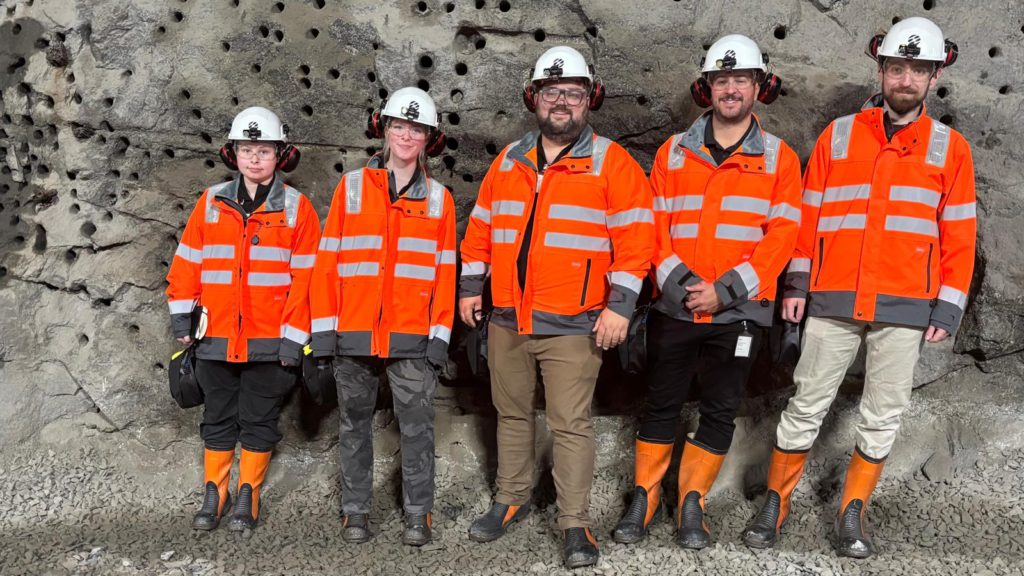
When I boarded the plane to Finland, I knew we were heading into something special. Three Cambrian College students, a colleague, and I, were starting a long journey to visit Sandvik’s Load and Haul facility in Turku as part of the final phase of an applied research project we had just completed with them, in which our team designed and fabricated a new technology concept for their battery electric loaders. What I did not expect was how much the trip would reinforce one of my growing convictions about the mining industry. That, despite cultural differences and language barriers, mining has its own universal language, one that bridges borders and fosters innovation.
Verbal divides were quickly bridged by the shared technical language used in mining. In Turku, as we gathered around drawings, CAD models, and the physical prototype that had traveled with us, those barriers melted away. Technical diagrams, engineering shorthand, and the unmistakable vocabulary of mining people carried us forward. More importantly, the prototype we developed in Sudbury was a success. When we demonstrated it in Finland, Sandvik’s engineers were impressed with the design and execution. That sense of shared accomplishment further reinforced the universality of mining innovation. The unspoken gestures, the nod of recognition when a problem is understood, the smile when a solution works, and the quiet admiration of clever design all carried across cultures with ease. This shared ethos of problem-solving and practicality is the common tongue of mining, and it allowed a Finnish engineer and a Canadian student to find common ground almost instantly.
The spirit of collaboration flourished because Sandvik’s research ethos meshed naturally with the Centre for Smart Mining’s applied approach. Our teams gelled quickly, driven by the same curiosity, iterative problem-solving, and insistence on hands-on validation. This reminded me that mining innovation has always been an international affair. Equipment is designed in one country, manufactured in another, and deployed in mines worldwide, with each region bringing unique expertise. Finland’s history in underground mining and its leadership in battery electric technology complement Sudbury’s decades of hard rock mining experience and current transition toward electrification. When ideas are shared openly across borders, technology adoption accelerates.
The physical setting of our next stop, Tampere, offered its own lessons in mining’s quiet integration into society. Our hosts took us to Sandvik’s test mine, which plays a crucial role in developing and proving new technologies. Unlike Sudbury, where the shape of the city itself announces its mining heritage, Tampere does not outwardly appear to be a mining town. The mine sits just outside the city, with little fanfare or signage to announce its presence. Many locals are only vaguely aware of the world-class innovation unfolding beneath their feet. Adding to its uniqueness is the coexistence of a glass factory directly above. Each time the mine advances with blasting, Sandvik must call the factory to coordinate, ensuring delicate production continues safely above while rock is broken below. This juxtaposition of glassmaking and blasting symbolizes Finland’s practical and careful approach to innovation.
Finland’s innovation culture demonstrated how much attitude matters in technological progress. Research in Tampere is not an afterthought but a central feature of industrial life. Continuous improvement, experimentation, and openness to collaboration are default modes of working. For our students, this was revelatory. They realized that innovation is not just about engineering expertise but about mindset. The willingness to question assumptions, to invite external partners, and to treat students as contributors rather than observers left a profound impression.
The student experience was transformative because they were active participants, not spectators. From the moment we stepped into the test mine, they were immersed in real-world innovation, contributing perspectives, and seeing their work in context. Applied research is designed to bridge theory and practice, but in Tampere the bridge felt tangible. For a welding student, seeing a fabricated component installed on a battery electric loader validated not only technical skill but also a sense of contribution to global industry. For engineering students, collaborating with Finnish counterparts reinforced that their training was relevant and portable. Their growing confidence showed in every conversation. They discovered that they belonged in these spaces, and that realization will shape their careers for years to come.
Cross-cultural collaboration matters because it creates the conditions for breakthroughs. No single country or company has a monopoly on good ideas, and mining’s future depends on weaving together diverse perspectives. Canadian students and Finnish engineers, welders and software designers, different regions, and different traditions all bring unique ways of looking at problems. Technology adoption is as much about trust and shared understanding as it is about engineering feasibility. The universal language of mining helps build that trust, and the openness we witnessed in Tampere proved that these bridges can be built quickly and meaningfully.
Looking ahead, these experiences will remain central to the growth of the Centre for Smart Mining. Applied research must continue to be about more than technical solutions; it must prepare the next generation of mining professionals to think globally, act collaboratively, and innovate with courage. Our partnership with Sandvik illustrates this point powerfully. By integrating students directly into the process and encouraging collaboration across borders, we accelerate technology adoption and nurture future leaders at the same time.
Mining is, at its core, a human enterprise built on ingenuity, resilience, and collaboration. In Finland, I saw how these qualities transcend borders, how students are transformed by applied research, and how the universal language of mining unites us in pursuit of safer, smarter, and more sustainable practices. As Sudbury continues to thrive as a hub of mining innovation, and as Turku and Tampere quietly push boundaries from beneath the surface, it becomes clear that the future of mining will not be written in isolation. It will be co-authored across cultures and continents by people willing to share, listen, and build together. 
Steve Gravel is the manager of the Centre for Smart Mining at Cambrian College.
Related Posts
Nokia debuts AI platform for mining operations
September 14, 2026
Nokia debuts AI platform for mining operations
BAUER unveils new rotary drill rig to celebrate golden jubilee
September 14, 2026
BAUER unveils new rotary drill rig to celebrate golden jubilee

KROHNE releases two new radar level transmitters
September 11, 2026
KROHNE releases two new radar level transmitters
Metso unveils Sampo Cell for improved ore extraction
September 10, 2026
Metso unveils Sampo Cell for improved ore extraction
Galantas exits Omagh gold project in $5M deal
September 9, 2026
Comments