Cracking the mine closure cost recovery code

One of the best memories of my career happened about a decade ago in Kugluktuk, Nunavut. My coworkers and I had just spent the day presenting our client’s tailings facility reclamation and closure plan in front of the opponent’s scientists/engineers, a bunch of lawyers and local community members. I was still firmly in the intermediate phase of my career and I was left somewhat disappointed by the canned and impersonal nature of the session. I was not senior enough at the time to be involved with any side discussions, but it turns out both parties, client and opponent, were also unofficially disappointed at the lack of progress. Then, something wonderful happened.
Somehow the regulator and our client allowed their scientists and engineers to meet after hours to decide how we could gain the opponent’s trust regarding closure of the tailings facility. Instead of following party lines or repeating meaningless language around returning the environment to its original state, we sat down and were brutally honest about current site conditions and what we could and could not do to improve the situation given safety concerns, time, equipment, people and money.
We took turns keeping notes because once it got after midnight the person sitting behind the laptop was the one most likely to fall asleep. These meetings ran for two nights, producing permit language that had the burden of evidence for closure bond return embedded within the mine license itself.
With the burden of evidence clearly laid out, our client could produce physical and chemical stability monitoring results before post-closure and access funds proactively for progressive closure. I thought at the time that the idea was so brilliant that it was only a matter of time until I would see it again. Unfortunately, over the last decade, I have been proven wrong, which is why I am sharing this Nunavut example as a lesson of what we could be doing in the north, Quebec or any province across Canada. Although this story may not seem applicable to the location, stage or technology of your mining, mine closure fundamentally looks the same regardless of where you are located, and I encourage you to discover how this story fits your project.
The bond trap
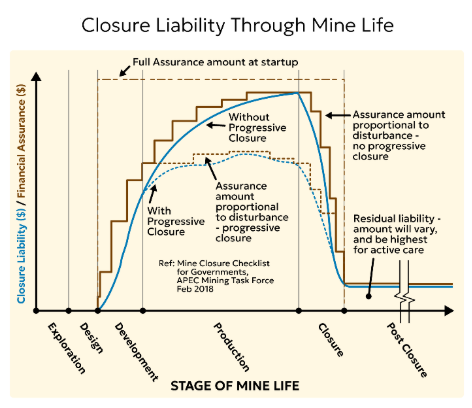
The territory of Nunavut holds bonds for both active and inactive mines to the estimated total of approximately $600 million in 2026. This estimate does not include legacy abandoned mines, as these sites predate today’s closure requirements. Unfortunately, the information behind the cost estimate is not contained in one document and had to be compiled from various sources, such as The Nunavut Water Board public registry; annual reports submitted by each mine; and company technical reports.
This pool of security credit should provide a strong incentive for mining companies to close their properties to get their bonds back. However, in most provinces, this incentive is rarely realized since the bond release mechanism is not straightforward, and in some cases, the entire bond is held until all the post-closure conditions are met.
Without measurable, quantitative criteria, the monitoring period could stretch to perpetuity. In the absence of clear bond release mechanisms, mining companies are reluctant to spend additional capital to execute closure. Instead, they prefer to enter care and maintenance (CM).
In Nunavut, most of the mines contributing to the bond estimate total are active, with the only closed sites being legacy abandoned mines. With the price of commodities such as gold and silver on the rise, Nunavut’s total reclamation security is expected to increase over the next decade.
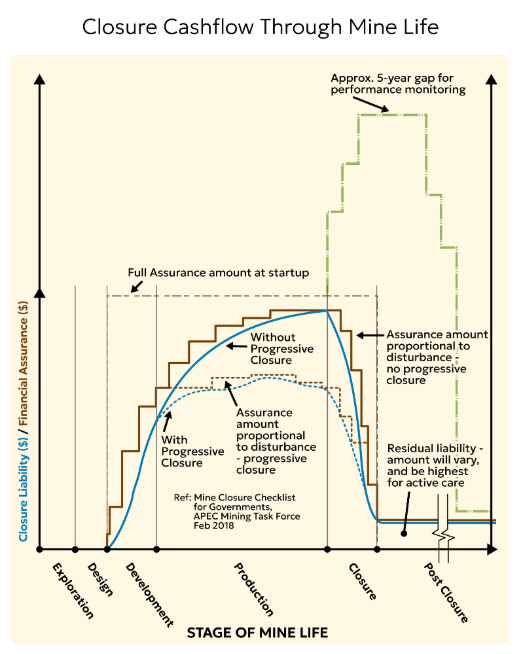
As projects reach full production and existing mines expand or deepen, closure liabilities, and therefore the required financial security, typically grow until progressive reclamation or eventual closure begins reducing those obligations. The true evidence of whether mining is sustainable in Nunavut is whether those active mines become new additions to the very short list of closed mines or new additions to the very long list of mines in CM.
Uncrackable codes
In my experience, there are few instances of financially significant progressive bond release, as there are typically no robust procedures for bond return, either before or during closure activities. As a result, many companies decide that entering a state of CM is less risky than attempting to fund closure activities with an unknown bond return mechanism. Although perhaps less risky in the short term, the primary long-term risk with entering CM is that it increases the chances of the bond not covering the cost of closure. Compounding this risk are the chances of the government/regulatory agency inheriting the mine closure.
Realistically, the most effective way to close mines is to have the operators close their own sites. The operators are the ones that have the institutional knowledge and the practical understanding that comes from physically working at the mine. Mining companies should be encouraged to advance their inactive properties from CM to active closure wherever practicable. However, the current lack of transparency around bond return does not inspire that intended behaviour. Part of the predicament for the mining companies includes a lack of reliable mechanisms to release the bond, which could impair and burden companies with further closure spending.
Combination or sledgehammer?
Within the closure security bond, there is a requirement for reclamation research. Historically, reclamation research has been confined to studying the growth of grass on soil. Instead, we should be researching whether a cover system will leave tailings/waste rock that is physically stable, chemically stable and compatible with the surrounding natural environment. The reclamation research requirement should be used as a trigger for initial closure communication with the regulator, regardless of the current project phase. The mining company should not do a thing related to closure without the regulator agreeing that the activity reduces uncertainty related to liability. And if it is agreed that the activity reduces closure liability, the next logical question is “How much?”
With these questions being asked early in the process, proof-of-concept or applied science cover and closure trials can be initiated during operations, when there are still abundant people, equipment, time and money. If the trials are successful in proving a closure concept and reducing liability, when the concept is applied at a large scale at the end of operations, the bond return mechanism will be more robust. This methodology could be used to avoid the scenario where a mine cannot afford to double pay for closure and instead goes into CM.
Mining companies, regulators and stakeholders need to agree to a transparent, measurable mechanism to progressively release the bond at the completion of individual closure components. This process should allow better financial planning for mining companies to carry out mine closure in a timely manner according to the approved plan. Most importantly, initiating the bond return conversation allows a starting point for the collective understanding of liability, risk and cost. If the conversation is advanced with the right framework, bond holders do not have to wait decades to see if closure works. The operator can use applied science and complete pilot studies during operations to prove closure concepts, progressively return parts of the bond and most importantly, fail early and often with your internal team to iterate rapidly before actual closure.
Taking a crack at the solution
Thinking back to my Kugluktuk experience, one widely-practiced closure concept in the Canadian North was the reliance on permafrost to encapsulate waste rock and tailings. Closure plans developed in the 1980s and 1990s did not have our current understanding of climate change and those plans assumed that permafrost depths would remain relatively constant into the foreseeable future. When monitoring data in the late 1990s and early 2000s began to suggest that thaw depths would penetrate the cover and waste, making the permafrost encapsulation closure concept obsolete. Some mining companies took that shifted understanding as an opportunity to improve their closure plans. Partially saturated covers were not new to mining, but they were relatively new to the Canadian North at the time. Their subsequent adoption as a pivot away from permafrost encapsulation gave mining companies a closure concept that was more physically and chemically stable in the face of climate change.
However, the regulators needed some convincing. During the community engagement sessions, we would get cross-examined by the opponent’s SMEs during the day. After dinner, at the only lodge in town, we were allowed to have meetings with those same SMEs in the joint dining room/kitchen that would stretch long into the night.
During those sometimes-heated discussions, we would decide collectively what evidence the proponent would need to provide to gain the trust of the opponent, through the language of science and engineering. Tailings facility closure investigations and studies were designed and executed only after in-depth communication with the regulators. This allowed both teams to close knowledge gaps and ensure the regulator’s consultants were satisfied with the long-term performance of the closure design. The investigations and studies included centreline geophysical survey of select dams; excavation of test pits for observation of active zone and cover profile in select cells; installation of standpipes, thermistors and moisture meters in select tailings cells; and thermal modelling and stability evaluation with and without permafrost.
The primary objective of the work was to confirm that the tailings cover would remain physically stable while providing chemical stability to groundwater contained in the cover and tailings. Ultimately, the regulators were convinced the tailings cover plan, with the presented known risks, was sufficient, which allowed the bond return discussion to begin. The objective of that discussion was to identify the sign-off requirements to signify cover completion and release of the associated bond.
Once our client gained the trust of the opponent’s consultants, the bond could be released annually based on the submission of sign-off documents and confirmation inspections by the regulators. The released bond allowed the operators to finance the next phase of closure activities with the prospect of more release based on annual milestones.
If the operators had not adaptively managed their initial closure concept, the progressive release of bond and ultimate closure of the site would not have been possible. Starting the conversations on closure early ultimately led to the bond return mechanism.
Safecracking 101
While Canadian mines have complied with closure legislation, billions of bond dollars are still held by regulators. The existing legislation, policies, framework, guidelines and money should warrant a high success rate of mine closure, but they have not.
I believe operators’ and consultants’ fear of communicating transparently about environmental liability and risk is limiting our opportunity to make mining and mine closure truly sustainable. In mine closure, when we are playing with geologic timescales, it only takes one mistake to create liability, risk and cost indefinitely. The scale of potential consequences is why we must advance our understanding collectively beyond the understanding of any one individual discipline or viewpoint. Capital access optimization for sustainability needs to be a joint effort.
The example above would help the collective understanding of the mining industry, but these lessons are not commonly shared, which is a waste of knowledge. If more mining companies and consultants could see that the midnight kitchen meeting is what they want, rather than shying away from an honest discussion of liability and risk, I am optimistic for the future of mining. Why? The midnight meeting is how we start making mining sustainable — portions of the returned bond can be used to fund future closure activities. And creating value without more cost — the mining company can access money they have already spent.
Let’s shift from holding billions in trust to actively investing in responsible closure.

Jim McKinley, PhD, P.Eng., is a senior hydrogeologist at NewFields Canada Inc.
Related Posts

Weir names new president of minerals division
October 21, 2026
Weir names new president of minerals division
Lion One reports preliminary operating results at Tuvatu, receives new underground drill
Hudbay, Mitsubishi approve Copper World construction
October 21, 2026
Hudbay, Mitsubishi approve Copper World construction
Sponsored video: Amex prepares for Perron bulk sample
October 20, 2026
Sponsored video: Amex prepares for Perron bulk sample

Comments