Unlocking Copper Mountain: Myriad Uranium charts path toward resource growth in Wyoming
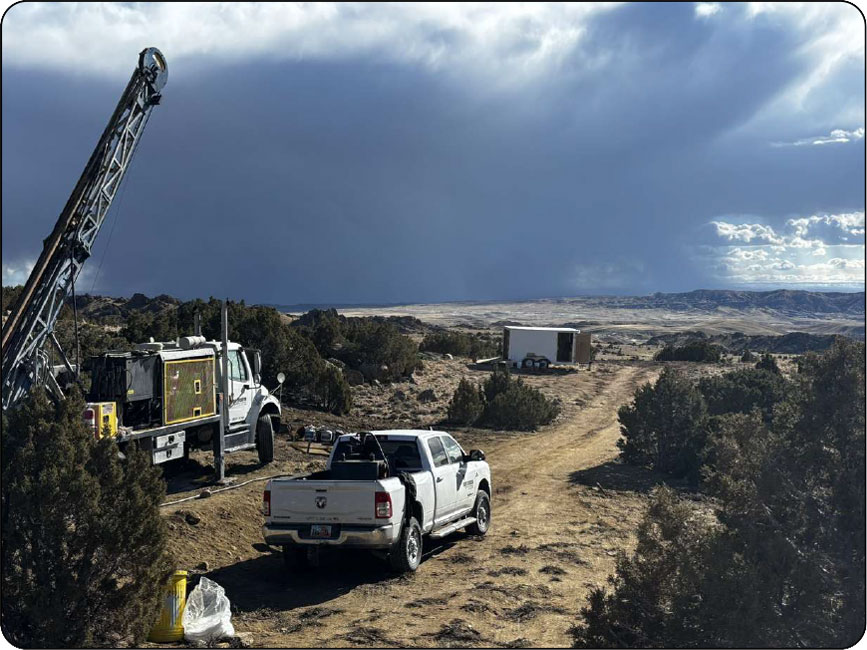
Myriad Uranium is advancing the Copper Mountain project in Wyoming; a historic uranium district once explored through programs led by Union Pacific and Bendix Field Engineering for the U.S. Atomic Energy Commission.
The company is combining historical datasets with modern drilling, geophysics and geological modelling, as it works toward a maiden mineral resource.
An updated NI 43-101 technical report marks a key step. It gives the company a framework for future drilling. With uranium demand tied to energy security, nuclear power growth and the rising electricity needs of data centres, Copper Mountain is drawing renewed attention as a potential domestic source of uranium supply.
Canadian Mining Journal spoke with Thomas Lamb (TL), CEO of Myriad Uranium, about the report, the Bendix dataset, the upcoming drilling and the role Copper Mountain could play in the U.S. uranium market.
CMJ: Before discussing Copper Mountain, can you tell us about your background and how you became CEO of Myriad Uranium?
TL: I began my career about 25 years ago as an M&A lawyer before moving into mining as an entrepreneur. In 2005, a business partner and I founded Gold Group, which we took public in 2010.
I later became involved in a project generator in East Africa. One of the companies that came out of that work was M2 Cobalt, which was sold to Jervois. I stayed on as an executive with Jervois.
A few years later, I was approached to become CEO of Myriad Uranium. At the time, the company was focused on Niger, which made sense because of my experience in Africa and my ability to speak French. Six months later, however, a military coup forced us to leave Niger.
That led us to Wyoming, where we acquired Copper Mountain. We have now earned up to a 75% interest in the project. Myriad has also added the Red Basin project in New Mexico. We have grown the company from about a $3-million market capitalization to roughly $50 million, and we are working toward an uplisting to either the New York Stock Exchange or NASDAQ.
CMJ: What are the most important conclusions from the updated NI 43-101 technical report?
TL: Almost all the historic exploration data at Copper Mountain was generated during the 1970s, when Union Pacific Railway and Southern California Edison partnered to advance what was intended to become a large conventional uranium mine. They drilled about 2,000 boreholes and invested approximately $125 million in today’s dollars before the project became fragmented through multiple ownerships.
Our team is the first to consolidate ownership across the district. The updated NI 43-101 technical report brings together the historical information with our own recent work for the first time in more than four decades.
The report integrates the historic drilling database, new geological information, the high-resolution airborne geophysical survey completed in Dec. 2025 and the U.S. Department of Energy’s 1982 Bendix Report, which assessed Copper Mountain’s uranium endowment at up to 655 million lb. That historical endowment estimate is not an NI 43-101 mineral resource, but it remains an extremely valuable technical reference.
By integrating this information into one technical framework, the report provides a clear path toward defining a maiden mineral resource and guides the next stages of exploration.
CMJ: How valuable is the Bendix dataset, and what does modern reinterpretation add?
TL: Copper Mountain is a unique project because it was one of only a handful of uranium properties in the U.S. that the Department of Energy considered strategically important during the early 1980s.
Bendix Engineering carried out a comprehensive study using the historic exploration data and published its findings in 1982. That report assessed a uranium endowment of up to 655 million lb. and generated an enormous amount of technical information. We now possess much of that original material, including microfiche records, and have been able to combine it with our own results.
The biggest advantage comes from applying modern technology to that historical database. In Dec. 2025, we completed a high-resolution airborne geophysical survey that provided several important new insights. One of the most significant discoveries was a major north-south structural corridor that now appears to control mineralization. That interpretation is new and fundamental to how we plan exploration.
The geophysics also revealed that almost all the new radiometric anomalies occur east of that structural corridor, while virtually all known historical resources and principal prospects are located to the west. That opens a new exploration corridor that previous operators were never able to investigate properly. The Bendix work had already suggested there was potential farther east, but there was not enough information available to test that concept. By combining the historic data with modern geophysics, we now have a much clearer understanding of where future discoveries may be made.
Our phase I drilling strengthened that interpretation. We completed 34 drill holes and made several important observations, including favourable radioactive disequilibrium. Laboratory assays returned uranium grades generally 20% to 60% higher than the historical grades, while mineralized intervals were also longer than previously recognized because of that disequilibrium.
CMJ: What is the next phase of drilling designed to demonstrate?
TL: We have divided the phase II program into three stages. The first stage, scheduled to begin in June 2026, focuses on verifying the historic database and confirming mineralization.
Copper Mountain contains seven known deposits, six of which formed part of the conventional mine plan developed in 1979. Our first objective is to confirm the historic mineralization by drilling two to four holes at each of five deposits that have never been tested using modern drilling techniques.
We want to validate the historic grades while improving our understanding of the geology and structural controls. Based on phase I, we also hope to demonstrate that the historic grades were understated because of radioactive disequilibrium.
The first stage will also include drilling at the Lucky Cliff prospect, immediately north of the historic mining area. Historic work identified an 85-foot interval grading 1,200 ppm equivalent uranium there. Given what we have learned elsewhere on the property, we are eager to see how those historic results compare with modern assays.
The second stage will test new high-priority exploration targets within the historic mining district and farther east, where the airborne survey identified numerous radiometric anomalies.
The third stage will focus on resource delineation and infill drilling, as we work toward a maiden mineral resource estimate.
CMJ: How did the airborne survey expand the target areas?
TL: The airborne survey was completed in Dec. 2025 using a helicopter flying approximately 30 metres above the ground. We covered 192 sq. km with 100-metre line spacing, producing data of exceptionally high quality.
The survey fundamentally changed our understanding of Copper Mountain. Previously, most attention had focused on the approximately 27-million-lb. historical resource contained within a relatively small central cluster of deposits. The new geophysics suggests the project’s potential extends well beyond that area.
The first major finding was the north-south structural corridor that now appears to control uranium mineralization throughout the district. The second was that most newly identified radiometric anomalies occur east of that structure, whereas virtually all historic resources, prospects and significant mineral occurrences lie to the west.
That creates a new exploration corridor with the potential to significantly expand the scale of the project. Those discoveries have reframed Copper Mountain from a project centred on known historical resources to one with district-scale exploration potential.
CMJ: Myriad recently announced the sale of the Red Basin project to Subatomic. Why is that important?
TL: We acquired the Red Basin project in New Mexico in early 2025 for approximately $525,000, split roughly equally between cash and shares. We have now sold a 90% interest in the project to Subatomic while retaining a 10% economic interest. We have also entered into a strategic alliance agreement with Subatomic, allowing us to work together on additional uranium opportunities.
Technology investors are becoming increasingly involved in uranium. I believe they see opportunities to modernize the industry, including parts of the fuel cycle that rely on technologies dating back decades.
CMJ: How do you see the domestic uranium market evolving, and where could Copper Mountain fit?
TL: The U.S. currently consumes about 50 million lb. of uranium annually while producing less than one million pounds. That imbalance has highlighted the importance of developing secure domestic sources of supply.
Government and industry recognize the need to increase domestic uranium production for strategic and energy security reasons. The growth of artificial intelligence, hyperscale data centres and other energy-intensive technologies is further strengthening demand for reliable long-term uranium supply.
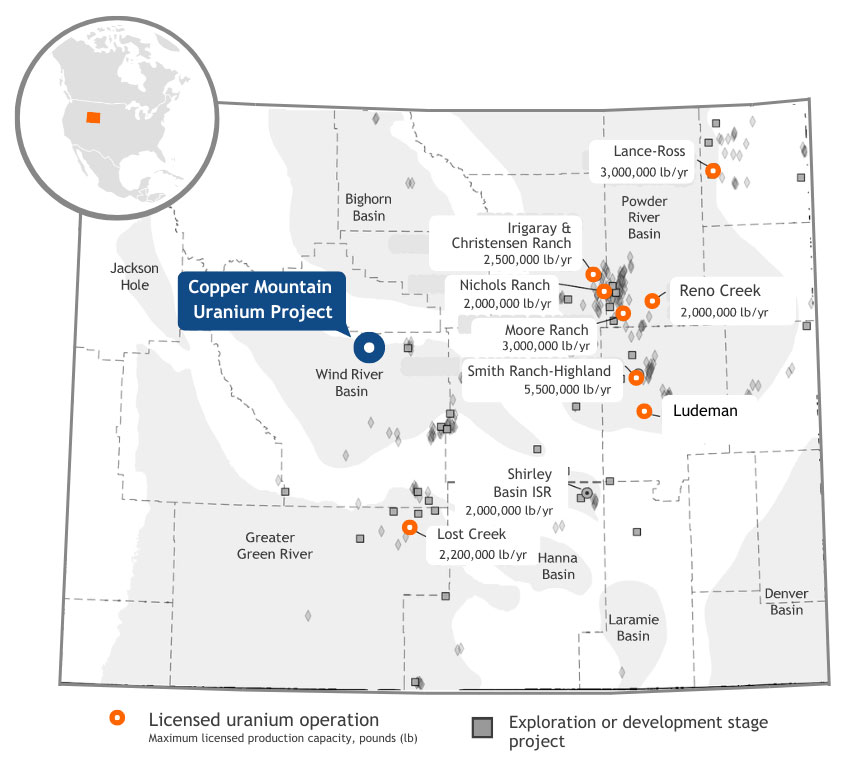
Copper Mountain is well-positioned within that environment. Wyoming remains the leading uranium-producing state in the U.S. and is one of the country’s most supportive mining jurisdictions. The project also benefits from its proximity to existing processing infrastructure, including the Sweetwater mill, and from our strategic alliance with Subatomic.
Watch the two-part video of the interview at
https://youtu.be/QJ1zTYlOUHY?si=udNTiYzMpnF3UmJW
Related Posts

Netzsch names new mining market manager
September 18, 2026
Netzsch names new mining market manager
Emerson rolls out standardized liquid panel solution
September 17, 2026
Emerson rolls out standardized liquid panel solution
Echo Seismic opens new specialist support division
September 17, 2026
Echo Seismic opens new specialist support division

Komatsu kicks off new machinery career campaign
September 16, 2026
Komatsu kicks off new machinery career campaign
Electra releases preliminary battery recycling results
September 16, 2026
Comments