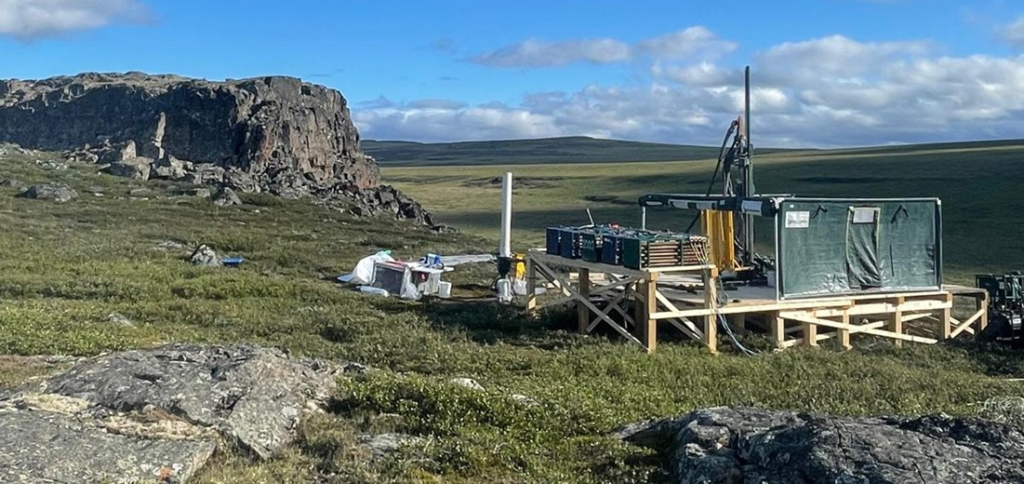
High-grade copper drilling results at White Cliff Minerals’ (ASX: WCN; US-OTC: WCMLF) Rae project in western Nunavut suggest the potential for a significant red metal system at its Danvers target, part of a historical copper area.
Highlight hole DAN26012 returned 19.8 metres grading 6.64% copper from 152.4 metres depth, including 7.6 metres at 11.38% copper and 3 metres grading 17.68% copper, the company reported Wednesday. That interval also included 1.5 metres at 21.1% copper, or one-fifth pure copper, the strongest result yet at Danvers. Rae is about 75 km west of the hamlet of Kugluktuk.
“These results rank among the highest-grade intercepts returned from Danvers and highlight the extraordinary potential of this rapidly growing mineralized system,” White Cliff Managing Director Troy Whittaker said in a release. He cited the target’s grades, growing strike length and open-ended mineralization.
Northern metal momentum
The results at Danvers come amid a heightened focus by governments on securing critical metals in Canada’s Far North, where limited infrastructure across vast distances present challenges to accessing its resource riches. Danvers and the wider Rae project are in Nunavut’s Kitikmeot region which would host the proposed federally-backed Grays Bay Road and Port Project connecting the Arctic Ocean with an all-season road into the Northwest Territories.
Other noteworthy results at Danvers include 6.1 metres grading 1.08% copper from 103.6 metres in hole DAN26009 and 19.8 metres at 1.03% copper from 230.1 metres depth in hole DAN26010. Hole DAN26011 cut 7.6 metres grading 1.92% copper from 144. 8 metres.
The assay results have confirmed copper mineralization over 2.6 km and visual red metal
mineralization points to the possibility that the wider system might extend more than 4 km along strike, White Cliff said. The company plans to drill the remaining 8 km on target before August.
Long-known district
Rae sits on the Teshierpi Fault Zone, a district-scale structure believed to host copper-silver mineralization across the historical Coppermine district. Recognized since the 18th century as a copper hotspot, the area has had little modern exploration. White Cliff began exploration at Rae in 2024.
A historical, non-compliant resource estimate from 1968 gives Danvers 4.16 million tonnes grading 2.96% copper.
White Cliff shares gained 13% to A1¢ apiece on Wednesday in Sydney, for a market capitalization of A$34 million (C$33.2 million). The stock has traded in a 12-month range of A1¢ to A3¢.
Comments