Asbestos and the quiet revolution
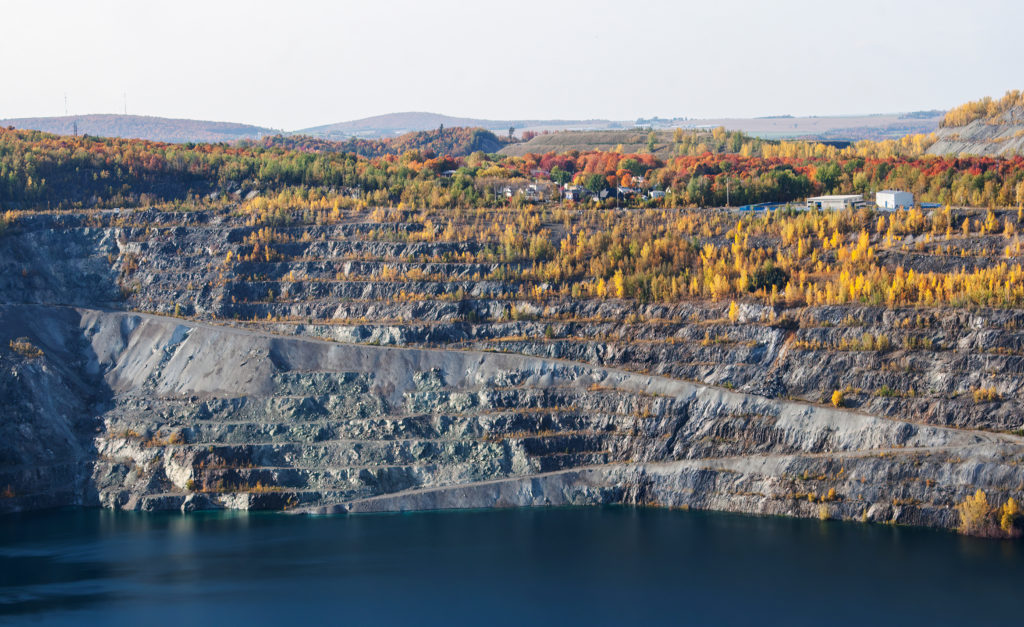
The province of Quebec has a long and tangled history of asbestos mining. In the 1880s, the opening of two large asbestos mines — Thetford Mines, located south of Quebec City, and the second was the massive open pit Jeffrey Mine, located in the Eastern Townships adjacent to the mining town of Asbestos (recently renamed Val-des-Sources) — positioned Quebec as the undisputed leader in Canadian asbestos production. At this early stage, industry used asbestos to manufacture textiles, book covers, insulation, and eventually brakes for automobiles.
It was the fire-proof properties of asbestos, however, combined with the building boom in housing after WWII, that led to extremely high demand for the fibrous mineral. In 1918, an American company specializing in construction material, Johns-Manville, became a major player in the Quebec asbestos industry when it purchased the Jeffrey Mine. The fact that an American company controlled a major producer of what was then thought of as “white gold” added weight to the arguments of nationalist, francophone Quebecers who dreamed of becoming “maître chez nous” with respect to resource development. As future separatist premier René Lévesque wrote in a 1960 edition of the influential Cité libre magazine, “our forests, our paper, our iron, our titanium, our asbestos, our gold, our copper, our silver, our zinc, our sulfur and the greatest part of our hydro-electric developments belong to Anglo-American businesses.”
Amid such critiques of Quebec’s apparent status as a resource colony, influential members of Quebec’s intelligentsia began to regard a strike at the Jeffrey Mine in 1949 as a key precursor to the province’s “Quiet Revolution.” Although the true beginning of the Quebec’s Quiet Revolution dates to the election of Jean Lesage’s Liberal party in 1960, which ushered in a period of transformative secularization and modernization, for some it was the asbestos strike that first signaled a rejection of Maurice Duplessis’ long-ruling and (according to his critics) backward looking Union Nationale government. Pierre Trudeau, writing in a collection of essays he published in 1956, declared that “the drama at Asbestos was a violent announcement that a new era had begun,” and “this strike is a turning point in the entire religious, political, social and economic history of the Province of Quebec.” For Trudeau, one of the key demands of the Asbestos strikers — formal recognition of the Confédération des travailleurs catholiques du Canada (CTCC) as the workers’ bargaining agent — was a clear challenge to the authoritarian, anti-union stance of the provincial government and a foreign company. Lévesque was more circumspect, writing in the same Cité libre article that, “in all sectors that have been exploited the longest (gold, asbestos, forests), we still do not exist, just as we did not before. By ripping out its heart and pulling like a ball-and-chain the ferocious hostility of its own government, labour has finally managed to secure salaries less inferior than those that used to be offered by the Americans and Ontarians. In the town of Asbestos, for example. That’s it.” Trudeau, however, saw something more profound in the strike than incremental salary gains: confirmation that Quebec could build a modern industrial economy for the benefit of its citizens and not just the bottom line of foreign companies.
But was the strike really a battle over the political and economic future of Quebec? In her book, A Town Called Asbestos, historian Jessica van Horssen has argued that Trudeau’s invocation of the strike as a “turning point” in Quebec’s history ignored the workers’ focus on improving their own specific working conditions and wages. In addition to the demand for union recognition, the CTCC bargained for a raise (from 85 cents to one dollar per hour), job security, additional paid holidays, and input on who was promoted at the mine. One crucial priority for the CTCC was better dust suppression to prevent asbestosis, a deadly scarring of the lungs from asbestos fibers causing shortness of breath and slow death among its victims.
The workers at the Jeffrey Mine were aware of the threat asbestos fibers posed to their health. In Jan. 1949, Burton LeDoux, a reporter at Le Devoir, published a report suggesting that Johns-Manville knew about the risk to workers, but had done nothing to improve air quality in the mine. As van Horssen argues, workers at Jeffrey Mine saw the fight for their health (and ultimately their lives) as much more important than accelerating the social and economic transformation of Quebec.
Given the issues at stake, perhaps it is no surprise that the strike was heated. After the workers walked off the job after the evening shift of February 13th, the mood for the first few days was light and celebratory, with picketers allowing workers to cross the line to maintain pit dewatering pumps. On February 18th, the company printed an ad in the local paper labelling the union’s demands as unreasonable, diminishing hope for a quick settlement. Two days later, Duplessis sent in the provincial police, a provocation for the striking workers, who saw it as an invasion of outsiders in a close-knit town, and well understood Duplessis’ long history of using the police to suppress organized labour. The strike became violent by mid-March, when workers responded to the company’s decision to use replacement workers by blowing up part of the rail line into town. Faced with threats of eviction from company-owned housing, the strikers set up barricades on the main roads into town on May 5th, prompting a standoff with police. The next day, the police decided to crack down on the strike, raiding a church where support strikers from Thetford Mines were sleeping and conducting beatings and mass arrests.
The strikers held on until June 30th, but the company managed to thwart most of the workers’ demands. An arbitration board awarded a 10 cent per hour raise and four extra paid holidays, but offered nothing on job security, promotions, or the abatement of asbestos dust in the working environment. The arbitration board accepted Johns-Manville’s claim that workers were safe from the dust so long as they were subject to frequent medical exams. Those who showed signs of lung distress could be removed from dusty workplaces so their lungs could heal over time, an approach that relied more on wishful thinking than scientific evidence. Over time, the company emphasized the use of respirators over air quality improvements, though workers found them uncomfortable and they often became clogged.
The body of evidence documenting asbestos risks mounted in the 1960s, including widespread scientific evidence that asbestos caused a form of lung cancer, mesothelioma, that could become acute decades after exposure. As medical lawsuits against Johns-Manville began to mount in the U.S., the company filed for bankruptcy protection in 1982, sold the Jeffrey Mine a year later, and eventually set up a trust fund to compensate thousands of workers exposed at mines and manufacturing facilities throughout North America. Pierre Trudeau’s attempt to snatch a victory for Quebec from the jaws of the strikers’ defeat ignored the fact that the province’s asbestos miners still faced danger from toxic dust decades after they walked off the job.
John Sandlos is a professor in the Department of History at Memorial University of Newfoundland. His new book, The Price of Gold: Mining, Pollution and Resistance in Yellowknife — co-authored with Arn Keeling and published by McGill-Queen’s University Press — was recently shortlisted for the Canadian Historical Association’s prize for best English-language scholarly book in Canadian history.
Related Posts
Sponsored video: Canagold nears build decision at New Polaris
October 9, 2026
Sponsored video: Canagold nears build decision at New Polaris
Sponsored video: Westhaven and Dundee eye a new B.C. gold camp
October 9, 2026
Sponsored video: Westhaven and Dundee eye a new B.C. gold camp
The great Canadian white gold rush
October 9, 2026
The great Canadian white gold rush
Canadian mines need an AI decision log before automation scales
October 9, 2026
Canadian mines need an AI decision log before automation scales
Comments