A new economic study for Omai Gold Mines’ (TSXV: OMG; US-OTC: OMGGF) namesake project in Guyana positions it among the largest and most valuable undeveloped gold projects in South America, with a $4-billion (C$5.5 billion) value, more than double its estimated costs.
Discounted at 5%, that net present value (NPV) in the new preliminary economic assessment (PEA) assumes a gold price of $3,600 per oz. and contrasts with the $1.42 billion in initial capital costs, Omai reported Wednesday. The PEA also outlines a 24% internal rate of return (IRR) and a 4.1-year payback period for the past-producing project that could mine 6.3 million oz. of gold over an 18-year life.
"The study validates a globally relevant scale and long-life production profile, with better throughput, production and strip ratio than our expectations," though offset by the $1.4 billion in costs and 4-year payback period, National Bank of Canada analyst Rabi Nizami said in a note on Wednesday.
‘Emerging M&A target’
"While there may be some initial profit taking on the news, we expect interest in Omai to continue to be strong going forward as we believe Omai is emerging as a clear M&A target of interest for global intermediate and large-cap producers," he added.
Despite the study’s positive economics, Omai shares were down 1% to $2.96 apiece on Wednesday morning in Toronto, for a market capitalization of $2 billion. The stock has traded in a 12-month range of 86¢ to $3.16.
The PEA comes just four months after Omai released a resource update for the project that showed it hosts one of the largest gold resources in the country. Omai is about 165 km south of the capital Georgetown in central Guyana.
Large past-producer
The project is one of South America’s largest past-producing gold mines, having yielded more than 3.7 million oz. between 1993 and 2005. Guyana has in recent years emerged as a choice gold jurisdiction, drawing investment with its stable mining regime, improving infrastructure and an array of discoveries that have positioned it as a new exploration hotspot alongside neighbours Suriname and Brazil.
"We are very pleased to deliver this PEA, which reinforces the potential for Omai to become a very large-scale mining operation with a clear path to bringing significant economic benefits to the people of Guyana,” Omai CEO Elaine Ellingham said in a release.
“As a past-producer, Omai has many benefits giving it a leg up to re-development, including highway access, a cleared site, an on-site airstrip, a tailings facility, known metallurgy, and the unique confidence that comes from a historical record of economic gold extraction.”
Oko West differences
When compared with G Mining Ventures’ (TSX: GMIN; US-OTC: GMINF) Oko West project in Guyana, Omai would produce about 1.9 million more oz. gold and over a longer life, according to the Oko West feasibility study from last year.
However, Oko West’s NPV is 9% more and its IRR is 19% higher. Initial costs are about a third lower, and its payback period is just 1.6 years. Oko West is about 105 km north of Omai.
Omai hosts 38.1 million indicated tonnes grading 2.04 grams gold per tonne for 2.5 million oz. contained metal, and 106.6 million inferred tonnes at 1.59 grams for 5.5 million ounces.
The project comprises the open-pit Wenot shear-hosted deposit and the adjacent underground Gilt intrustion-hosted deposit. An April 2024 PEA gave the project an after-tax NPV (at a 5% discount rate) of $556 million at a gold price of $1,950 per oz. It covered only the Wenot open pit and about 1.84 million oz. of resources.
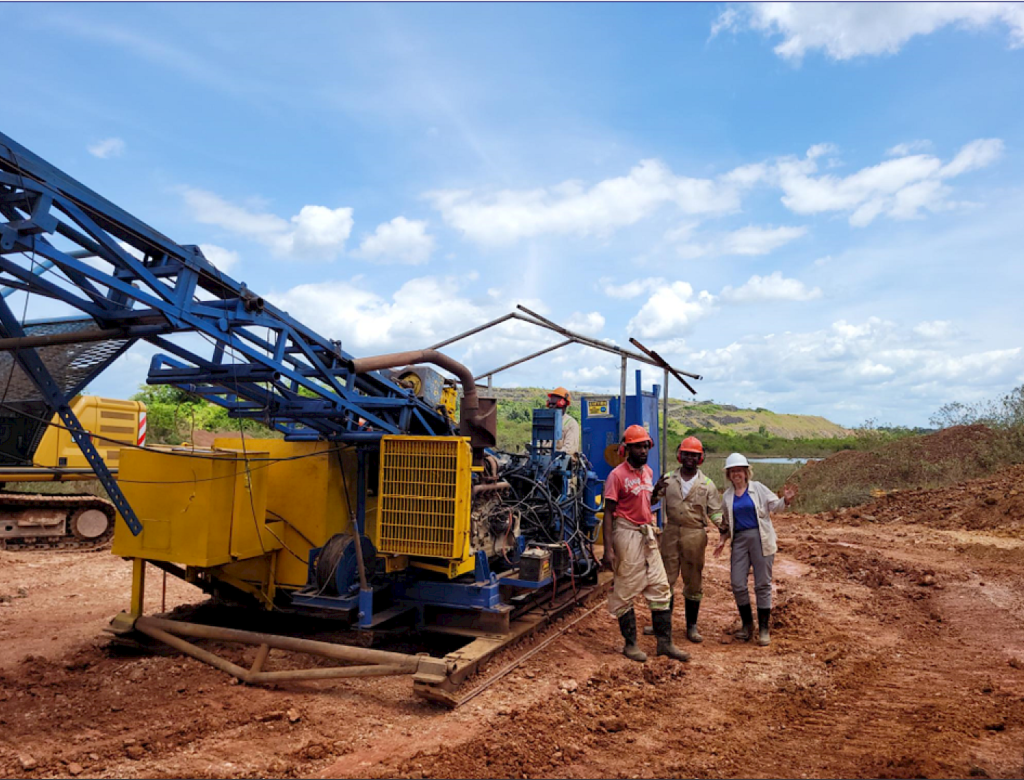
Drilling is ongoing at Wenot with five rigs, opening the possibility of further growth at the site, Ellingham said.


Comments