Unlocking value in mining through smarter lubrication strategies

In modern mining, productivity and cost efficiency are so closely linked that you cannot effectively evaluate one without fully understanding the other. That is why Mobil Lubricants experts have moved beyond supplying lubricants to become strategic allies for the entire operation. By expanding the scope of the support for mining operations to help deliver measurable value through technical expertise, data-driven insights and advanced lubrication solutions that reduce total operating cost, we have found opportunities to improve reliability, efficiency and confidence.
Investing now to save money over time
For Mobil Lubricants experts, this approach typically includes using higher-quality lubricants, such as synthetic oils, to improve equipment performance, along with services and tools to track results. At first glance, upgrading from conventional oils to synthetics or adding services may appear to increase costs, which often creates hesitation for operations focused on short-term budgets. However, the benefits to true cost of ownership extend far beyond the upfront price of the lubricant.
When evaluated holistically, synthetic lubricants offer a strong value proposition. Their advanced formulations provide improved thermal stability, oxidation resistance and wear protection. This may lead to more consistent performance under extreme mining conditions. Equipment such as haul trucks, excavators and loaders operate under heavy loads, high temperatures and near-continuous use. In large mining haul trucks, for example, switching to a synthetic engine oil can help provide benefits beyond daily operation — it can also extend oil drain intervals and even component life.
Helping extend engine rebuild timing
Across the mining industry, engine rebuild timing varies widely depending on operating conditions and maintenance practices: Baseline expectations are typically 12,000 to 15,000 operating hours under harsh conditions, while most well-managed operations plan rebuilds in the 18,000-to-22,000-hour range. Finally, strong maintenance practices and condition monitoring can extend performance to 18,000 to over 25,000 hours. In practical terms, anything beyond ~25,000 hours is generally considered high performance.
Importantly, rebuild timing is not fixed — it is condition-based. Factors such as payload, haul grade, idle time, oil condition and wear trends can shift overhaul timing by over 10,000 hours between similar trucks within the same fleet.
Against this backdrop, Mobil Lubricants experts have demonstrated that switching to a synthetic oil program can help extend engine life beyond typical industry ranges. While many operations rebuild engines around 18,000 to 22,000 hours, synthetic lubrication programs have enabled some engines to reach over 40,000 hours before requiring a rebuild — beyond standard performance levels. When an engine rebuild in mining can cost around $500,000, the financial impact is clear.
The best way to determine the cost benefits is by analyzing the cost-per-hour of a given machine. While conventional engine oil costs around $1.30 per operating hour, standard rebuild intervals drive high depreciation costs up to approximately $28 per hour.
By comparison, a synthetic oil program’s $3.20 per hour can more than offset the corresponding 25,000-hour engine rebuild interval, which could drop depreciation costs to about $20 per hour — resulting in net savings for synthetic users of roughly $6.10 per hour. If the rebuild intervals reach 40,000 hours, the potential savings increase even more and up to approximately $13.50 per operating hour.
Extending oil drain intervals
Synthetic lubricants also provide another key benefit: an extended oil drain interval. In many cases, this benefit alone can justify converting a fleet because it delivers immediate and visible savings at the site level.
Conventional engine oils typically require replacement every 500 operating hours, while synthetic oils can often extend this interval to 1,000 hours or more. This reduces synthetic oil-related cost from about $3.20 to approximately $1.60 per hour — bringing it close to conventional oil cost, but with improved performance. That is before considering the reduced oil consumption, maintenance frequency, labour, downtime and reduced risk of contamination of other maintenance-related issues.
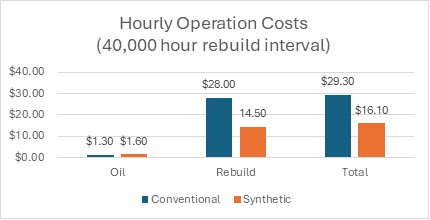
These benefits become even more impactful at the fleet level. For example, a mining operation with 40 haul trucks operating 6,000 hours per year could achieve total savings of up to $3.2 million annually, based on $13.20-per-hour savings. This level of improvement can improve margins and free up capital for other operational priorities.
Helping improve reliability
Beyond cost savings, advanced lubrication solutions improve reliability. Reduced wear and better protection lower the risk of unexpected failures, increasing equipment availability. By reducing interruptions and optimizing maintenance schedules, synthetic lubricants support more predictable and efficient operations.
Importantly, achieving these results requires more than simply changing products. It involves a comprehensive approach that combines premium lubricants with technical expertise, field support and data analysis. Mobil’s approach emphasizes working closely with mining operations to understand site conditions, identify opportunities and implement tailored lubrication strategies. This includes monitoring equipment performance, analyzing oil condition and continuously improving maintenance practices based on real-world data.
Overall impact
These integrated solutions help mining operations move from reactive maintenance to a more proactive and performance-driven approach. The value of lubrication is not in its purchase price, but in how it impacts the entire operation. With better data and insights, supervisors and managers can make more informed decisions that improve fleet performance and reduce long-term costs.
Jonathan Leland is a lubrication engineer at ExxonMobil.
Related Posts
Liberty Gold stretches Black Pine’s reach in Idaho
October 22, 2026
Liberty Gold stretches Black Pine’s reach in Idaho

Weir names new president of minerals division
October 21, 2026
Weir names new president of minerals division
Hudbay, Mitsubishi approve Copper World construction
October 21, 2026
Hudbay, Mitsubishi approve Copper World construction
Copper surplus masks looming $332B mine shortfall
October 20, 2026
Copper surplus masks looming $332B mine shortfall
Eriez debuts copper reduction process for scrap metal recycling
October 19, 2026
Comments