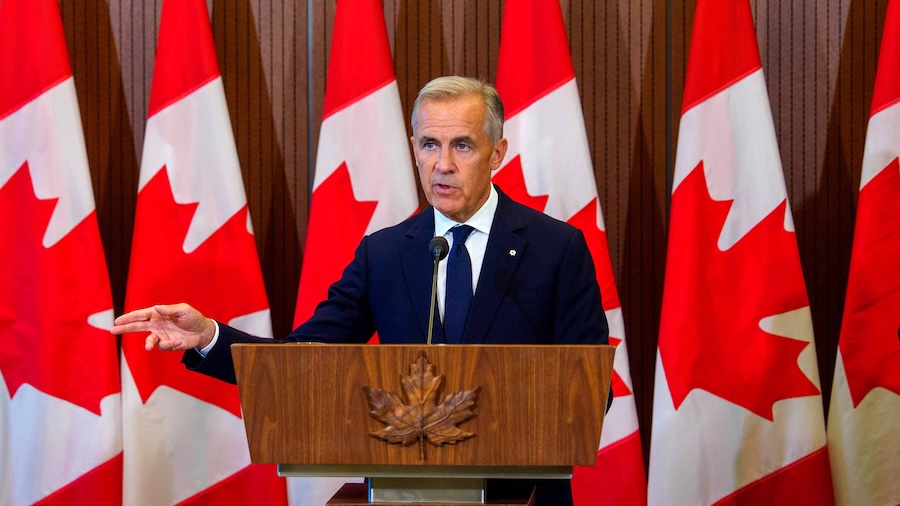
Prime Minister Mark Carney is putting mining at the centre of Canada’s bid for C$1 trillion ($721 billion) in global investment as Ottawa seeks capital to build mines, processing plants and the infrastructure needed to get more of the country’s resources to market.
More than a third of the 167 projects being pitched at the first Canada Investment Summit in Toronto this week involve minerals and mining. The broader portfolio spans energy, infrastructure, manufacturing and technology as the government brings Canadian businesses face-to-face with some of the world’s largest investors.
The mining-heavy pitch comes as escalating trade tensions with the US increase pressure on Canada to diversify its economic relationships and find new markets for its resources. But attracting investors is only part of the challenge: Canada must also show it can permit, finance and build major projects quickly enough to compete for global capital.
Mining capital
Carney invited 100 of the world’s biggest investors, collectively overseeing more than $70 trillion in assets, to the summit.
Expected attendees include BlackRock chairman Larry Fink and Temasek CEO Dilhan Pillay, along with managers of Norway’s government pension fund and representatives of state-owned companies such as Abu Dhabi National Oil Co.
Among the mining companies seeking capital is Troilus Mining (TSX: TLG), which needs $1.43 billion to develop its gold-copper project in Quebec. The prospectus also includes a nuclear-fuel services project described as Canada’s first uranium refining and conversion facility in more than 40 years.
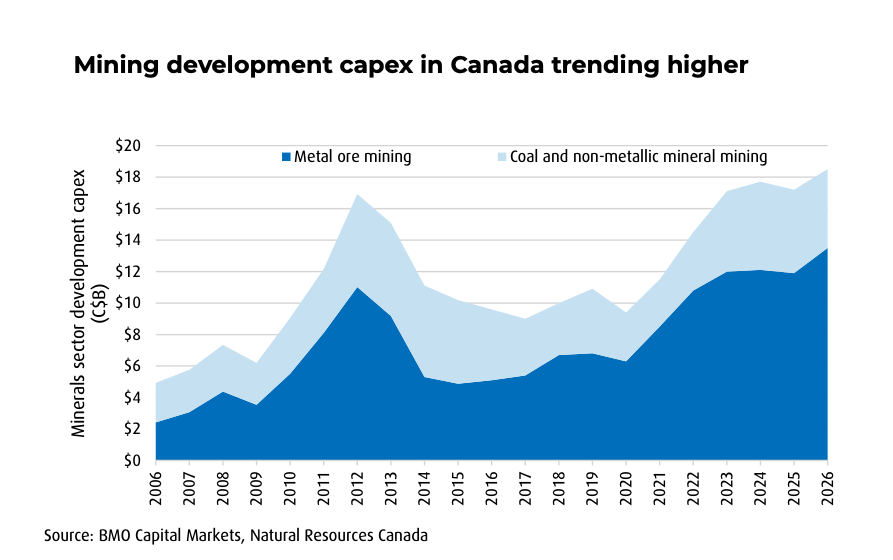
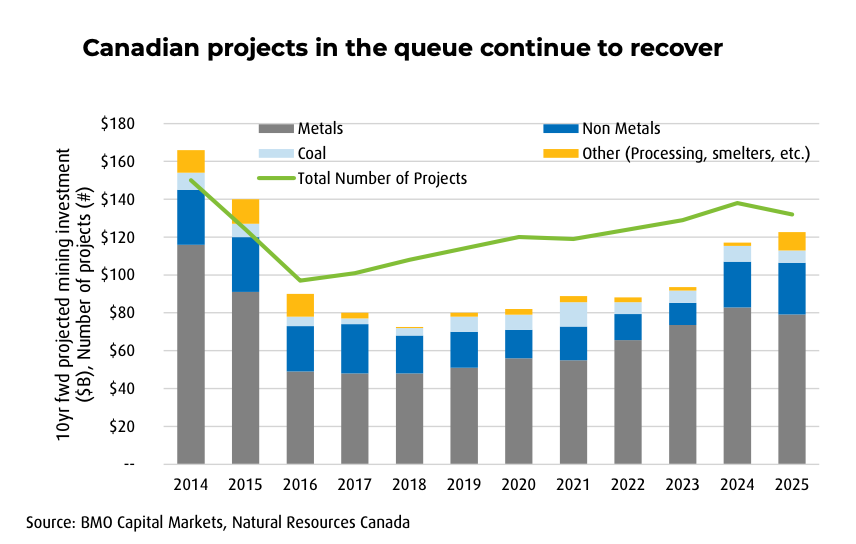
The investment gap leaves substantial room for growth. BMO Equity Research forecasts annual Canadian development capital expenditures will increase more than 11% over the next two years.
Mining companies covered by BMO are expected to spend about C$350 billion on operating costs, sustaining capital and growth projects to produce Canadian metals and minerals over the next five years.
Beyond commodities
Canada’s opportunity extends beyond extracting commodities, BMO Global Metals & Mining analyst Matthew Murphy said in an investment report. Additional capital is needed for copper smelting and refining, by-product recovery, battery precursor materials, rare earth separation, magnets, graphite processing and recycling.
Building those capabilities could allow Canada to capture more value from its mineral wealth instead of relying primarily on upstream production.
The country has already produced major mining companies and attracted some of the world’s largest operators, giving investors exposure across commodities and market capitalizations. They range from Canadian-based Agnico Eagle Mines (TSX: AEM; NYSE: AEM) to global miners Glencore (LSE: GLEN) and BHP (NYSE: BHP; LSE: BHP).
For investors gathering in Toronto, BMO’s analysis suggests the opportunity is therefore broader than financing individual mines. Reaching Canada’s investment ambitions will require capital for infrastructure, mineral production, processing and downstream industries that can turn its resource base into more complete domestic supply chains.
Carney’s push for investment also extends beyond Canada’s borders. After the summit, he is scheduled to travel to Saint-Pierre-et-Miquelon, France, on Sept. 20 to meet French President Emmanuel Macron.
The two leaders are expected to discuss deeper cooperation in strategic sectors including energy and critical minerals, along with aerospace and advanced technologies such as quantum computing, satellites and supercomputing. The talks come as Canada pursues closer economic and security relationships with France and the European Union.
Carney has also put figures with deep business and investment experience in key government positions. He appointed Dominic Barton, chair of Rio Tinto (ASX, LON: RIO) and a former Canadian ambassador to China, as chair of Invest in Canada, the federal agency responsible for attracting foreign direct investment.
Building challenge
For miners, access to capital solves only one part of the development equation.
Carney has moved to streamline project approvals and accelerate major developments, but Canada’s lengthy permitting processes and history of delays remain potential obstacles to converting investment commitments into producing mines and processing facilities.
The issue is particularly acute in mining because deposits cannot be moved to jurisdictions offering faster approvals. Developing a mine can require billions of dollars in upfront investment alongside roads, power, processing plants and transportation infrastructure before its commodities reach customers.
Energy investors have faced similar problems. Carney has reversed some climate policies introduced under former prime minister Justin Trudeau and supported the prospect of another oil pipeline, yet some executives remain wary after previous projects failed to advance.
Enbridge Inc.’s (TSX: ENB) proposed Northern Gateway pipeline had its federal approval overturned by a court, while TC Energy (TSX: TRP) abandoned its C$15.7-billion Energy East project to carry crude to Eastern Canada.
Canada could encourage reluctant investors to move off the sidelines by putting government capital behind projects, according to TD deputy chief economist Derek Burleton.
The summit’s success could ultimately hinge on whether Canada can move beyond supplying raw materials and attract the investment needed to build domestic refining, processing and manufacturing capacity that captures more of their value.


Comments