Tomra Mining and K+S Minerals and Agriculture have reached a major milestone in their technological partnership at the Zielitz mine in Germany with a successful underground sorting pilot plant for rock salt pre-separation. The project seeks to minimize stockpiling, relieve the bottleneck at the mineshaft and enable further mine expansion, and the underground pilot plant uses a Tomra XRT sorter that was specially adapted to meet K+S’s objectives—a unique solution developed specifically for the mine’s conditions and requirements.
This pilot project represents the latest step in a long-standing collaboration between Tomra and K+S, Europe’s leading salt producer and a global supplier of potash minerals. Their partnership dates back to 1998, when Tomra installed its first color sorter at the Braunschweig-Lüneburg site in Grasleben, and the two companies have since worked together on numerous projects and conducted extensive testing across various plants.
K+S launched the Zielitz project as part of its effort to find practical, long-term measures that improve sustainability and boost productivity across its production and supply chains, and it partnered with Tomra to investigate ways to remove barren waste underground, substantially reduce stockpiling and raise the ore grade through the shaft.
Dr. Isabell Pfaffe, a co-author in a recent technical paper on the project, said: “The handling of backfill has been an important issue in mining for decades. The ever-increasing demands of deeper and more complex deposits, the economic necessity for economies of scale and increasing environmental regulations must be met. The lean manufacturing approach of removing worthless minerals from the material stream as early as possible and further processing the valuable minerals in a concentrated form promises numerous advantages.”
The sorting plant was installed underground and commissioned in 2022, and it employs Tomra’s XRT technology to identify and remove waste material—predominantly halite (NaCl)—with a potassium (K2O) content below 2%. By sorting mined material underground to divert waste and reuse parts of it as backfill, the pilot plant tackles three key challenges at Zielitz. First, it reduces stockpiling, which currently requires significant environmental protection measures.
Second, it eases the bottleneck at the main shaft, which can hoist up to 45,000 metric tons per day and therefore has no spare capacity for future expansion or the return of processed waste underground. Third, it addresses infrastructure limits ahead of a planned mine extension spanning more than 40 km, since the site currently lacks the transport capacity and facilities to return processed waste as backfill into mined-out areas.
To meet K+S’s goals, Tomra developed a custom solution based on a Tomra COM XRT 2.0 1200 sorter with a sensing system, setup and algorithms specially tuned for the project. The process starts with a feed system that uses an adjustable flow divider on the main belt to direct raw salt to a double-deck vibration screen, which separates material into defined size fractions while returning oversize and undersize material to the main belt. Operators can change the screen mats to test different size ranges.
After screening, the material moves to the XRT sorter, which detects potash-bearing rocks and ejects unwanted sodium salt, which has a lower atomic density. Material classified as waste, with potassium content below 2%, is sent to a conveyor for backfill, while the concentrate returns to the main belt and continues to the shaft.
Installing the pilot sorting system underground presented significant logistical challenges, most notably the need to transport the 18-ton XRT sorter through the shaft; the team carefully disassembled the machine, lowered it in components and reassembled it onsite. Tomra’s prior experience with underground installations proved invaluable in overcoming this challenge in close cooperation with K+S personnel.
The pilot project has met its objectives and demonstrated that the Tomra XRT sorter can effectively remove liberated halite. The pilot plant currently processes 50 tons per hour and can divert up to half of the feed as barren rock underground, reducing the burden on the shaft and enabling higher mining throughput. A portion of the barren waste (potassium content below 2%) serves as backfill, lowering the amount sent to stockpiles, while the remaining feed—now with nearly double the ore grade compared with the previous setup—is blended back into the main stream to the shaft and hoisted to the processing plant.
With these successful results, the companies are planning the next phase, which includes exploring capacity scaling and integrating Tomra’s AI-powered OBTAIN technology. OBTAIN uses Deep Learning to identify the properties of each individual particle—even when particles touch on the belt—so the technology achieves single-particle precision in high-throughput ore sorting and can increase precision and reliability independently of the sorter’s capacity.
Jens Michael Bergmann, global segment manager of industrial minerals at Tomra Mining, commented: “Our vision of what can be achieved in a further stage, introducing more sorters with OBTAIN, is to sort as many tons of ROM as possible. The sorted waste, which is about half of the sorter feed, is used for backfilling, and the remaining amount of high-grade product is conveyed to the shaft. The aim is to further increase the K2O grade at the shaft, which will mean hoisting the same tonnage but at a higher grade in the future,”
He added: “This will automatically reduce stockpiling, and the downstream processing steps at the surface installations will be more efficient due to the higher potassium grade of the hoisted raw material. We have started testing OBTAIN to see how much we can increase the sorter capacity while maintaining the same performance. The initial trials at the Tomra test center have shown very promising results.”
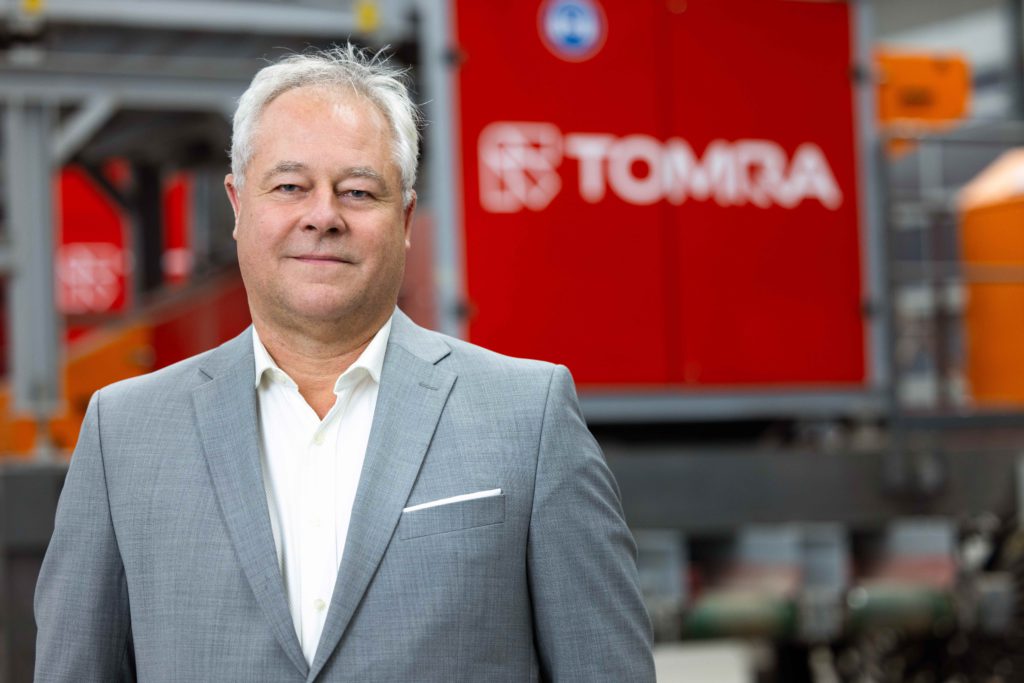
Jens Michael Bergmann, global segment manager of industrial minerals at TOMRA Mining.
The Zielitz pilot plant has already drawn interest from other mining companies facing similar operational and environmental challenges, and by combining advanced engineering, sensor technology, AI-driven data processing, Tomra’s installation experience and the strong K+S collaboration, the project highlights the transformative potential of sensor-based underground pre-separation.


Comments