Hydro‑Québec power application and 50,000‑t bulk sample permitting underway PMET Resources (TSX: PMET; US-OTCQX: PMETF) submitted the environmental and social impact assessment (ESIA) […]
Hydro‑Québec power application and 50,000‑t bulk sample permitting underway
PMET Resources (TSX: PMET; US-OTCQX: PMETF)submitted the environmental and social impact assessment (ESIA) for its Shaakichiuwaanaan project to federal and provincial authorities, marking a major step toward mine authorization. The company filed the ESIA on March 31, 2026, and the federal Impact Assessment Agency of Canada (IAAC) has deemed the submission complete and launched the first statutory public consultation, which runs through May 28, 2026.
"In just roughly four years since the first drill hole at CV5 in November 2021, we've delivered the lithium-only feasibility study and submitted the final ESIA documentation for mine authorization – a testament to the quality of the asset and the team behind it. But it does not stop there, as we continue to progress the project's critical path through to FID," Ken Brinsden, PMET’s president and managing director, said.
"Shaakichiuwaanaan has the scale, grade and strategic positioning to become one of the world's leading critical minerals projects, right here in Quebec, supporting North American and global supply chains. As geopolitical tension grows across energy and the critical minerals sphere, this represents a massive opportunity for Quebec and Canada to be front-and-centre in the future of lithium, caesium, and tantalum supply to global markets," he added.
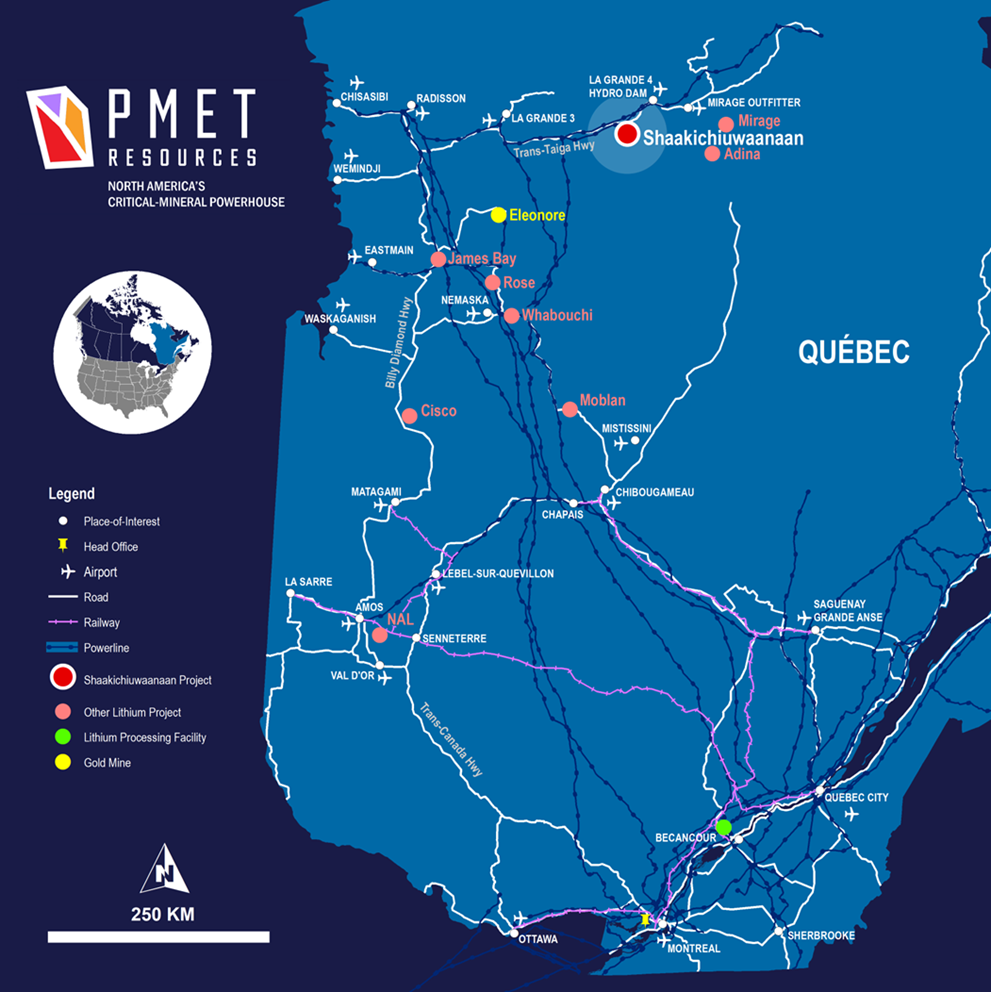
Regional map showing location of the Shaakichiuwaanaan project. Credit: PMET Resources
Provincial review under the COMEX/COMEV process is also underway, the company said, and it expects comments from provincial authorities as it advances permitting and de‑risking work. PMET said the ESIA and its October 2025 CV5 lithium-only feasibility study form the twin pillars supporting final mine approval for the hybrid open‑pit and underground proposal.
Studies and engineering
PMET is updating its CV5 feasibility study to include tantalum as a co‑product and running a parallel PEA/scoping study on the broader CV5+CV13 project that will cover lithium, caesium and tantalum. The company said both studies remain on track for the fourth quarter of 2026 completion and will feed detailed engineering for underground infrastructure.
Bulk sample and power
The company has applied for an underground bulk sample of roughly 50,000 tonnes from the upper levels of the proposed CV5 underground mine, targeting the high‑grade Nova zone and pollucite‑hosted caesium occurrences. The bulk sample permitting is under review, with COMEV feedback expected in the June quarter, and PMET says project engineering is progressing to be shovel‑ready by year‑end.
PMET has also lodged a power application with Hydro‑Québec and says the utility has acknowledged receipt and is reviewing the submission. The company highlighted that Hydro‑Québec’s La Grande 4 (LG4) Tilley substation sits about 45 km from the project, offering an attractive, low‑cost renewable power option that could limit distribution losses and infrastructure constraints.
Resources and reserves
PMET describes Shaakichiuwaanaan as one of the world’s largest pegmatite mineral resources for lithium, caesium and tantalum, and reported a probable mineral reserve at CV5 of 84.3 million tonnes at 1.26% Li2O. The consolidated resource for CV5+CV13 totals about 108.0 million tonnes indicated at 1.40% Li2O and 33.4 million tonnes inferred at 1.33% Li2O, the company said.
PMET said it will continue working with federal and provincial regulators and with the Cree Nation as it advances permitting, engineering and study work toward a final investment decision.

Comments