The trillion-dollar gold question:
Could a new process help unlock gold trapped in refractory ores?
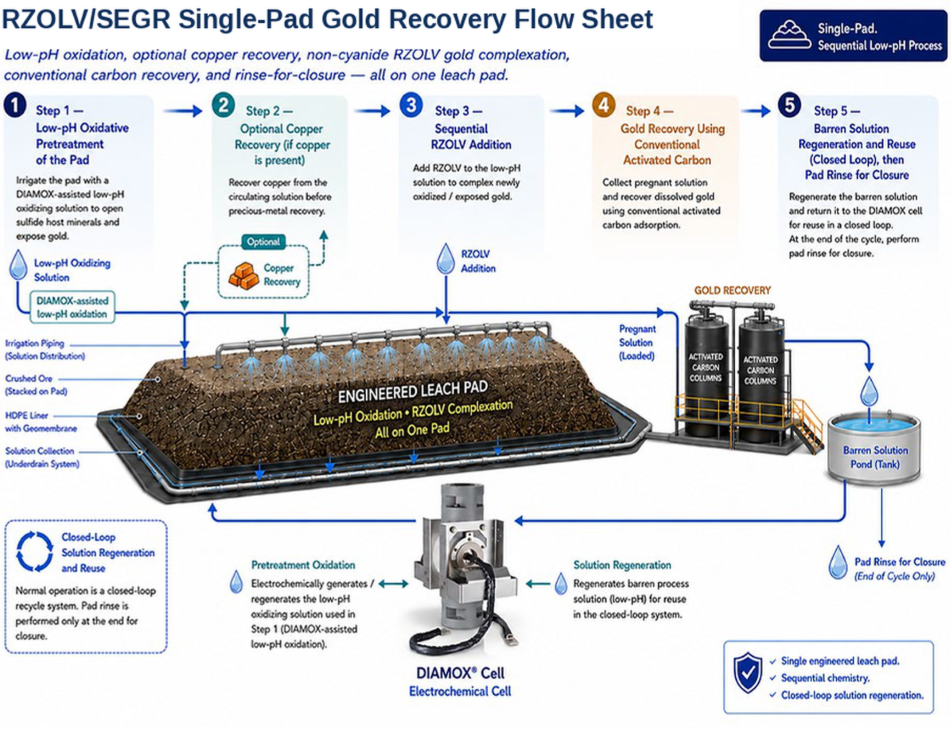
Some of the world’s largest untapped gold inventories are not hidden in unexplored mountains. They are already known, drilled and, in some cases, sitting above ground in tailings and spent heaps. The problem is that much of this gold is trapped inside minerals such as pyrite and arsenopyrite, beyond the practical reach of conventional leaching.
According to an analysis by McKinsey & Company, refractory deposits account for approximately 24% of current global gold reserves and 22% of gold resources. Much of this inventory is located in established mining regions with long histories of gold exploration and production, including North America, Oceania and the Commonwealth of Independent States.
The 230-page RZOLV/SEGR technical study (Sequential Electrochemical Gold Recovery) draws on the McKinsey analysis and cites an estimated 580 million ounces of refractory gold reserves and resources. At an illustrative gold price of approximately US$4,100 per ounce, that inventory would have a notional gross contained-metal value of about US$2.38 trillion.
That figure is not a project valuation and should not be interpreted as economically recoverable value. It does not account for ore grade, metallurgical recovery, capital and operating costs, dilution, taxes, royalties, financing, permitting, environmental obligations or the time value of money. Nor should the entire 580-million-ounce inventory be considered economically stranded or technically recoverable.
Nevertheless, the scale places the opportunity in perspective. At the same illustrative gold price, 0.1% of the cited inventory — approximately 580,000 ounces — would have a gross contained-metal value of roughly US$2.38 billion, while 1%, or approximately 5.8 million ounces, would represent about US$23.8 billion.
That explains why the gold industry continues to search for better ways to process refractory ores — and why the emerging RZOLV/SEGR concept deserves serious attention.
It also calls for disciplined skepticism. The underlying technical study was prepared by RZOLV Technologies and is explicitly classified as a hypothesis-level technical framework. It is not a feasibility study, engineering design or commercial guarantee.
Gold is present; the problem is access
The central scientific proposition behind RZOLV/SEGR is deceptively simple: refractory gold is often an access problem before it is a leaching problem.
A gold particle may be chemically soluble in cyanide, thiourea, thiocyanate or another complexing system. But no reagent can dissolve gold if it cannot reach the metal’s surface. In refractory ores, microscopic and submicroscopic gold may be enclosed within pyrite, arsenopyrite, chalcopyrite or other sulfide minerals. Associated sulfides can also consume oxygen and reagents, generate passivating compounds or interfere with the downstream capture of dissolved gold.
A 2025 review in the journal Minerals noted that the depletion of high-grade deposits is increasing the importance of refractory gold. The review identified pyrite and arsenopyrite encapsulation as a central challenge, observed that conventional grinding may not adequately expose the gold, and described how sulfides and base metals can consume oxygen, alkali and cyanide during conventional processing.
The mining industry already knows how to overcome this problem. Pressure oxidation uses oxygen, high temperature and high pressure to destroy or alter the sulfide host before gold leaching. Bio-oxidation uses microorganisms and ferric-iron cycling to perform a similar task under milder conditions. Roasting oxidizes sulfides thermally. More recent heap-based approaches use prolonged atmospheric oxidation before conventional cyanide recovery.
These technologies demonstrate that oxidative pretreatment can work. In one example summarized in the 2025 review, acidic pressure oxidation increased gold extraction from 21.22% without pretreatment to 86.21% after pretreatment. Another study increased exposed gold from 4.23% to 80.4%, followed by approximately 90.2% leaching efficiency. These results do not prove that RZOLV/SEGR will succeed, but they support its most important scientific premise: alter the sulfide host, and previously inaccessible gold can become recoverable.
The limitations of established methods are equally well-understood. Autoclaves are capital-intensive and technically complex. Roasting requires rigorous control of sulfur and arsenic emissions. Biological systems can require long residence times and careful management. Acidic pretreatment followed by alkaline cyanidation also creates an awkward chemical reversal: the material must be neutralized, conditioned and shifted from an acidic oxidation environment into a strongly alkaline leach environment. That transition can consume caustic reagents and form precipitates that complicate processing.
Why the low-pH sequence matters
The study proposes different architecture. Its process is built around low-pH oxidative pretreatment, sequential non-cyanide complexation, activated-carbon recovery and closed-loop solution recycling.
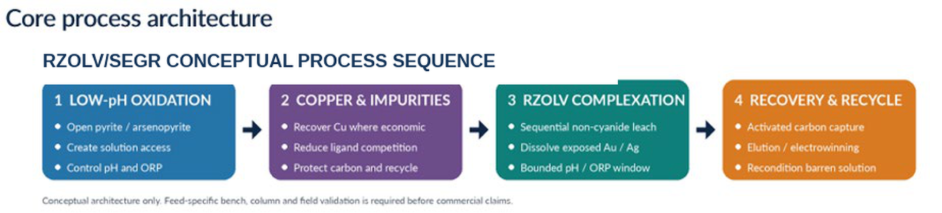
The most compelling aspect of the concept is not simply the substitution of one gold-leaching reagent for another. It is the decision to avoid undoing the chemistry created during pretreatment.
Instead of oxidizing sulfides in an acidic environment, neutralizing the material and then returning to alkaline cyanidation, RZOLV/SEGR proposes to keep the process within a broadly compatible low-pH operating window.
First, an oxidized solution — potentially generated and controlled using boron-doped diamond (BDD) electrodes — would attack the sulfide matrix. The objective is to create porosity and microfractures, expose gold-bearing surfaces and establish a controlled ferric-to-ferrous iron cycle.
Second, copper and other interfering base metals could be removed where the mineralogy supports it. This could generate a copper by-product while reducing ligand consumption, oxidant demand, carbon co-loading and contamination of the recycled solution.
Third, RZOLV would be introduced only after the pretreatment stage had reached measurable mineralogical and chemical endpoints. The proprietary sulfur-based ligand system would complex the newly exposed gold within a bounded pH and oxidation-reduction potential (ORP) window. Excessive oxidizing power is as undesirable as insufficient oxidation: too little leaves the gold inaccessible, while too much can degrade the ligand, mobilize unnecessary impurities and create passivation.
Finally, the dissolved gold would be adsorbed using activated carbon, followed by elution, electrowinning and refining, as applicable. The barren solution would be chemically reconditioned and returned to the process rather than routinely discharged.
This sequencing matters. Adding RZOLV directly to unoxidized refractory ore would risk consuming valuable reagent on sulfides, copper, iron and other side reactions. The ore must first be transformed from a chemically chaotic refractory feed into a conditioned material containing solution-accessible gold. The study therefore defines RZOLV as part of a staged redox-management platform — not a “magic” reagent capable of dissolving gold that remains sealed inside intact sulfide grains.
Diamond electrodes are real; the mining application is not yet proven
The proposed use of BDD electrochemistry gives the platform both its technical appeal and its greatest scale-up risk. Boron-doped diamond is not a fictional or purely laboratory material. Element Six, part of the De Beers Group, launched its DIAMOX advanced-oxidation cell in 2016 using free-standing BDD electrodes for difficult industrial wastewater. The system drew on more than 20 years of electrochemical oxidation research and was designed to generate powerful oxidizing conditions in a robust, modular reactor.
In 2024, Element Six and Lummus Technology announced a partnership to apply diamond-enabled electrochemical oxidation to the destruction of persistent PFAS compounds in water — additional evidence that BDD is developing an industrial track record outside mining.
At heap scale, performance will depend on solution distribution, current density, electrical conductivity, permeability, mass transfer, temperature, electrode durability, mineral variability and the ability to deliver oxidizing chemistry uniformly through the ore body.
Individual elements of the proposed architecture have laboratory or industrial precedent, and RZOLV has generated bench-scale metallurgical results on selected materials. However, the complete integrated RZOLV/SEGR sequence has not been demonstrated in a representative heap-scale operation. That qualification is not a minor footnote; it is the central commercial question.
BDD technology may be capable of generating the required oxidizing species. The unresolved issue is whether those species can be produced and delivered through a heap rapidly, evenly and economically enough to liberate meaningful quantities of gold.
Why even partial success could be worth billions
RZOLV/SEGR’s case rests on stacked value. An integrated, single-pad system could reduce handling, eliminate separate oxidation and cyanide pads, limit pH conversion and simplify solution management, pending engineering and metallurgical demonstration. In suitable polymetallic feeds, acid-soluble copper removal could generate by-product revenue, reduce RZOLV ligand competition and protect carbon and recycling circuits. Commercial success requires recovered gold, silver and copper to outweigh processing, energy, reagent, water, residue, environmental and compliance costs. Early targets may include partially oxidized tailings, spent heaps, copper-bearing residues and accessible sulfide-boundary gold. Even limited success could unlock billions; the trillion-dollar figure describes inventory scale, not projected value capture.
Non-cyanide does not mean no risk
RZOLV/SEGR could recover precious metals without new cyanide, reducing procurement, transport, storage, safety and detoxification requirements and easing permitting or community concerns. However, cyanide has a century of operating experience and governance: more than 200 International Cyanide Management Code signatories undergo independent three-year audits covering its life cycle. Low-pH processing is not benign; it may mobilize arsenic, metals and sulfate, requiring recovery, treatment, stabilization and closure testing. The study rejects “non-toxic,” “benign” and “discharge-free” claims. The tailings standard contains six topic areas, 15 principles and 77 requirements. The environmental case for RZOLV/SEGR will depend on before-and-after evidence showing that metal mobility, toxicity, water quality and residue stability have improved — or at minimum have not deteriorated.
The validation program that will decide the platform’s future
The next step is not another market size estimate. It is an independently managed, stage-gated metallurgical program.
The study proposes a partner-sponsored 24- to 36-month validation effort estimated at US$3 million to US$4.5 million. The program would move from bench testing on several representative feed composites to heap-relevant column tests and then to a field demonstration of roughly 5,000 to 10,000 tonnes.
That work must prove five connected propositions. Low-pH pretreatment must measurably increase the quantity of solution-accessible gold. RZOLV must then dissolve that exposed gold at an acceptable reagent and energy cost. Activated carbon — or another recovery medium — must capture the dissolved precious metals without unacceptable fouling or losses. The barren solution must remain recyclable without runaway accumulation of iron, copper, sulfate, chloride, salinity or ligand-degradation products. Finally, the treated residues and process waters must meet clearly defined environmental and closure endpoints.
A credible program should compare the same feed through direct cyanidation, direct RZOLV leaching, low-pH oxidation followed by RZOLV, alkaline heap oxidation followed by cyanide and, where appropriate, pressure oxidation or bio-oxidation. It should reconcile gold, silver, copper, arsenic, iron, sulfur, water and reagent mass balances. Results should be independently assayed and reported with confidence intervals, not selected from the best-performing bottle roll.
The biggest risks are identifiable: insufficient sulfide oxidation, excessive energy consumption, high acid demand in carbonate-rich ores, passivation by sulfur or iron compounds, arsenic mobilization, carbon fouling, unstable ligand chemistry and excessive bleed volumes from the recycle circuit. None is automatically fatal. But each must be converted into a measurable go/no-go criterion rather than deferred to future engineering.
The path to commercial validation
RZOLV/SEGR should neither be dismissed as another speculative cyanide alternative nor promoted prematurely as a proven trillion-dollar breakthrough.
Its scientific foundation is credible. Oxidative pretreatment can expose gold locked inside sulfides. Acidic non-cyanide complexation is an active field of research. Activated carbon offers a practical connection to existing gold-recovery infrastructure. Copper removal and closed-loop recycling could create valuable operational synergies. BDD electrodes are already being developed for difficult industrial oxidation applications.
The innovation lies in combining those elements into one disciplined sequence: open the refractory matrix, remove chemical interference, dissolve the exposed gold, capture it using familiar downstream equipment and recycle the solution.
But integration is not evidence. Until the process operates successfully in a representative field heap-leach test, its recovery, energy, reagent, environmental and cost claims remain projections.
That is precisely why the opportunity is interesting. The validation budget is small relative to the value of the mineral inventory being targeted, and failure can be identified before full commercial capital is committed. If the technology proves useful only for selected spent heaps, partially refractory tailings and copper-bearing residues, it could still unlock billions of dollars in gross metal value. If it ultimately demonstrates broad, economical heap-scale treatment of sulfide-hosted gold, its significance could be far greater.
Author disclosure
Duane Nelson is president and CEO of RZOLV Technologies Inc., developer of the RZOLV technology and proposed SEGR process discussed in this article.
RZOLV/SEGR is a development-stage concept that has not been demonstrated at representative heap or commercial scale. This article is for technical and industry information only and does not constitute a feasibility study, engineering design, permit application or guarantee of performance. Results will depend on site-specific mineralogy, metallurgy, operating requirements, environmental performance and permitting, and require independent validation.
Contained-metal values are illustrative gross figures, not estimates of recoverable value, project value, revenue or value attributable to RZOLV. “Non-cyanide” applies only to the proposed precious-metal leaching stage and does not mean non-toxic, benign, risk-free or discharge-free. Low-pH processing may mobilize regulated constituents requiring containment, treatment, stabilization and closure testing.
Related Posts
Gold refining goes electric
September 16, 2026
Gold refining goes electric
Electra releases preliminary battery recycling results
September 16, 2026
Electra releases preliminary battery recycling results
Kootenay Silver reports strong silver grades at Columba
September 16, 2026
Kootenay Silver reports strong silver grades at Columba
New Found Gold reaches commercial output at Hammerdown
September 16, 2026
New Found Gold reaches commercial output at Hammerdown

Sudan gold mine collapse kills at least 70 miners
September 16, 2026
Comments