Africa’s critical-minerals pipeline has expanded by 36% since early 2025, but the surge in exploration and development isn’t yet translating into much new production, according to an updated database compiled by Paris-based Africa Business+ and EY.
There are now 658 projects across bauxite, cobalt, copper, graphite, lithium, manganese, nickel and platinum across the continent, up from 483 in the first quarter of 2025, the firms say in a new report issued this month. Exploration projects jumped 82% to 198 and development projects rose 70% to 129, while the number in production increased just 11% to 288.
“That dynamic reveals the full tension in the sector,” Gaël Tanguy, senior consultant for infrastructure advisory at EY, said in a release. “Africa is preparing tomorrow’s supply, supported by global demand, without being able to respond at the same pace just yet.”
The widening gap highlights the challenge facing African governments and miners as attention shifts from finding critical-mineral deposits towards financing, permitting and building them. The database also points to increased state ownership, a lithium exploration rush, defence demand and more domestic processing as forces reshaping the continent’s mining sector.
Lithium rush
Lithium accounts for most of the recent increase. Of 32 projects added since this year's first quarter, 27 involve lithium across 13 countries, led by Zimbabwe and Nigeria. Australian companies are involved in about a third and Canadian groups in roughly a quarter.
But 25 of the 27 lithium projects remain at the exploration stage, suggesting the increase represents a rush to secure prospective ground rather than new supply likely to reach the market soon.
Projects still early in the mining cycle aren’t expected to contribute production before the next decade, Africa Business+ and EY say. Existing operations may provide the quickest source of additional supply: the database identifies 44 mine-expansion projects, half of which are already under way. The researchers estimate discovery-to-production timelines at 15 to 17 years, compared with significantly lower capital requirements and development risks for expansions.
Major projects
That preference for expanding established operations is already visible in Zambia. First Quantum Minerals (TSX: FM) brought the Kansanshi expansion into commercial production late last year, adding a third processing train at the country’s largest copper mine. Barrick Mining (TSX: ABX; NYSE: B), meanwhile, is advancing the Lumwana expansion, with first copper from the enlarged operation targeted for the first quarter of 2028. First Quantum expects Kansanshi to produce 175,000 to 205,000 tonnes of copper this year before climbing to as much as 260,000 tonnes in 2028.
In the Democratic Republic of Congo (DRC), Ivanhoe Mines (TSX: IVN; US-OTC: IVPAF) remains one of the continent’s most prominent copper developers despite setbacks at its Kamoa-Kakula complex. The company is also pushing the nearby Makoko district towards mine planning after increasing its resource this month to about 12 million tonnes of contained copper, with a scoping study planned for early 2027.
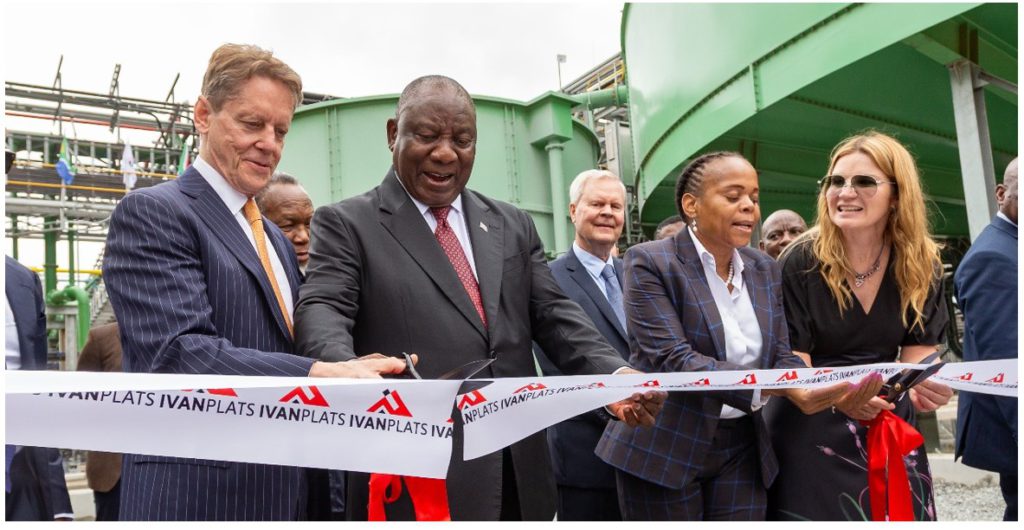
Ivanhoe is also building out its Platreef mine in South Africa, one of the continent’s major new platinum-group metals developments. Concentrate production began late last year and commercial production is expected in the fourth quarter, while a stage-two expansion is targeting annual output of more than 450,000 oz. of platinum, palladium, rhodium and gold by the end of 2027.
Lithium provides a sharper contrast between projects already reaching market and the exploration rush identified by Africa Business+ and EY. Kodal Minerals (LSE: KOD) began production at its Bougouni mine in Mali in 2025 and shipped its first concentrate to China later that year. Atlantic Lithium (AIM: ALL; ASX: A11; GSE: ALLGH), meanwhile, won parliamentary approval in March for its Ewoyaa project, planned as Ghana’s first lithium mine, but it remains at the development stage.
Larger state role
African governments are also taking bigger positions in mining projects. Public entities in the DRC now control 48% of projects in the country, up from 39% in February 2025, according to the database. Mali’s 2023 mining code permits state ownership of as much as 35%, while Burkina Faso can take stakes of up to 15%.
That trend has already had consequences for foreign miners. Mali’s new code, for example, gives the government a 35% interest in B2Gold’s (TSX: BTO; NYSE-A: BTG) Fekola Regional project, while disputes over the code have roiled other operators in the country.
Defence demand
The study also finds increasing overlap between Africa’s mineral resources and military supply chains. Five of the eight commodities it follows are among the 12 raw materials NATO designated as critical to defence in 2024, representing 321 African projects, or 49% of the database.
NATO’s list includes cobalt, graphite, lithium, manganese and platinum, along with aluminium, beryllium, gallium, germanium, rare earth elements, titanium and tungsten. Securing these materials is important to maintaining defence production and reducing supply-chain vulnerabilities, the alliance says.
Processing push
Africa Business+ and EY also identify 101 processing facilities, concentrated in South Africa, the DRC and Zambia. Governments are increasingly using mining policy to encourage domestic processing rather than exports of unprocessed material.
China remains deeply embedded in that buildout. Chinese companies are involved in 123 projects tracked by the database and 54% of projects in the DRC, spanning mining, transport and processing infrastructure.

Comments