Canada’s mining advantage has an IP problem

Canada likes to think of itself as a mining superpower. It finances projects around the world, hosts the industry’s biggest gathering, and sits on vast reserves of lithium, nickel, cobalt, and other critical minerals that are indispensable to the global energy transition. All of that is true.
What is less often said — at least not plainly — is that Canada is falling behind where it matters most in a modern mining economy: owning the technologies that make those resources valuable.
“More than half of industry-directed IP that Canadian universities generate is assigned to foreign companies,” a study from the Centre for International Governance Innovation noted, pointing to a steady erosion of Canadian-owned innovation. Taken together, research from government, legal analysts, and policy institutes suggests a pattern that is becoming difficult to ignore. Canada risks settling into a familiar role: extracting resources while others control the intellectual property that drives long-term value.
A global leader without global IP share
There is no question about the scale of Canada’s mining sector. The “IP Canada Report 2025” from the Canadian Intellectual Property Office still places the country among the world’s key jurisdictions for intellectual property filings and a central hub for mining investment.
But the industry itself is changing. Automation, artificial intelligence, and the race for critical minerals are reshaping how mining works and, more importantly, where value is created. On that front, the numbers are sobering.
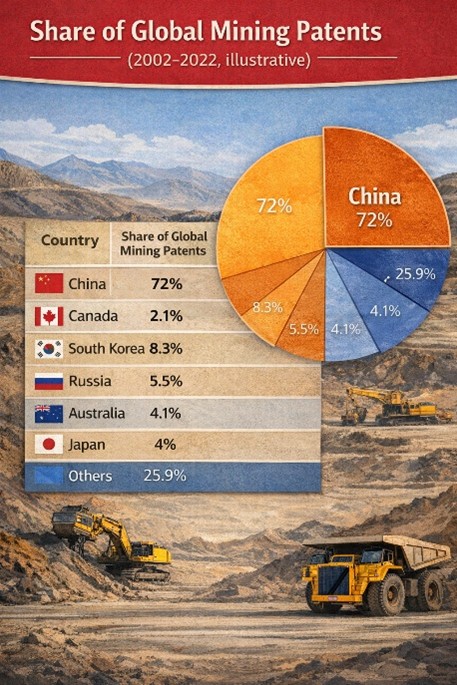
The “Ontario Mining Technology Patents Report 2024,” analyzed by Cassels Brock and Blackwell LLP, shows that mining-related patent filings have surged globally since 2018. Canada’s share, however, remains small — about 2.1%. China, by contrast, accounts for roughly 72% of published patents in the field. The rest — just over a quarter — is spread across other countries. The imbalance is stark and, increasingly, consequential.
That gap is not simply a statistical curiosity. It reflects a deeper structural issue identified in “Building Canada’s Capacity to Use Intellectual Property for Innovation 2025” by the Centre for International Governance Innovation. Canada produces ideas. It just does not consistently hold onto them.
Foreign ownership dominates at home
The problem becomes more pronounced when you look at what happens inside Canada.
According to the same federal reporting, most patent filings in Canada come from non-residents. In other words, Canada is a place where intellectual property is protected, but not necessarily created and owned.
In mining, that translates into a quiet dependency. Core technologies — everything from processing techniques to digital mine systems — are often developed and patented elsewhere, then deployed here.
IP law experts noted that the issue is the intellectual property typically remains with the parent company and not the country where the IP is employed. It is a simple observation, but it captures the essence of the problem.
Researchers have a name for it: “IP leakage.” Work done in Canada ends up owned somewhere else, often through licensing arrangements or acquisitions that shift control abroad.
The commercialization problem
If there is a single point where Canada consistently falters, it is in the transition from research to real-world application.
Innovation, Science, and Economic Development Canada flagged this repeatedly. Mining technologies are not easy to commercialize. They require scale, capital, and the ability to integrate into complex, high-risk operations.
Myra J. Tawfik, writing in “Addressing a Gap in Canada’s Global Innovation Strategy,” puts it more bluntly. Weak IP strategy, she argues, leads to underdeveloped — or entirely absent — commercialization plans. The result is predictable: promising ideas that never translate into durable business advantages.
Universities, mining research, and intellectual property
Canadian universities sit at the front end of this story. Institutions like the University of British Columbia, Queen’s, McGill, and the University of Toronto have built global reputations in mining engineering, earth sciences, and materials research. Their work feeds directly into advances in mineral processing, exploration technologies, and data-driven mining systems. In that sense, Canada’s academic base is not the problem. If anything, it is one of the country’s strengths.
The difficulty arises when that research moves beyond the lab. Studies from the Centre for International Governance Innovation show that a significant share of university-generated IP — particularly when tied to industry partnerships — ends up in foreign hands. The reasons are not mysterious. Multinational firms often bring funding, infrastructure, and a path to market. In return, they secure ownership.
Bern Klein, a professor of mining engineering and a mining innovator at UBC, has said in the past that mining IP needs to stop being seen solely as purely academic output and he cautions that mining technologies are designed to be used by mining firms quickly.
That tension — between collaboration and control — runs through much of Canada’s innovation system. Universities excel at early-stage discovery. They are less consistent when it comes to translating that work into domestically owned companies or technologies.
There are ways to improve. Technology transfer offices can take a more strategic approach, particularly in sectors like mining where long-term value is tied to IP ownership. Licensing agreements can be structured to retain equity or shared rights. Researchers can be supported in navigating patent systems, not just publishing results.
A widening global gap
Elsewhere, countries are not standing still. China has made a deliberate push to dominate mining-related intellectual property, linking resource extraction with manufacturing and patent development. The U.S. and Australia have tightened connections between mining firms, equipment manufacturers, and technology developers, making it easier to move innovations from concept to deployment.
Canada, by comparison, looks fragmented. Its strengths — geology, capital markets, and regulatory frameworks — remain intact. But its intellectual property strategy has not kept pace with its resource ambitions. The result is a gap that is becoming harder to explain away. Canada extracts. Others innovate — and, crucially, own.
Case study: Sandvik and the IP reality
If there is a single company that captures how this dynamic plays out, it is Sandvik.
Sandvik is deeply embedded in modern mining. Its technologies — automated drilling systems, digital platforms, advanced equipment — are widely used in Canadian operations. Behind those technologies sits an extensive portfolio of patents.
It is not alone. Firms such as Komatsu, Vale, Epiroc, Joy Global, and Sumitomo Metal Mining also hold significant IP positions, alongside a broader set of players that includes Caterpillar, Rio Tinto, Anglo American, Boart Longyear, Wenco, Newtrax Technology, Honeywell, and Hexagon Mining.
Kim Simelius leads a specialized team of patent professionals spanning eight countries at Sandvik Mining and Rock Solutions, where each patent tells a story of innovation shaping the mining industry’s future.
Canada’s recent and ongoing IP policy reform
There are signs that policymakers have begun to take the issue more seriously. The Canadian Intellectual Property Office, in its “2024–2025 Annual Report,” highlighted the rollout of a new Next Generation Patents system designed to modernize and streamline the application process. Commissioner Konstantinos Georgaras framed it as part of a broader effort to make the system easier to navigate for innovators.
The 2025 federal budget pushed further in that direction, with new funding for programmes aimed at helping firms build and manage IP portfolios. That includes support for initiatives like Elevate IP, the Innovation Asset Collective, and the National Research Council’s advisory services.
At the same time, the government has taken a firmer stance on critical minerals. Industry Minister François-Philippe Champagne signalled that foreign investment in the sector would face tighter scrutiny, noting that major transactions would be approved only in “the most exceptional of circumstances.”
These measures point to a broader shift. Intellectual property is no longer being treated as a niche legal issue. It is increasingly tied to questions of economic security, industrial policy, and long-term competitiveness.
The bottom line
Canada’s position in global mining is not in doubt. What is less certain is whether it will capture the full value of that position.
Too much of the intellectual property tied to mining — whether developed in universities, firms, or partnerships — ends up owned elsewhere. If that continues, Canada will keep supplying the materials the world needs. But the technologies that define how those materials are extracted, processed, and used will increasingly belong to others. That is not just an economic issue. It is a strategic one.
Joseph Quesnel is daily news editor with the Canadian Mining Journal.
Related Posts
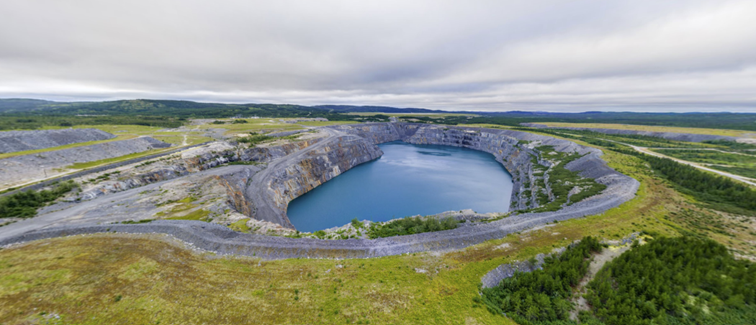
Troilus nails down US$850 million for gold-copper mine redevelopment
September 28, 2026
Troilus nails down US$850 million for gold-copper mine redevelopment
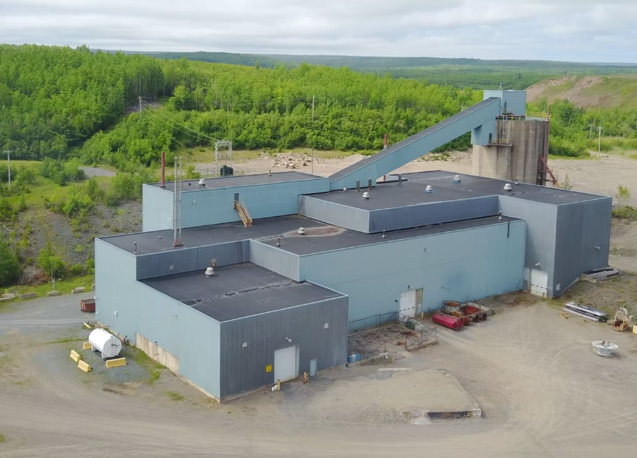
Ore sorting tests slice CAPEX for EDM’s Scotia lead-zinc mine by 57%
September 28, 2026
Ore sorting tests slice CAPEX for EDM’s Scotia lead-zinc mine by 57%
Sponsored video: Isometrix says shared data can flag mine risks early
September 28, 2026
Sponsored video: Isometrix says shared data can flag mine risks early

Team TS^2 wins AI4SafeMines student competition
September 28, 2026
Team TS^2 wins AI4SafeMines student competition
Hudbay lifts Snow Lake gold output estimate by 60%
September 28, 2026
Comments