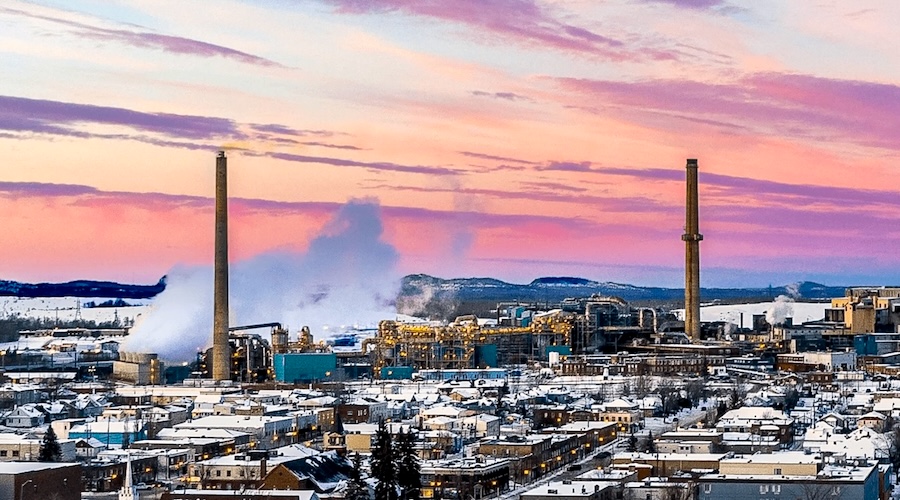
Glencore's Horne Smelter in Rouyn-Noranda recorded an annual average arsenic concentration of 40.9 nanograms per cubic metre in 2025, staying below Quebec's authorized limit of 45 ng/m³ for another year while community health advocates continue questioning whether current standards adequately protect residents.
Compliance with provincial standards
The copper smelter, which has operated in the northwestern Quebec city since 1927, released monitoring data showing all measured metals—including arsenic, cadmium, lead and nickel—remained within provincial targets. Arsenic concentrations at the facility's legal monitoring station dropped 44% compared to 2022 levels and have declined more than 70% since 2005.
However, the reported levels remain significantly above health benchmarks used elsewhere. The World Health Organization states no safe threshold exists for arsenic exposure, while Health Canada's reference concentration for lifetime exposure sits at 30 ng/m³—nearly 37% below Horne's 2025 reading.
"I am proud of what our teams have achieved and of their continued commitment," Vincent Plante, executive general manager for Glencore's North American Copper Value Stream, said. "We are confident that the Horne Smelter's operations are safe for the surrounding community. They were safe 20 years ago, when arsenic concentrations were significantly higher, and they remain safe today."
Distance-based concentration patterns
The smelter's monitoring network shows concentrations decrease with distance from the facility. At Glencore Arena, located 440 metres from the site boundary, arsenic levels measured 75% lower than at the legal station. Company data indicates 96% of Rouyn-Noranda's urban area recorded concentrations at or below 15 ng/m³.
International comparisons
Marie-Elise Viger, Director of Environment for Glencore's North American Copper Operations, compared Horne's performance to European facilities. "At an equivalent distance from the reactor, the Horne Smelter already delivers environmental results comparable to, and in some cases better than, those of Aurubis Hamburg, recipient of the German Sustainability Award," Viger said.
The company noted that weather conditions, including wind patterns, influence annual variations in measured concentrations. Despite challenging meteorological conditions in 2025, the facility maintained compliance with all authorized targets.
Future investment requirements
Glencore indicated that further emission reductions would require new investments and operational improvements, emphasizing the need for "stable and predictable regulatory framework going forward." The company has invested over $500 million in environmental upgrades since 2007, including installation of acid plant improvements and fugitive emission controls.
Quebec's Ministry of Environment continues monitoring the facility under a ministerial authorization that requires annual reporting of ambient air concentrations. The province has indicated it may review emission limits as part of ongoing environmental assessments.
To learn more, go to www.Glencore.ca



Comments